

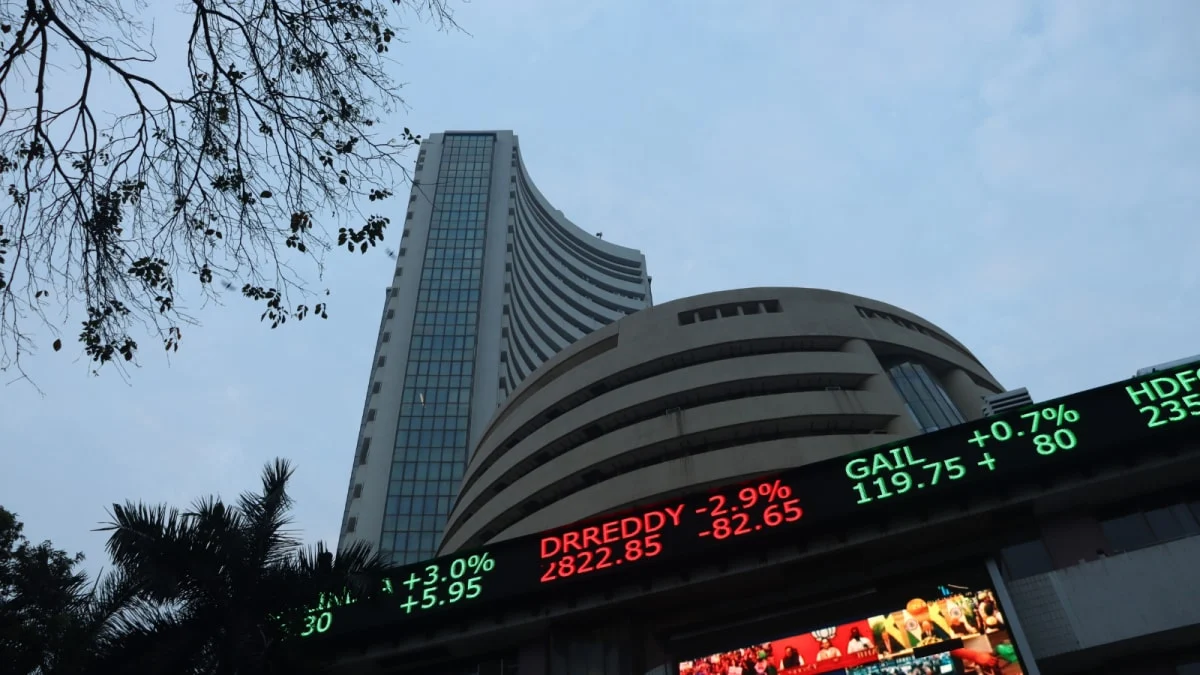
New Delhi, India, June 1, 2026 – Indian equity markets experienced a tumultuous trading session on Monday, succumbing to sharp selling pressure after opening with significant gains. The benchmark Sensex plunged over 500 points, reversing an impressive intraday surge, as investors reacted to escalating geopolitical tensions in the Middle East, persistent foreign institutional investor (FII) outflows, and looming domestic economic data and policy decisions. The dramatic turnaround underscored a palpable shift towards risk aversion across the broader market.
The S&P BSE Sensex concluded the day at 74,267.34, marking a substantial decline of 508.40 points, or 0.68%. Similarly, the Nifty 50, India’s broader market index, settled at 23,382.60, down 165.15 points, or 0.70%. The session was characterized by a volatile 1,100-point swing in the Sensex from its intraday high, leaving investors navigating a landscape fraught with uncertainty.
A Day of Dramatic Swings: From Euphoria to Apprehension
The trading day commenced with an optimistic tone, largely fueled by a positive carryover from global cues and initial hopes for a constructive week. The Sensex surged past the 75,000 mark, hitting an intraday high of 75,367.93, while the Nifty 50 touched 23,733.70. For a brief period, it appeared as though the market was poised to extend its recent rally.
However, this early exuberance proved to be fleeting. As the trading hours progressed, a confluence of negative developments began to erode investor confidence. Reports detailing intensified hostilities in the West Asia region, coupled with a renewed surge in international crude oil prices, triggered a broad-based sell-off. The initial buying momentum dissipated rapidly, replaced by widespread profit-taking and a decisive shift towards defensive assets. By the afternoon, both indices had surrendered all their gains and plunged deep into negative territory, with the Sensex plummeting over 1,100 points from its peak and the Nifty shedding nearly 350 points before trimming some losses in the final hour of trade. This sharp reversal highlighted the fragility of market sentiment in the face of evolving global and domestic challenges.
Middle East Tensions Ignite Global Risk Aversion
A primary catalyst for Monday’s market downturn was the renewed escalation of geopolitical tensions in the Middle East. Fresh reports of targeted US strikes in the region, coupled with intensified cross-border hostilities between Israel and Lebanon, reverberated through global financial markets, prompting a widespread shift towards risk-off sentiment.
Vinod Nair, Head of Research at Geojit Investments, commented on the situation, stating, "Recent US strikes and the escalation in cross-border hostilities between Israel and Lebanon have exerted significant selling pressure on equity markets, reflecting heightened geopolitical uncertainty and a shift towards risk-off sentiment." He further noted that investors are now keenly observing any signs of diplomatic progress, especially as the conflict enters its fourth month, seeking a de-escalation that could stabilize global economic outlooks. The persistent instability in the region has broader implications for global supply chains, trade routes, and, critically, energy markets.
The Strait of Hormuz: A Critical Chokepoint
Adding to the geopolitical anxieties was the renewed focus on the Strait of Hormuz. Ponmudi R, CEO of Enrich Money, highlighted that "renewed tensions between the US and Iran and the continued closure of the Strait of Hormuz have intensified concerns over global energy supplies." The Strait of Hormuz, a narrow waterway connecting the Persian Gulf with the Arabian Sea, is arguably the world’s most critical oil transit chokepoint. An estimated one-fifth of global oil consumption, or about 21 million barrels per day, passes through this strait. Any disruption or perceived threat to shipping in this vital passage sends immediate shockwaves through international crude oil markets.
The possibility of prolonged closure or significant impediments to navigation in the Strait of Hormuz directly threatens global energy security, potentially disrupting supplies from major oil-producing nations in the Middle East. Such a scenario could lead to a severe supply crunch, driving oil prices to unprecedented levels and triggering a global economic slowdown.
Crude Oil’s Inflated Threat to India
The geopolitical turmoil directly translated into a significant spike in international crude oil prices. During Monday’s session, benchmark international crude oil prices climbed close to $91 per barrel, while domestic crude futures also witnessed strong gains. This surge is a major concern for India, which relies heavily on imports to meet over 85% of its crude oil requirements.
A sustained increase in crude oil prices has multiple adverse implications for the Indian economy. Firstly, it exacerbates inflationary pressures, driving up the cost of transportation, manufacturing, and various consumer goods. This could force the Reserve Bank of India (RBI) to maintain a hawkish stance for longer, potentially delaying interest rate cuts that are crucial for stimulating economic growth. Secondly, higher crude oil imports widen India’s current account deficit, putting pressure on the Indian rupee against the US dollar. A depreciating rupee makes imports even more expensive, creating a vicious cycle. Finally, elevated fuel prices can dampen consumer spending and erode corporate profit margins, particularly for sectors heavily dependent on energy inputs. The market’s immediate reaction reflects these deep-seated fears about the potential economic fallout.
Domestic Headwinds: FII Outflows and Policy Anticipation
Beyond the global geopolitical landscape, domestic factors also played a significant role in Monday’s market decline. Persistent selling by Foreign Institutional Investors (FIIs) and mounting uncertainty ahead of key economic events contributed to the cautious sentiment.
Foreign Institutional Investors Continue Exit
FIIs have been net sellers in the Indian equity markets for several consecutive sessions, a trend that continued on Monday. While specific data for the day was awaited, market participants indicated continued significant outflows, contributing to the pressure on benchmark indices. FII selling is often driven by a combination of global risk-off sentiment, where investors withdraw capital from emerging markets to seek safer havens, and specific domestic concerns. Higher interest rates in developed economies, particularly the US, also make dollar-denominated assets more attractive, drawing capital away from markets like India. The sustained FII selling signals a lack of conviction among foreign investors regarding India’s near-term growth prospects or an aversion to the heightened global risk environment. Their continuous divestment adds liquidity pressure and can undermine market breadth.
RBI Policy and GDP Data Await
Adding to the domestic uncertainty are two crucial events slated for the end of the week: the Reserve Bank of India’s Monetary Policy Committee (MPC) meeting and the release of India’s Gross Domestic Product (GDP) data for the previous quarter. These events are expected to provide critical cues on the future trajectory of interest rates and economic growth, respectively.
The RBI’s MPC, which will convene later this week, is widely expected to maintain the current repo rate, but its commentary will be dissected for any hints regarding future policy actions. Investors will be particularly keen to understand the central bank’s assessment of inflation, especially in light of rising crude oil prices, and its outlook on economic growth. Any hawkish signals or concerns about persistent inflationary pressures could dampen hopes for early rate cuts, which are crucial for credit growth and investment.
Simultaneously, the release of GDP data for the preceding quarter will offer a comprehensive snapshot of India’s economic health. A stronger-than-expected growth number could provide a much-needed boost to market sentiment, suggesting resilience despite global headwinds. Conversely, any disappointment could further fuel concerns about an economic slowdown, reinforcing the cautious stance adopted by investors. These two data points will likely dictate the market’s near-term direction and could either alleviate or intensify the prevailing uncertainty.
Sectoral Landscape: Financials and FMCG Bear the Brunt, IT Shines
The sell-off on Monday was broad-based, impacting most sectors, but some bore a heavier brunt than others, while one notable sector managed to defy the downward trend.
Consumer Staples and Banking Sector Under Pressure
The Nifty FMCG index emerged as the worst-performing sector of the day, plunging 2.3%. Heavyweights such as Hindustan Unilever and ITC, bellwethers of consumer demand, came under significant pressure. The decline in FMCG stocks can be attributed to several factors, including concerns over inflationary pressures (which can impact raw material costs and consumer purchasing power), potential slowdown in rural demand, and general risk aversion. Higher crude oil prices directly impact packaging and logistics costs for FMCG companies, squeezing their margins.
Financial stocks also witnessed heavy selling, reflecting concerns about interest rate sensitivity and the broader economic outlook. The Nifty Financial Services index declined 1.36%, while the Nifty Bank index fell 1.1%. The Nifty Financial Services Ex-Bank index, which includes NBFCs and other non-bank financial companies, dropped more than 2%, indicating widespread weakness across the financial ecosystem. PSU banks also remained under pressure, with the Nifty PSU Bank index losing 1.85%. Among the notable laggards were Kotak Mahindra Bank, Bajaj Finance, Bajaj Finserv, Axis Bank, SBI, and ICICI Bank. Auto stocks also came under pressure, with the Nifty Auto index declining 1.7%, reflecting concerns over rising input costs and potential impact on consumer discretionary spending.
Technology Sector: A Beacon of Resilience
In stark contrast to the broader market decline, technology shares proved to be the lone bright spot. The Nifty IT index gained a robust 2.66%, supported by strong buying interest in major players like Infosys, Tech Mahindra, TCS, and HCLTech. Infosys surged 3.7%, while Tech Mahindra advanced 3.8%. TCS gained nearly 2%, and HCLTech also contributed positively, collectively helping to limit the overall losses in the benchmark indices.
The resilience of the IT sector can be attributed to several factors. Globally, technology stocks have shown strength, fueled by optimism surrounding artificial intelligence (AI)-led spending and digital transformation initiatives. Furthermore, a potentially weaker rupee (if FII outflows continue) can benefit export-oriented IT companies by increasing their dollar-denominated revenues when converted back to Indian currency. The sector’s defensive characteristics, coupled with strong deal pipelines and positive global technology sentiment, made it an attractive safe haven amidst the market turmoil.
Broader Markets Face Deeper Corrections
The weakness observed in the frontline indices was even more pronounced in the broader market segments. The Nifty Midcap 100 index declined 1.45%, while the Nifty Midcap 150 lost 1.36%. Small-cap stocks also ended lower, with the Nifty Smallcap 100 falling 0.88% and the Nifty Smallcap 250 declining 0.79%.
Vinod Nair explained this phenomenon, stating, "The Nifty Mid and Smallcap underperformed, as investors moved towards relatively better-valued opportunities in large-cap equities, seeking stability amid global uncertainties." During periods of heightened uncertainty and risk aversion, investors typically flock to larger, more established companies with greater liquidity and perceived stability. This "flight to safety" often leads to a disproportionate decline in mid and small-cap stocks, which are generally more sensitive to economic fluctuations and liquidity constraints. The relatively weaker performance of the broader market segments indicates a widespread cautious sentiment and a preference for quality and stability among investors.
Rising Volatility Signals Investor Apprehension
Reflecting the growing nervousness and uncertainty among market participants, India VIX, often referred to as the ‘fear gauge,’ rose 2.2% to 16.54. A higher VIX indicates that traders are anticipating larger price swings in the near future. This rise in volatility suggests that investors are bracing for potential market fluctuations ahead of crucial domestic and global developments, including the upcoming RBI policy decision, GDP data, and any further escalation in geopolitical tensions. The elevated VIX underscores a market environment where sudden and significant price movements are considered more likely, necessitating a cautious approach from traders and investors alike.
Expert Perspectives and Technical Outlook
Market analysts and technical experts are closely monitoring the evolving situation, offering insights into the market’s current state and potential future movements.
Analysts Weigh In on Market Dynamics
Ponmudi R of Enrich Money reiterated the dominance of geopolitical developments in shaping investor sentiment. He emphasized the interplay of global and domestic factors, noting that "investors are increasingly looking for signs of diplomatic progress after the conflict entered its fourth month, while domestic participants are also tracking the resumption of India-US trade negotiations for potential support to sentiment." The confluence of global risks and domestic policy decisions creates a complex environment for market participants, demanding constant vigilance and adaptability.
Market commentators generally agreed that while the initial opening gains reflected some underlying optimism or positive momentum, the swift reversal indicated how quickly sentiment can shift in the current volatile climate. The focus remains on external triggers, particularly oil prices and geopolitical developments, which have a direct bearing on India’s economic stability.
Nifty’s Crucial Support Levels Tested
From a technical perspective, the Nifty 50’s performance on Monday has raised concerns among chartists. Ponmudi R observed that "the Nifty’s break below the crucial 23,500 level has weakened the near-term market structure." He added that the index’s failure to witness any meaningful recovery after the initial decline reflected continued bearish sentiment and weak market breadth.
According to his analysis, the 23,500 level will now act as immediate resistance for the Nifty, followed by a stronger hurdle in the 23,600-23,750 zone. A sustained move above these levels would be required to signal a resumption of bullish momentum. On the downside, the next important support lies around 23,300-23,250. A breach of this critical zone could open the door for a further decline towards the psychological 23,000 mark, indicating a deeper correction in the near term. The technical setup suggests that the bears currently hold the upper hand, and a convincing rebound would require strong positive catalysts.
The Path Forward: Awaiting Clarity Amidst Uncertainty
As the market grapples with a complex web of global and domestic challenges, investors will be keenly awaiting clarity from several fronts. The immediate focus will remain on the Middle East, with any signs of de-escalation or diplomatic breakthroughs potentially offering a respite to crude oil prices and global risk sentiment. Concurrently, the outcomes of the RBI Monetary Policy Committee meeting and the upcoming GDP data release will be paramount in shaping the domestic market’s trajectory.
The central bank’s stance on inflation and growth, along with its assessment of the impact of rising crude oil prices, will provide crucial guidance. Similarly, the GDP data will offer a clearer picture of India’s economic momentum. In the interim, market participants are likely to adopt a cautious approach, favoring defensive sectors and large-cap opportunities, and maintaining a close watch on global geopolitical developments and their implications for commodity markets. The dramatic swings observed on Monday serve as a stark reminder of the inherent volatility and interconnectedness of financial markets in the current global environment.
