

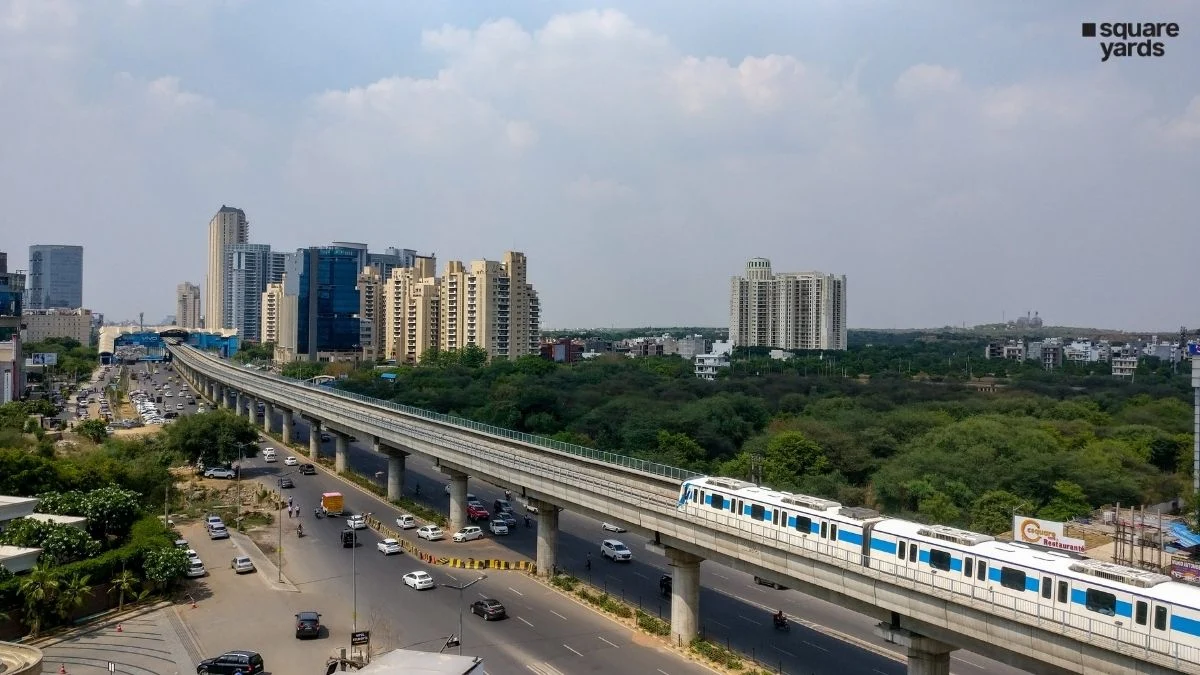
GURUGRAM — In a move set to fundamentally redefine the geography of the National Capital Region (NCR), the Haryana government has officially cleared the final alignment for the ambitious ₹15,000 crore Gurugram-Faridabad-Noida Namo Bharat Rapid Rail Transit System (RRTS) corridor. This 64-kilometer high-speed artery is designed to bridge the gap between the three largest economic powerhouses of the region, promising to slash transit times between Gurugram and Noida from a grueling two hours to a mere 40 minutes.
Executed by the National Capital Region Transport Corporation (NCRTC), this project represents the next phase of the Prime Minister’s "Namo Bharat" initiative. With construction slated to begin in December 2026, the corridor is not merely a transport project but a catalyst for massive capital appreciation and urban transformation across residential and commercial pockets in Haryana and Uttar Pradesh.
I. Main Facts: A Tri-City High-Speed Link
The Gurugram-Faridabad-Noida RRTS corridor is envisioned as a "Regional Mobility Backbone." Unlike traditional metro systems that focus on short-distance urban commuting, or standard railways that cater to long-distance travel, the RRTS is a hybrid system designed for high-frequency, high-speed regional connectivity.
Key Project Specifications:
- Total Length: 64 Kilometers.
- Estimated Cost: ₹15,000 Crore.
- Top Speed: 160 km/h (Operational speed averaging 100-110 km/h).
- Travel Time: Gurugram to Noida in ~40 minutes; Gurugram to Faridabad in ~20 minutes.
- Station Count: 18 planned stations (8 in Gurugram, 10 in Faridabad/Noida extension).
- Interconnectivity: Direct links to the Delhi Metro Yellow Line, Rapid Metro, Violet Line, and the upcoming Delhi-Alwar RRTS.
The most innovative feature of this corridor is its hybrid RRTS-cum-Metro model. This allows high-speed regional trains to share tracks with local metro services. The result is a tiered transit system: express trains will stop only at major hubs for long-distance commuters, while local "shuttle" services will cater to every station along the route, ensuring that no micro-market is left behind.
II. Chronology: From Blueprint to Groundbreaking
The journey of the Gurugram-Faridabad-Noida corridor has been one of rigorous planning and inter-state cooperation.
- 2023–2024: Initial Conceptualization: Following the success of the Delhi-Meerut RRTS (the first Namo Bharat line), the NCRTC identified the Gurugram-Noida axis as the next high-priority zone due to the extreme traffic congestion on the Mehrauli-Badarpur Road and the Faridabad-Gurugram Expressway.
- 2025: Feasibility and DPR: The Detailed Project Report (DPR) was commissioned to study the geological challenges of the Aravalli hills and the dense urban clusters of Faridabad.
- May 4, 2026: Alignment Clearance: The Haryana government, led by Chief Minister Nayab Singh Saini, officially approved the final alignment, settling disputes regarding station locations and land acquisition strategies.
- Q3 2026: Tendering and Procurement: The NCRTC is expected to float international tenders for civil construction and rolling stock (train sets) by September 2026.
- December 2026: Construction Commencement: Work is scheduled to begin simultaneously on the Gurugram and Faridabad legs to ensure synchronized completion.
- 2030 (Projected): Operational Readiness: If timelines hold, the first phase of the corridor is expected to be commissioned by late 2030.
III. Supporting Data: Technical Integration and Station Logistics
The corridor is strategically mapped to touch the most vital commercial and residential nerve centers. The 18 stations are distributed to maximize "Transit-Oriented Development" (TOD).
The Gurugram Leg (14.5 km Integrated Section):
In Gurugram, the line begins at IFFCO Chowk, a massive multimodal hub. From here, it moves toward Gwal Pahari, linking established commercial zones like Sector-29 and the Millennium City Centre with the burgeoning luxury residential belts along the Gurugram-Faridabad Road.
The Faridabad Leg:
Faridabad will host 10 stations, with Bata Chowk serving as the primary interchange for the Delhi Metro Violet Line. This section is designed to rejuvenate the industrial heritage of Faridabad, connecting it to the tech-heavy markets of its neighbors.
The Noida-Jewar Connection:
Perhaps the most significant data point for investors is the route through the Surajpur Interchange. By routing the line here, the government is effectively tying the industrial heart of Haryana directly to the Noida International Airport (Jewar). The Surajpur Junction will act as a "Mega-Hub," where this corridor meets the Ghaziabad-Jewar RRTS, creating a seamless high-speed loop around the entire National Capital Region.
IV. Official Responses: The Government’s Vision
Speaking at the alignment clearance event, Haryana Chief Minister Nayab Singh Saini emphasized the socio-economic impact of the project.
"This is not just a train line; it is an economic engine," Saini stated. "By integrating the RRTS with the existing Delhi Metro Yellow and Violet lines, we are creating a borderless NCR. A professional can live in Faridabad, work in a tech park in Noida, and have dinner in Gurugram, all without the exhaustion of traffic. This project will open up new investment corridors that will sustain Haryana’s growth for the next three decades."
NCRTC Officials also highlighted the environmental considerations of the project. A spokesperson noted that the elevated sections of the track would be equipped with advanced noise barriers and "silent-track" technology to minimize the impact on residential colonies in Gurugram and Faridabad. Furthermore, the project is expected to take approximately 100,000 private vehicles off the road daily, significantly reducing the carbon footprint of the region.
V. Implications: Real Estate, Economy, and Lifestyle
The approval of this corridor has sent ripples through the real estate market, with analysts predicting a "paradigm shift" in property valuation.
1. The Transformation of Greater Faridabad
For years, Greater Faridabad (Sectors 75–89) was seen as a peripheral market, hindered by poor connectivity to Noida and Gurugram. The RRTS changes this narrative overnight. With a 20-minute transit time to Noida, Faridabad is positioned to become a primary residential choice for IT professionals who find Noida’s housing market saturated or overpriced. Experts suggest a potential 25–30% appreciation in land values in these sectors before the first pillar is even cast.
2. Gurugram’s Emerging Luxury Belt
In Gurugram, the Gwal Pahari area and the sectors flanking the Faridabad Road are set to transition from "upcoming" to "prime." The ease of access to the IFFCO Chowk multimodal hub means that these areas will no longer be dependent on private cars, making them highly attractive for premium commercial developments and high-end gated communities.
3. The "Aerotropolis" Effect
The link to Surajpur Junction is the "X-factor." By providing a high-speed path to the Noida International Airport, the RRTS makes the Gurugram-Faridabad-Noida corridor part of a global transit network. This is expected to stabilize commercial land values and attract multinational corporations looking for office spaces that are equidistant from both Delhi’s IGI Airport and the new Jewar Airport.
4. Last-Mile Connectivity and Urban Density
The hybrid model ensures that "last-mile connectivity" is built into the system. With 18 stations over 64 km, the average distance between stops is roughly 3.5 km—significantly shorter than traditional regional rails but longer than metros. This "sweet spot" encourages high-density residential development around stations, which the government plans to incentivize through TOD policies, allowing higher Floor Area Ratio (FAR) for developers near the RRTS corridor.
5. Economic Synergy
The corridor will allow for a more fluid labor market. Noida’s strength in IT and manufacturing, Gurugram’s dominance in finance and corporate headquarters, and Faridabad’s industrial base will finally be integrated. This synergy is expected to boost the regional GDP by facilitating the movement of skilled labor and reducing the logistics costs associated with the current congested roadways.
Conclusion
The clearance of the Gurugram-Faridabad-Noida RRTS alignment marks a definitive turning point for Northern India’s infrastructure landscape. As the NCRTC prepares for a December 2026 construction start, the focus now shifts to land acquisition and the technical challenges of traversing the Aravalli terrain. For residents, it promises an end to the "commuter’s nightmare." For investors, it represents perhaps the last great "ground-floor" opportunity in the NCR real estate market. The Namo Bharat initiative is no longer just a project on paper—it is the fast-approaching future of regional mobility.
