

Bengaluru, India – June 19, 2026 – In a powerful and thought-provoking theatrical presentation, Udupi’s Punaha Theater recently unveiled "Angaara," a compelling play that delves into the persistent and insidious ramifications of the caste system in coastal Karnataka. Directed by Abhinav Grover and penned by Usha Kattemane, "Angaara" was staged at the Prestige Centre for Performing Arts in Bengaluru as a significant offering within the 2026 Girish Karnad Fellowship programme and the broader Chiguru & Kusumale Theatre Festival, meticulously organized by the Samagata Foundation and Bhasha Centre. The production, a potent fusion of indigenous performance traditions, multilingual narrative strategies, and incisive socio-political critique, aims to illuminate the deep-seated inequalities that continue to shape lives in the region.
The Playwright’s Bold Vision: Confronting Contemporary Realities
Playwright Usha Kattemane articulates her artistic motivation with a clear and resolute statement: "Writing from a safe space is the easier path. But I like challenges. They keep a writer alive. That is why I tried to create a play that reflects the contemporary life of Tulunadu." This declaration underscores Kattemane’s commitment to confronting uncomfortable truths and eschewing facile narratives. "Angaara," a title that evokes the primal element of fire, suggests a play that is not merely descriptive but actively searing, intent on igniting reflection and challenging complacency.
The play centers on the religious and agrarian lives of the marginalized Koraga community, indigenous to the Tulunadu region of coastal Karnataka. Through its narrative, "Angaara" masterfully employs Kambala, the region’s iconic buffalo ritualistic race-sport, as a dramatic backdrop. This choice is far from incidental; Kambala, while celebrated as a vibrant cultural expression, also serves as a potent symbol of the region’s socio-economic fabric, often intertwined with traditional power structures. Kattemane’s script skilfully navigates the inherent contradictions between tradition and modernity, exposing the enduring grip of caste hegemonies and the pervasive nature of social exclusions. Crucially, the play eschews the notion that caste discrimination is a relic of the past. Instead, it meticulously illustrates how these prejudices can persist, subtly embedded even beneath the veneer of cultural pride, aspirations for progress, and political maneuvering.
A Stage Transformed: Visualizing Social Divides
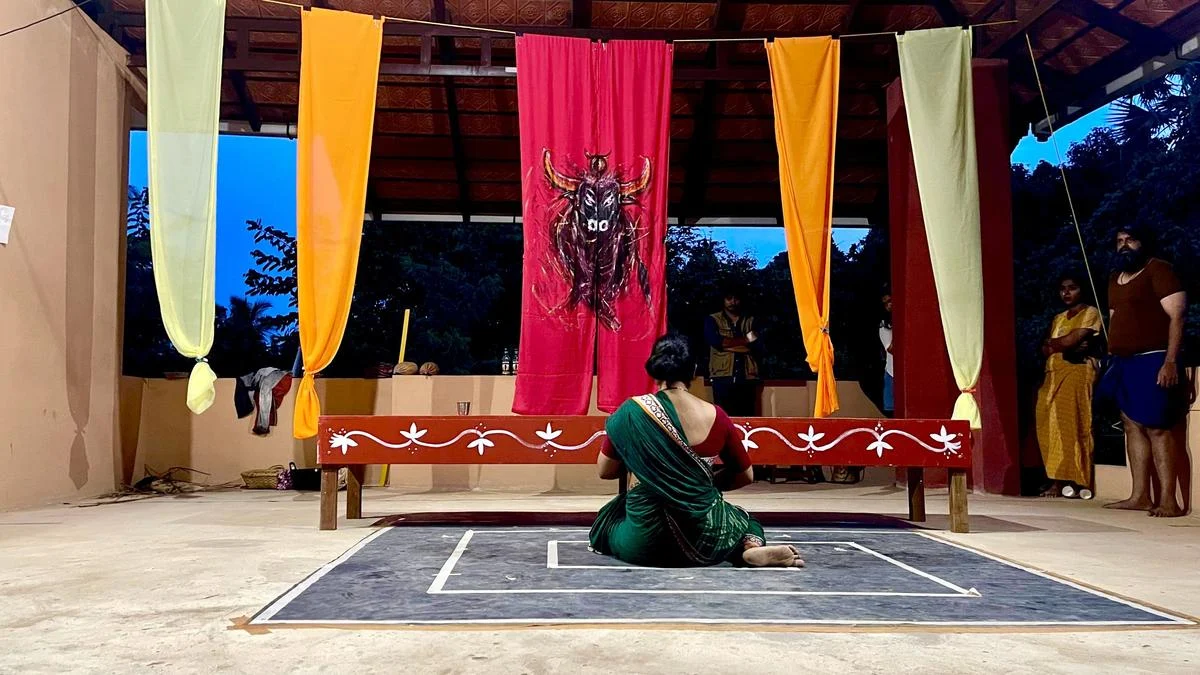
Director Abhinav Grover’s staging of "Angaara" is a testament to his astute understanding of theatrical space and its potential for metaphorical resonance. The stage itself becomes a character, a canvas upon which social stratifications are visually rendered. Fabric partitions are strategically employed to delineate distinct areas, each representing a separate social world within the play’s universe. This visual design not only evokes the aesthetic of traditional theatrical methods but also operates as a powerful metaphor for the deeply entrenched social divisions that plague the Koraga community and, by extension, the broader caste hierarchy.
The play’s commitment to authenticity and its reflection of Tulunadu’s linguistic landscape are further emphasized through its deliberate use of multiple languages. Tulu, Kannada, Konkani, and English are woven into the dialogue, mirroring the multilingual reality of contemporary Tulunadu. This linguistic fluidity is not merely an aesthetic choice; it serves as a vital tool for dialogue between characters, highlighting their differing social positions, cultural backgrounds, and spheres of influence. The interplay of languages becomes a microcosm of the complex social interactions and power dynamics at play within the community.

Echoes of Mythology, Resonance of Reality: The Ekalavya-Dronacharya Framework
"Angaara" opens with a striking and symbolically rich invocation of the Ekalavya-Dronacharya episode from the Mahabharata. This ancient narrative, masterfully reimagined by Sanjeeva Suvarna’s Gurudakshina Yakshagana, serves as an underlying framework for the entire play, consistently underscoring the theme of caste-based separation. The choice to cast a woman as Ekalavya is a particularly astute move, immediately introducing layers of complexity related to gender as well as access and opportunity. This reinterpretation challenges traditional interpretations and broadens the play’s critique to encompass intersectional oppressions.
The Yakshagana segment is far from a mere introductory prologue; it seamlessly transitions into the main narrative, creating an effective theatrical bridge that links ancient mythology to contemporary social realities. This deliberate integration allows the audience to perceive the enduring relevance of age-old power dynamics and their manifestations in the present day. The cyclical nature of oppression, as depicted through this mythological lens, lends a profound depth to the play’s central concerns.
Angaara and Nethra: Navigating Identity and Challenging Norms
At the heart of "Angaara" is the character of Angaara, a government school teacher hailing from the Koraga community. He embodies a generation caught in the crosscurrents of conflicting influences: the emancipatory potential of education and rationalism on one hand, and the weight of inherited traditions and societal expectations on the other. Angaara’s growing skepticism towards the traditional "daiva worship" (spirit worship) places him at odds with his family, creating internal and external conflicts. Actor Baliga delivers a nuanced portrayal of Angaara, eschewing the archetype of a firebrand reformer. Instead, he presents a deeply conflicted individual grappling with the immense challenge of reconciling disparate worlds and identities.
Paralleling Angaara’s personal journey is the story of Nethra, a woman who has returned to her natal home after experiencing bereavement. Nethra’s burgeoning interest in purchasing and managing racing buffaloes for Kambala directly challenges deeply entrenched gendered expectations. Her ambition questions traditional notions of ownership, the division of labor, and the public participation of women in spheres historically dominated by men. Nethra’s arc highlights the struggles faced by women who dare to defy societal norms and assert their agency in a patriarchal framework.
Deyyu: The Maternal Intermediary and the Power of Ritual
One of the most compelling and layered characters in "Angaara" is Deyyu, Angaara’s mother. Her presence on stage is charged with an undeniable emotional intensity. In a poignant flashback, Deyyu is depicted invoking spiritual powers through chanting to protect the life of an ailing infant Angaara. This scene positions her as an intermediary between the human and divine realms, a figure of authority within the ritualistic systems of her community. Her role raises crucial questions about female agency within these systems, which are often perceived as inherently patriarchal. Deyyu’s connection to the spiritual world, while seemingly traditional, becomes a source of power and resilience, demonstrating that resistance and agency can manifest in various forms.

The Scathing Indictment of Kambala: Dehumanization Beneath the Spectacle
"Angaara" delivers its most potent and searing indictment of the caste system during the climactic Kambala celebrations. The scene is charged with an almost palpable tension. The premature lowering of a red bull-faced flag triggers widespread panic and an urgent recourse to ritualistic remedies, underscoring the community’s reliance on tradition in moments of crisis. It is at this juncture that Angaara seizes the opportunity to reveal a grim chapter of historical exploitation. He recounts instances where members of the Koraga community were allegedly forced to run in front of the racing buffaloes, a dangerous and dehumanizing practice intended to clear the path of nails and thorns.
This stark comparison between human beings and the racing buffaloes is deliberately disquieting. It compels the audience to confront the historical reality of dehumanization that is often conspicuously absent from narratives that celebrate regional cultures and traditions. The spectacle of Kambala, when viewed through the lens of "Angaara," transforms from a joyous cultural event into a painful reminder of the enduring legacy of oppression. The play forces a reckoning with the uncomfortable truths that lie beneath the surface of celebrated cultural practices.
A Legacy of Fire: Unresolved Questions and Enduring Relevance
"Angaara" wisely refrains from offering simplistic solutions or implying that caste oppression is a problem confined to the annals of history. Instead, the play poses a series of difficult and vital inquiries. It probes how prejudice continues to be perpetuated through established institutions, ingrained rituals, complex interpersonal relationships, and even self-serving political interests. The production’s strength lies in its powerful performances, its intricately layered scriptwriting, and its astute synthesis of regional performance traditions.
Through its unflinching gaze, "Angaara" substantiates the enduring and vital potential of theatre to challenge collective memory and confront societal blind spots. The "fire" invoked in the play’s title is not merely a destructive force; it serves as an insistent ember, a constant reminder of histories that refuse to fade away. It symbolizes the ongoing struggle for justice and equality, a fire that may smolder but never truly dies, waiting for the opportune moment to reignite and illuminate the path forward. The play leaves the audience with a profound sense of unease and a call to action, urging them to examine their own roles in perpetuating or dismantling the structures of caste.
