

Vazhuvur, a tranquil town nestled within the Mayiladuthurai district of Tamil Nadu, stands as a potent nexus where the profound depths of Saivite tradition intertwine with the vibrant history of Bharatanatyam. This unassuming locale holds a dual significance, revered as one of the hallowed Ashta Veerattanams – the eight sacred abodes where Lord Shiva is believed to have manifested his supreme valour through extraordinary heroic deeds. Simultaneously, Vazhuvur resonates with the legacy of Vazhuvoor Ramaiah Pillai, a towering figure of the 20th century and a pivotal guru in the evolution of Bharatanatyam, whose influence extends to the silver screen through his choreography in Tamil cinema. The distinct Vazhuvur bani, a principal school of Bharatanatyam, finds its genesis in this very lineage.
The Divine Manifestation: Lord Shiva as Gajasamharamurti
At the heart of Vazhuvur’s spiritual significance lies the Veeratteswarar Temple, a sanctuary that houses an awe-inspiring bronze idol of Gajasamharamurti. This magnificent sculpture captures Lord Shiva in his most formidable and fearsome aspect, depicted in the act of vanquishing the formidable elephant demon, Gajasura. This particular manifestation of Shiva is a testament to his power to obliterate malevolence and restore cosmic order. The Gajasamharamurti idol is widely acclaimed as a pinnacle of Chola bronze artistry, with scholarly consensus dating it to the reign of the illustrious King Rajaraja I. Its exquisite craftsmanship and dynamic portrayal vividly reflect the unparalleled artistic excellence that characterized the Chola period.
While Lord Nataraja, in his iconic form as the Cosmic Dancer, embodies the philosophy of cosmic balance and creation, the Samharamurti aspect of Shiva represents his destructive, yet ultimately purifying, power. According to the esteemed scholar T.A. Gopinatha Rao, author of the seminal work The Elements of Hindu Iconography, the Samharamurti form of Shiva is known by various appellations, each signifying the annihilation of a specific demonic entity. In this context, Shiva is specifically revered as Gajasamharamurti, the slayer of Gajasura, the elephant demon. In Tamil lore, he is profoundly venerated as Yanai Uritha Thevar, translating to "The Lord who flayed the skin of the asura after it had assumed the form of an elephant," a powerful epithet highlighting the gruesome yet triumphant nature of this divine act.

The iconography of Gajasamharamurti is not confined to Vazhuvur; it graces temple walls and sculptures dating back to both the Pallava and Chola eras, underscoring its long-standing importance in South Indian religious art. However, the Vazhuvur bronze idol distinguishes itself with its exceptional artistry and dynamic composition. Gopinatha Rao himself lauded it as "a remarkable piece of artistic work, both for its size and the excellence of its execution." The deity is depicted standing triumphantly atop the severed head of the elephant demon, its body caught in a powerful, dynamically twisted pose that eschews conventional iconographic rigidity, imbuing the sculpture with an extraordinary sense of movement and fierce energy.
Artistic Innovation and Iconographic Nuance
The unique posture of the Vazhuvur bronze icon has captivated art historians and iconographers. R. Kalaikovan, the visionary founder of the Rajamanickanar Centre for Historical Research, notes that the deity’s stance does not strictly adhere to the recognized dance karanas (classical Bharatanatyam dance postures) such as the Bhramaraka Karana or the Bhrishta Svastika Karana. He elaborates, "The deity stands on the severed head of the elephant-demon with one leg and the hip dramatically twisted, creating a unique sculptural composition." This deviation suggests an artistic liberty taken by the sculptor to amplify the dramatic narrative and the divine power being conveyed.
Gopinatha Rao’s detailed description, accompanied by a photographic reproduction in his influential treatise, offers profound insights into the idol’s intricacies. He meticulously notes the deity’s finely sculpted face, characterized by large, rounded eyes and projecting tusks that accentuate its terrifying aspect. A jata-mandala (matted hair arrangement) encircles the head, adorned with a crescent moon on the left and a serpent on the right. The jata-makuta is further embellished with a skull, dhattura flowers, and other ritualistic ornaments, all contributing to the fearsome yet divine persona.

The Gajasamharamurti idol is depicted with eight arms, each holding significant symbolic implements. Two of the right hands brandish a udukkai (a small hand drum) and a finely crafted trishula (trident), while another grasps a khadga (sword). The object in the fourth right hand remains indistinct in available photographic reproductions. The left hands hold a kapala (skull bowl), a khetaka (shield), and a tanka (battle axe). The dramatic intensity of the scene is further amplified by the presence of two ganas (attendants of Shiva) flanking the deity. Each of these ganas, with their own four arms, are shown playing drums and other musical instruments, creating a celestial orchestra to accompany Shiva’s cosmic triumph.
Echoes in Stone: The Pullamangai Relief
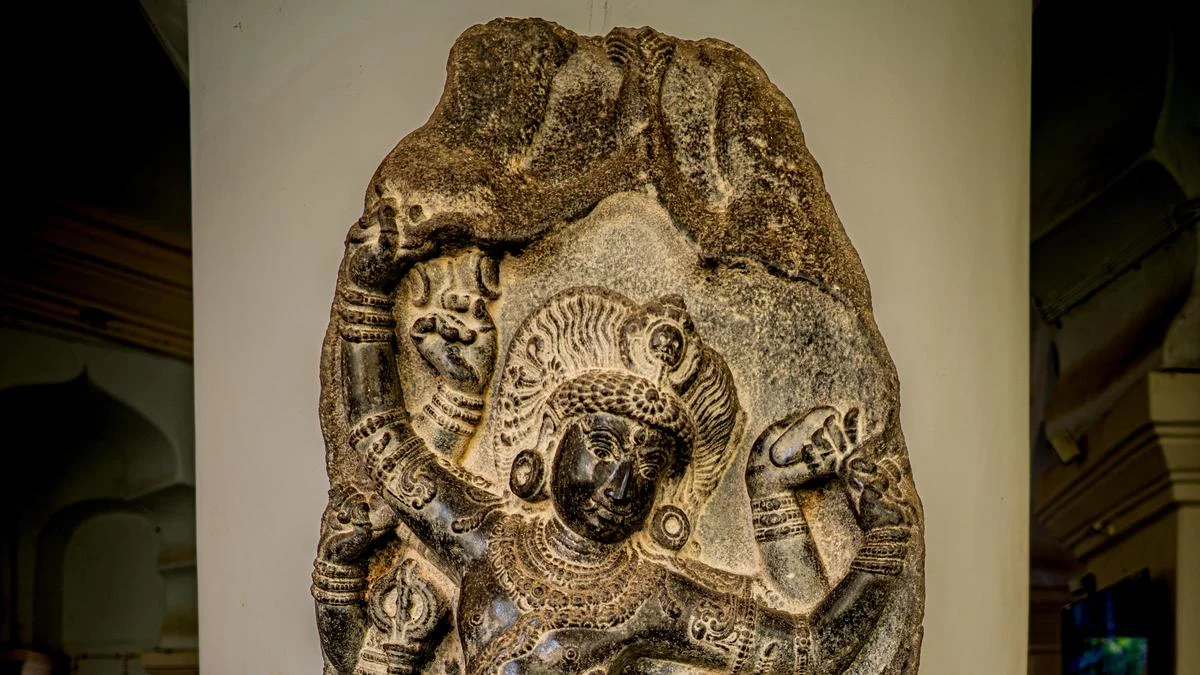
Another significant and artistically compelling depiction of Gajasamharamurti is found etched in stone on the walls of the Brahmapuriswarar Temple in Pullamangai, Thanjavur district. Despite its relatively miniature scale compared to the Vazhuvur bronze, this stone sculpture masterfully captures every intricate detail associated with this powerful iconographic form. R. Kalaikovan, alongside R. Akila and M. Nalini, authors of Pullamangai Alanthuraiyar Koil, provide a detailed analysis of this relief, stating, "It combines elements of both Bhramara Karana and Bhrishta Svastika Karana. The body below the waist twists to the right, while the upper torso faces forward. The right foot rests upon the slain elephant demon, and the left leg is raised to display the kunchita pada (bent foot)." This nuanced posture, blending elements of recognized dance forms while retaining its unique dynamism, showcases the sculptor’s profound understanding of both iconography and aesthetic representation.
The narrative depicted in the Pullamangai relief adds another layer of emotional depth to the scene. The fierce posture of Gajasamharamurti is so potent that it is suggested to have startled even Goddess Parvati. The relief subtly portrays her seated on Shiva’s lap, with the child Muruga reaching out towards one of her attendants. This detail implies that Parvati, overwhelmed by Shiva’s ferocious manifestation, is entrusting the frightened child to the attendant, highlighting the overwhelming power of the divine act.

Centuries of exposure to the elements have remarkably failed to diminish the enduring beauty and dramatic impact of the Gajasamharamurti relief at Pullamangai. The sheer genius of the Chola sculptor has inspired contemporary artists. Laitharam, the founder of Vismayam Arts, has undertaken the meticulous task of recreating this millennium-old masterpiece. By painstakingly crafting a three-dimensional model and then fashioning a striking replica from stone powder and resin, Laitharam has breathed new life into this ancient artwork, making its grandeur accessible to a contemporary audience.
A Dance Legacy: Vazhuvoor Ramaiah Pillai and the Vazhuvur Bani
Beyond its spiritual and artistic dimensions, Vazhuvur holds a prominent place in the annals of Indian classical dance. It is the birthplace of Vazhuvoor Ramaiah Pillai, a luminary who significantly shaped the trajectory of Bharatanatyam in the 20th century. Pillai was not only a revered guru but also a celebrated choreographer whose work graced the opulent sets of Tamil cinema, introducing the classical dance form to a wider audience. His unique style and pedagogical approach gave rise to the Vazhuvur bani, one of the most influential and widely practiced schools of Bharatanatyam today.
The Vazhuvur bani is characterized by its emphasis on fluid movements, graceful transitions, and a deep connection to the devotional and narrative aspects of Bharatanatyam. Gurus trained in this tradition are known for their ability to imbue their performances with a profound sense of spirituality and theatricality. The legacy of Ramaiah Pillai continues to flourish through his disciples and their subsequent generations, ensuring that the distinctive Vazhuvur style remains a vibrant and evolving force in the world of Bharatanatyam.

Connections to Other Artistic Expressions
The presence of Gajasamharamurti iconography extends beyond Vazhuvur and Pullamangai. Another remarkable idol of this deity, originally belonging to the Darasuram temple, is now preserved in the Thanjavur museum. According to Kalaikovan, this idol, like the Vazhuvur bronze, does not strictly adhere to any specific Karana but exhibits a striking resemblance in its overall depiction to the Vazhuvur piece. He describes it as "a total depiction," suggesting a holistic and powerful representation of Shiva’s triumph.
The confluence of divine narratives, artistic mastery evident in sculptures and bronzes, and the rich legacy of dance found in Vazhuvur underscores the town’s profound cultural significance. It is a place where the ferocity of the divine, the pinnacle of artistic achievement, and the grace of classical dance converge, offering a compelling glimpse into the enduring traditions of Tamil Nadu. The ongoing efforts to preserve and reinterpret these artistic and cultural treasures, such as Laitharam’s replica, ensure that the stories and the aesthetic brilliance of Vazhuvur continue to resonate for generations to come.
The spiritual and artistic heritage of Vazhuvur serves as a powerful reminder of the intricate tapestry of Indian culture, where religious devotion, artistic expression, and performative arts are deeply interwoven, creating a legacy that is both timeless and continuously evolving. The Ashta Veerattanam, the Gajasamharamurti idol, and the lineage of Vazhuvoor Ramaiah Pillai collectively paint a vibrant picture of a place where the divine, the artistic, and the cultural converge in a harmonious and powerful symphony.
