

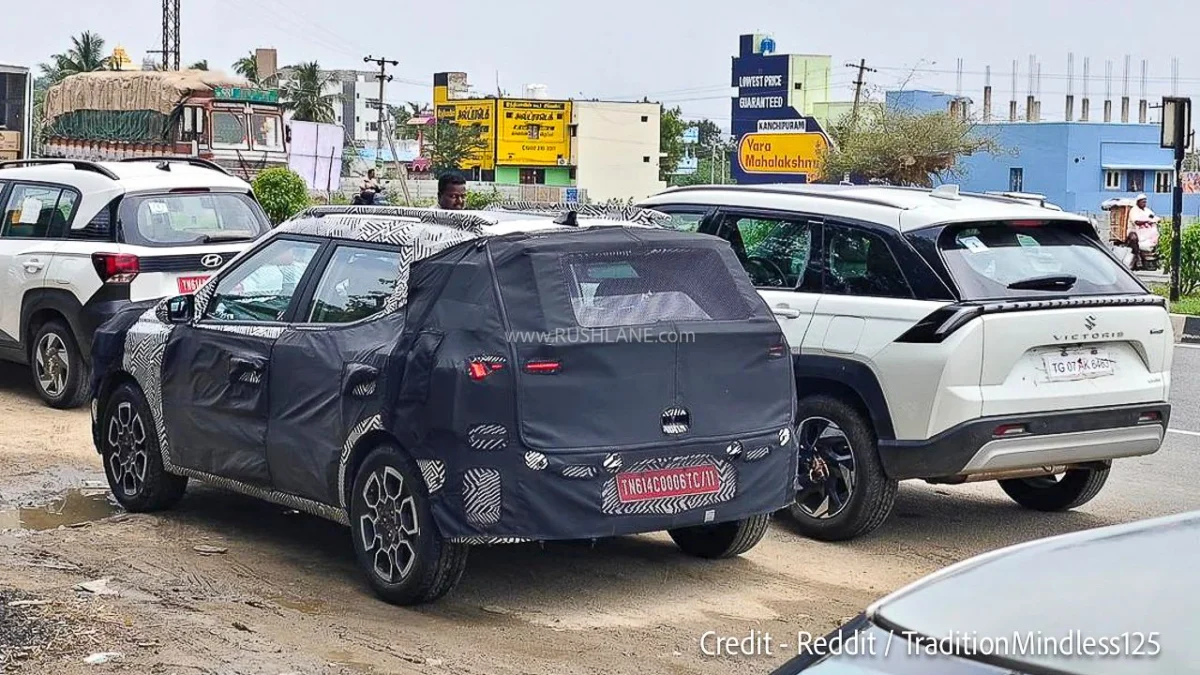
The Indian automotive landscape is currently witnessing a tectonic shift in consumer preferences, where the traditional hatchback and sedan segments are rapidly yielding ground to high-riding, versatile SUVs. At the forefront of this transformation is Hyundai Motor India Limited (HMIL), a manufacturer that has historically leveraged its "SUV-first" strategy to maintain a dominant market share. Recent developments, highlighted by the repeated sightings of a new crossover-styled SUV—internally codenamed BC4i and based on the international Hyundai Bayon—suggest that the South Korean giant is preparing for its next major offensive.
The latest spy photographs have captured the BC4i test mule benchmarking alongside the Maruti Victoris, a move that signals Hyundai’s intent to disrupt the burgeoning 4.2-meter to 4.4-meter SUV sub-segment. This article explores the technical nuances, market positioning, and strategic implications of Hyundai’s upcoming "Bayon-derived" contender.
I. Main Facts: Bridging the Gap in the SUV Hierarchy
The upcoming Hyundai BC4i is not merely an adaptation of a European model; it is a calculated response to the "white space" existing within Hyundai’s current Indian portfolio.
1. Positioning Between Venue and Creta
Currently, Hyundai’s SUV lineup features a significant price and size jump between the sub-four-meter Venue and the midsize Creta. As the Creta moves further upmarket with premium features and higher price points, a vacuum has been created for buyers who desire a vehicle larger than a compact SUV but find the Creta’s top-tier variants financially out of reach. The BC4i, expected to measure approximately 4.3 meters, will bridge this gap.
2. The Benchmarking Rival: Maruti Victoris
The sighting of the BC4i alongside the Maruti Victoris is the most telling detail of the recent leaks. The Victoris has rapidly ascended to become the second best-selling SUV in its class, trailing only the Hyundai Creta. By benchmarking the BC4i against the Victoris, Hyundai is signaling that it aims to capture the "value-conscious midsize" buyer—those who prioritize cabin space and footprint over the sheer performance or prestige of the Creta.

3. Crossover Aesthetics vs. Pure SUV Stance
While the Creta follows a traditional, boxy SUV silhouette, the Bayon-based BC4i adopts a more "crossover" profile. It features a sloping roofline, a more aerodynamic stance, and sharp, angular bodywork. However, for the Indian market, spy shots suggest that Hyundai has modified the suspension and wheel arches to provide a more "upright" and rugged look, catering to local tastes for road presence.
II. Chronology of Development: From European Roots to Indian Roads
The journey of the BC4i from a European hatchback-based crossover to an Indian midsize contender has been a multi-year process of engineering and market research.
- 2021: The Global Debut: Hyundai launches the Bayon in Europe, based on the BC3 i20 platform. It was designed specifically for narrow European streets, focusing on efficiency and compact dimensions.
- Late 2023: The BC4i Project Commences: Reports emerge that Hyundai India is working on a "long-wheelbase" or "re-engineered" version of the Bayon platform to suit the Indian market’s demand for rear-seat legroom and ruggedness.
- Early 2025: Initial Prototype Sightings: Heavily camouflaged test mules are spotted on the outskirts of Chennai. These early units reveal a larger footprint than the European Bayon, confirming a bespoke approach for India.
- Mid-2026: Benchmarking against the Victoris: The latest spy shots emerge, showing the vehicle in a near-production state. The presence of the Maruti Victoris indicates that Hyundai is fine-tuning the ride quality, NVH (Noise, Vibration, and Harshness) levels, and spatial ergonomics to match or exceed the segment’s current leader.
- Expected 2027: Commercial Launch: While not officially confirmed, industry analysts expect the BC4i to make its debut in the first half of 2027, potentially replacing or sitting alongside higher variants of the Venue.
III. Supporting Data: The 4.2m–4.5m Segment Explosion
To understand why Hyundai is investing in the BC4i, one must look at the sales data and market trends governing the Indian automotive sector.
1. Market Share of Midsize SUVs
The 4.2m to 4.5m SUV segment has seen a Year-on-Year (YoY) growth of over 25% in the last two fiscal years. Buyers are increasingly opting for "lifestyle" vehicles that can serve as primary family cars.
- Hyundai Creta: Remains the undisputed leader, averaging 15,000 to 17,000 units per month.
- Maruti Victoris: Since its launch, it has stabilized at approximately 10,000 to 12,000 units per month, proving there is a massive appetite for alternatives to the Creta.
2. The Shift Toward Alternative Fuels
Data suggests that within the midsize segment, the demand for diesel is slowly plateauing, while the demand for factory-fitted CNG and Strong Hybrids is skyrocketing.

- CNG Penetration: In the sub-compact segment, CNG accounts for nearly 30% of sales. Hyundai aims to bring this trend to the 4.3m segment with the BC4i, offering a factory-fitted dual-cylinder CNG kit to maximize boot space—a feature currently lacking in many midsize SUVs.
3. Dimension Comparison (Estimated)
| Feature | Hyundai Venue | Hyundai BC4i (Est.) | Hyundai Creta |
|---|---|---|---|
| Length | 3,995 mm | 4,300 mm | 4,330 mm |
| Wheelbase | 2,500 mm | 2,610 mm | 2,610 mm |
| Ground Clearance | 190 mm | 200 mm | 190 mm |
IV. Official Responses and Corporate Strategy
While Hyundai Motor India Limited has maintained its standard "no comment on future products" policy regarding the BC4i, the company’s broader corporate announcements provide a clear roadmap.
1. "Beyond the Horizon" Strategy
During recent investor meets, HMIL executives emphasized a strategy of "segment-creating products." They highlighted that as the market matures, "micro-segments" will emerge. The BC4i is the embodiment of this philosophy—a vehicle that doesn’t quite fit the traditional "Compact" or "Midsize" labels but carves out its own niche.
2. Focus on Localization
Hyundai has committed to increasing the localization of its parts to over 90% for upcoming models. This is crucial for the BC4i, as it must be priced competitively against Maruti Suzuki and Tata Motors. By utilizing a modified version of an existing global platform, Hyundai can achieve economies of scale while tailoring the "top-hat" design to Indian sensibilities.
3. The Green Push
Hyundai’s official stance on "Clean Mobility" suggests that every new SUV platform from 2025 onwards will be "powertrain agnostic." This supports the theory that the BC4i will feature not only internal combustion engines (ICE) but potentially a battery-electric (EV) derivative later in its lifecycle.
V. Implications: A Battle for the "Heart of the Market"
The arrival of the Hyundai BC4i carries significant weight for the manufacturer, its competitors, and the Indian consumer.

1. Pressure on Maruti and Tata
For Maruti Suzuki, the BC4i represents a direct threat to the Victoris and the Grand Vitara. For Tata Motors, it challenges the Curvv and the Nexon. Hyundai’s reputation for "feature-loading" means that the BC4i is likely to offer ventilated seats, a panoramic sunroof, and Level 2 ADAS (Advanced Driver Assistance Systems) at a price point that could undercut the segment’s current incumbents.
2. Cannibalization vs. Incremental Growth
A critical risk for Hyundai is whether the BC4i will steal sales from the Creta. However, analysts believe that the BC4i will attract a different demographic—younger, urban professionals who prefer a "sporty crossover" over a "family SUV." By offering both, Hyundai creates a "pincer movement" that traps competitors between the value-driven BC4i and the premium Creta.
3. Redefining the "Entry-Midsize" Segment
The BC4i could potentially mark the end of the "premium hatchback" as we know it. If Hyundai can offer a 4.3-meter SUV with CNG efficiency at the price of a high-end i20 or Baleno, the market will likely shift entirely toward the SUV form factor.
4. Technological Democratization
With the BC4i, Hyundai is expected to democratize high-end tech. Features like a 10.25-inch dual-screen setup, 360-degree cameras, and connected car tech (BlueLink) will likely become standard in the mid-trim levels, forcing other manufacturers to upgrade their offerings or risk obsolescence.
Conclusion: The New Benchmark in Sight?
The Hyundai BC4i (Bayon-based SUV) is more than just another vehicle in a crowded market; it is a strategic maneuver designed to consolidate Hyundai’s power in India. By benchmarking against the Maruti Victoris, Hyundai is admitting that the competition has found a lucrative niche, and they intend to reclaim it.

With a blend of European design language, Indian-specific engineering, and a focus on cost-effective fuels like CNG, the BC4i is poised to be a formidable contender. As we move toward the 2027 launch, the industry will be watching closely to see if this crossover can step out of the Creta’s shadow and become a legend in its own right. One thing is certain: the battle for the Indian driveway is about to enter its most intense chapter yet.
