

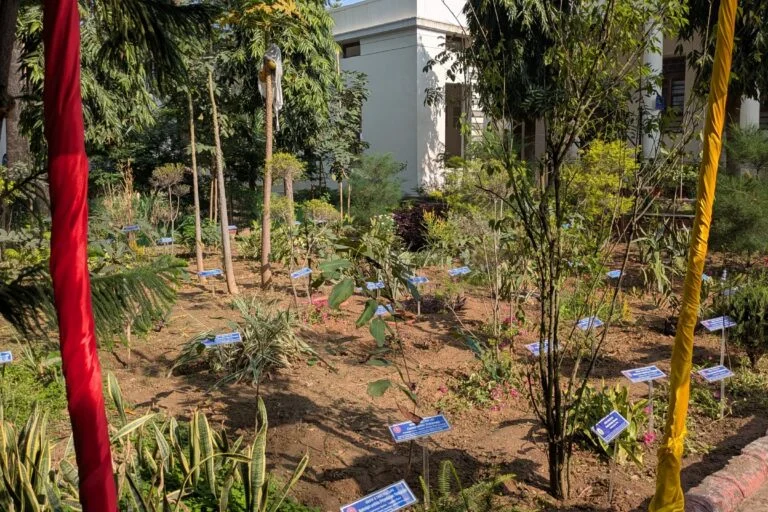
In a quiet, verdant corner of Delhi University’s North Campus, a prehistoric sentinel stands watch over a modern experiment in survival. The Ginkgo biloba, often referred to as a “living fossil,” is the sole survivor of a botanical lineage dating back nearly 290 million years. Having survived the mass extinction that claimed the dinosaurs and endured the shifting of continents, this ancient tree is now at the heart of a pioneering ecological intervention: the Carbon Garden.
As India’s capital continues to grapple with seasonal smog and chronic air quality degradation, the Carbon Garden represents a departure from traditional ornamental landscaping. It is a living, breathing laboratory designed to sequester carbon, filter particulate matter, and restore the delicate ecological balance of urban environments.
Main Facts: An Engineered Ecosystem for Urban Resilience
The Carbon Garden is defined not merely by the beauty of its flora but by its functional utility. Developed by the Department of Botany at Delhi University, the initiative is a nature-based solution (NbS) to the escalating crisis of urban air pollution. Unlike a standard park, this space is an "engineered ecosystem" where every species—from microscopic algae to towering canopy trees—is selected for its specific contribution to carbon sequestration and air purification.
Key Components of the Carbon Garden
The garden is structured as a multi-tiered system that integrates terrestrial and aquatic environments. Its primary features include:
- Diverse Plant Categories: The garden houses a curated mix of hydrophytes (water-dwelling plants), xerophytes (drought-resistant plants), mesophytes (moderate-climate plants), and ancient plant groups like pteridophytes (ferns) and bryophytes (mosses).
- The "Living Fossil" Anchor: The Ginkgo biloba serves as a symbol of resilience, chosen for its long life and ability to store carbon over centuries.
- Microbial Synergies: The garden leverages the power of microorganisms—algae, bacteria, and fungi—to break down complex atmospheric pollutants.
- Practical Scalability: Designed to function on relatively small parcels of land, the model is intended for replication in residential colonies, school campuses, and industrial zones.
Professor Dinabandhu Sahoo, Head of the Department of Botany and the visionary behind the project, describes the garden as a natural filtration system. "We often look to technology for solutions to air pollution, but plants have been perfecting this process for millions of years," says Sahoo. "The Carbon Garden is an attempt to harness that ancient wisdom in a modern urban context."

Chronology: From Academic Concept to Regional Expansion
The journey of the Carbon Garden began three years ago within the research labs of Delhi University. Recognizing the limitations of standard "green belts," Professor Sahoo and his team sought to create a more intensive, scientifically backed approach to urban greening.
- 2021–2022: The Design Phase: Research was conducted to identify plant species with the highest rates of carbon uptake and the best ability to trap Particulate Matter (PM2.5 and PM10). The team focused on the interaction between soil, water, and air.
- 2023: The Pilot Garden: The first Carbon Garden was established at the North Campus of Delhi University. This period involved monitoring the growth of the Ginkgo biloba saplings and establishing the aquatic systems featuring Canna and Spirulina.
- Early 2024: Data Collection and Validation: Informal studies began to show significant differences in the micro-climate and air quality within the garden compared to the surrounding urban sprawl.
- Mid-2024: Scaling and Partnerships: The success of the DU model caught the attention of national security and industrial sectors. The Central Industrial Security Force (CISF) Eastern Sector partnered with the university to bring the model to industrial heartlands.
- Late 2024 and Beyond: The initiative transitioned from a single university site to a regional movement, with 44 gardens planned across Jharkhand, Bihar, and eastern Uttar Pradesh.
Supporting Data: Measuring the Ecological Impact
The efficacy of the Carbon Garden is backed by preliminary data that suggests a profound impact on the immediate environment. According to an informal study conducted by the Department of Botany, the garden acts as a "cool island" and an air-purification hub.
Air Quality and Temperature Metrics
When comparing the environment inside the Carbon Garden to the nearby arterial roads of Delhi, the results were stark:
- Air Quality Index (AQI): During morning hours, the AQI inside the garden was recorded between 76 and 81—levels considered "satisfactory." In contrast, the AQI just outside the garden perimeter was 133, categorized as "moderate" to "unhealthy" for sensitive groups.
- Particulate Matter: Levels of PM2.5 and PM10—the tiny particles that penetrate deep into the lungs—were found to be nearly 50% lower inside the garden.
- Thermal Regulation: In the peak of the afternoon, temperatures within the Carbon Garden were approximately 4°C lower than the surrounding urban areas, demonstrating the power of evapotranspiration and canopy cover in mitigating the urban heat island effect.
The Science of the "Phyllosphere"
One of the most significant, yet invisible, aspects of the garden is the role of tree bark and leaf surfaces. Professor Sahoo highlights that a single square meter of tree bark can host nearly six trillion microbes. These microorganisms inhabit the "phyllosphere" (the surface of plants) and are capable of metabolizing toxic gases such as methane and carbon monoxide, converting them into harmless organic compounds or nutrients for the soil.
Furthermore, the integration of aquatic plants like Spirulina and Chlorella ensures that the garden produces high levels of oxygen while simultaneously cleaning rainwater and cycling nutrients through the soil.

Official Responses: Academic and Industrial Perspectives
The Carbon Garden has garnered support from both the academic community and government agencies, though experts urge a cautious, localized approach to its expansion.
Academic and Student Engagement
For students at Delhi University, the garden has transformed botanical education. Zoya Khan, an undergraduate botany student, describes it as a "living lab." "In the classroom, we learn about carbon cycles in the abstract," Khan says. "In the Carbon Garden, we can actually see how different plant groups—from the ancient gymnosperms to modern angiosperms—work together to stabilize the environment."
Industrial Adoption
The model’s most significant endorsement comes from the Central Industrial Security Force (CISF). Prabodh Chandra, Inspector General of the CISF Eastern Sector, has spearheaded the rollout of 44 gardens. "We are developing these gardens across Jharkhand, Bihar, and eastern Uttar Pradesh," Chandra stated. "Four are already operational in Ranchi, Nabinagar, Barauni, and Tanda. By the end of this monsoon, we expect the remaining 40 to be fully operational, providing a green shield for our personnel and the surrounding communities."
Expert Critiques
While the concept is widely praised, some scientists emphasize the need for regional customization. Geetha Ramaswami, team lead at SeasonWatch (Nature Conservation Foundation), notes that "local ecological context is vital." She warns that a "one-size-fits-all" approach could be counterproductive. "Plant species that thrive in Delhi’s semi-arid climate may not be suitable for the humid conditions of Kerala. To maximize benefits, we must prioritize native biodiversity and ensure that non-native species do not become invasive."
Environmental scientist Chirashree Ghosh, though not directly involved in the project, sees the garden as a tool for cultural change. "It encourages people to engage directly with ecological restoration. It creates a culture where sustainability becomes second nature rather than a forced policy," Ghosh explains.

Implications: A Blueprint for the Greener City
The implications of the Carbon Garden initiative are profound, particularly given the global health crisis linked to air pollution.
Addressing the Public Health Crisis
According to the World Health Organization (WHO), air pollution is responsible for over seven million premature deaths annually. In India, the crisis is particularly acute, with the country accounting for an estimated 1.7 million of those deaths. Data from IQAir consistently ranks Indian cities among the most polluted in the world. In this context, the Carbon Garden offers a low-cost, high-impact strategy for urban centers that cannot afford massive high-tech filtration systems.
Nature-Based Solutions (NbS)
The Carbon Garden aligns with the global shift toward Nature-Based Solutions for climate change. By using diverse plant life to manage carbon, the project moves away from monoculture plantations—which are often prone to disease and provide limited ecological services—toward resilient, biodiverse systems.
Scalability and Urban Planning
The primary advantage of this model is its "spatial economy." Traditional urban forests require vast tracts of land, which are rarely available in densifying cities. The Carbon Garden, however, can be tucked into the corners of office complexes, the edges of school playgrounds, or the medians of wide boulevards.
As the Ginkgo biloba saplings at Delhi University continue to grow, they represent more than just a nod to the earth’s biological past. They are symbols of a potential future where cities are no longer concrete heat traps, but integrated ecosystems capable of healing themselves. The Carbon Garden initiative suggests that the key to surviving the Anthropocene may well lie in the same botanical resilience that allowed the "living fossil" to survive the eras that came before.
