

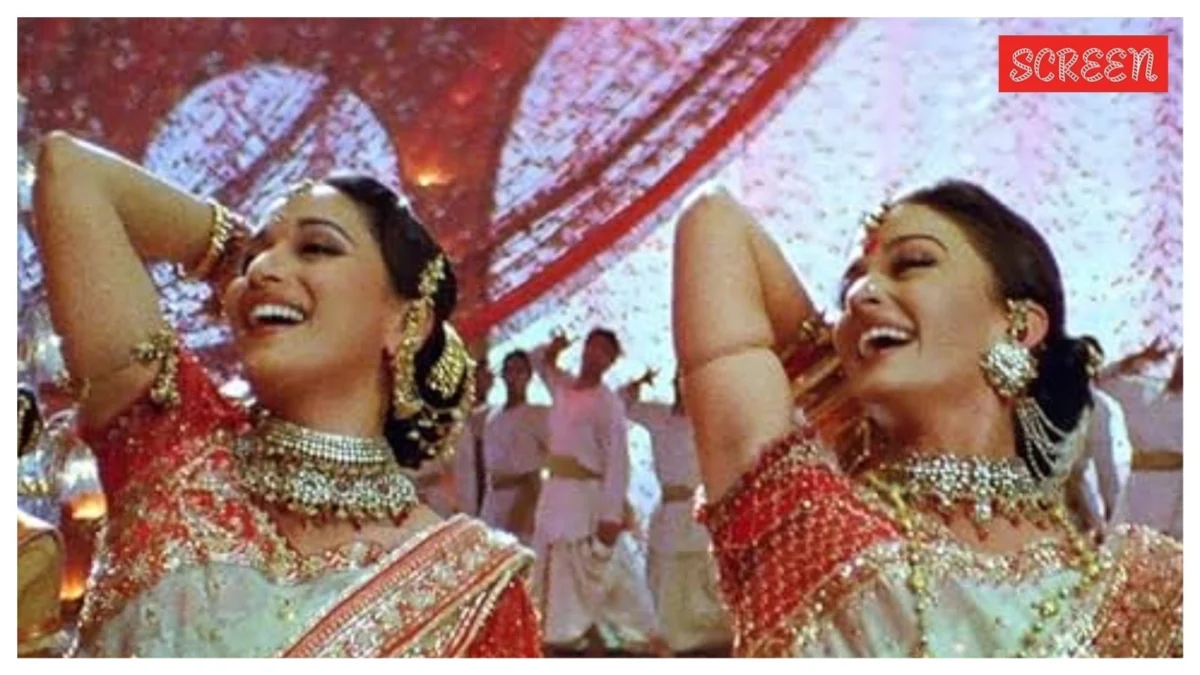
Mumbai, May 19, 2026 – A startling revelation has emerged from the annals of Bollywood, casting a new light on the creation of one of Hindi cinema’s most iconic dance sequences. Twenty-four years after the grand spectacle of "Dola Re Dola" from Sanjay Leela Bhansali’s 2002 magnum opus Devdas graced the silver screen, a former crew member has unveiled the immense challenges faced by lead actress Madhuri Dixit, who was four months pregnant during the filming of the song. This discovery not only highlights Madhuri’s extraordinary commitment to her craft but also underscores the legendary choreographer Saroj Khan’s unwavering dedication, even amidst her own health struggles.
The groundbreaking revelation, shared by Rubina Khan, a member of Saroj Khan’s dance troupe, offers a poignant glimpse into the demanding realities behind the glamorous façade of filmmaking. While "Dola Re Dola," a vibrant duet featuring Madhuri Dixit and Aishwarya Rai Bachchan, is celebrated for its visual splendor and intricate choreography, the story behind its execution is one of perseverance, pain, and an unyielding spirit.
A Legacy of Collaboration: Saroj Khan and Madhuri Dixit’s Enduring Partnership
The name Saroj Khan is synonymous with the golden era of Bollywood dance. Her masterful choreography elevated songs to narrative art forms, and Madhuri Dixit, with her expressive eyes and unparalleled grace, was often her muse. Their professional relationship, which spanned decades, was a powerhouse of creativity, yielding some of the most memorable dance numbers in Indian cinema.
From the electrifying energy of "Ek Do Teen Chaar" in Tezaab (1988), which catapulted both Khan and Dixit into superstardom, to the melancholic elegance of "Tabaah Ho Gaye" in Kalank (2019), their collaborations were consistently met with critical acclaim and audience adoration. Each project seemed to build upon the magic of the last, solidifying their status as an inseparable creative force. The chemistry between choreographer and dancer was palpable, a testament to years of trust, understanding, and a shared vision for artistic excellence.
The Untold Story of "Dola Re Dola": A Dance of Resilience Amidst Pregnancy
The iconic "Dola Re Dola" sequence, a visual feast set against the opulent backdrop of Bhansali’s Devdas, required months of meticulous planning and execution. Rubina Khan, speaking to Bollywood Thikana, shared that the song’s shooting alone spanned a grueling 17 days, preceded by at least a month of intensive rehearsals. The cast and crew worked tirelessly, with actors and dancers often rehearsing separately to perfect every nuance.
It was during this demanding period that the significant revelation about Madhuri Dixit’s condition came to light. "There’s a step in which Madhuri ma’am turns and sits down," Rubina recounted. "That shot kept happening from 9 am to 10 pm because she was four months pregnant. So, she couldn’t turn properly and was feeling dizzy." The physical toll of the intricate steps, compounded by the early stages of pregnancy, made even seemingly simple movements a Herculean task for the actress.
Rubina further elaborated on the immense difficulties Madhuri faced, adding, "She also had fever at that time. She struggled a lot." Despite the physical discomfort and illness, Madhuri’s professionalism shone through. In a testament to her deep respect for her guru, Saroj Khan, she never once requested a change in choreography, even when her well-being was compromised. "She’d never ask for a step to be changed. Whatever Master ji said is set in stone," Rubina emphasized. "Newer artists would still tell Master ji a step is tough and if it can be changed. But Master ji would seldom change a step she suggested. She insisted on doing the same step anyhow."
This unwavering adherence to Saroj Khan’s vision, even under such challenging circumstances, speaks volumes about Madhuri Dixit’s dedication to her art and her profound respect for her choreographer. It paints a picture of an artist who prioritized artistic integrity and the director’s vision above personal discomfort.
A Glimpse into Madhuri Dixit’s Life and Return to the Limelight
Madhuri Dixit’s personal life at the time of Devdas’ filming was also undergoing significant shifts. She had married Dr. Shriram Nene, a cardiovascular surgeon based in the United States, in 1999. At the zenith of her career, she had made the bold decision to relocate to Denver, seemingly stepping away from the Bollywood spotlight.
It was Sanjay Leela Bhansali’s persuasive charm that managed to lure her back for the pivotal role of Chandramukhi in Devdas. Her performance was widely lauded, earning her critical acclaim and solidifying her enduring appeal. The film’s completion marked a significant milestone, and shortly thereafter, Madhuri welcomed her first son, Arin Nene, in 2003, followed by her second son, Ryan Nene, in 2005. This period of motherhood led to a hiatus from acting.
Her return to the silver screen came in 2007 with Anil Sharma’s directorial debut, Aaja Nachle. However, the family eventually made a permanent move back to Mumbai, signaling a renewed engagement with the Indian film industry and a closer proximity to her roots.
Saroj Khan’s Own Battles: Dedication Amidst Illness
The challenges faced during the filming of "Dola Re Dola" were not confined to Madhuri Dixit alone. The legendary Saroj Khan herself was reportedly battling illness during the arduous shooting schedule. Sanjay Leela Bhansali, in an interview with The Quint, recalled Saroj Khan’s extraordinary resilience. "She was in a lot of pain, but she would lie down on the floor and give instructions. She shot for 15 days," Bhansali shared.
The choreographer’s unwavering commitment to her work was further exemplified by an anecdote shared by Bhansali after Saroj Khan’s passing in 2020. He recounted visiting her in the hospital with Aishwarya Rai Bachchan on the day Devdas was released. In a semi-conscious state, Saroj Khan’s immediate concern was the reception of her work. "On the day Devdas released, Sarojji was in hospital. Aishwarya and I went to meet her. In her semi-conscious state she asked, ‘Dola Re Dola pe paise miley ya nahin?’ (Did the audience shower coins on ‘Dola Re Dola’?)" Bhansali recalled, highlighting her profound passion and her desire for her artistic contributions to be recognized and appreciated, even in her most vulnerable moments.
The "Salim-Javed of Choreography": Saroj Khan’s Enduring Impact
Sanjay Leela Bhansali has often lauded Saroj Khan as the "Salim-Javed of choreography." This powerful analogy draws a parallel between Saroj Khan’s revolutionary impact on dance direction and the legendary screenwriting duo Salim Khan and Javed Akhtar, who redefined storytelling in Indian cinema. Bhansali argued that while many talented choreographers have graced the industry, Saroj Khan’s contribution to the profession remains unparalleled, much like the indelible mark left by Salim-Javed on screenplay writing.
However, the relationship between Bhansali and Saroj Khan was not without its complexities. Years after Devdas, Saroj Khan publicly alleged that Bhansali had plagiarized her choreography for the popular song "Ram Chahe Leela" from his 2013 film Goliyon Ki Rasleela: Ram-Leela. She claimed that her work, originally conceived for the film, was used without her consent or proper credit, which was instead falsely attributed to choreographer Vishnu Deva. This incident, though a point of contention, does not diminish the immense respect Bhansali held for Khan’s artistry, as evidenced by his heartfelt tributes.
Implications and a Testament to Artistic Integrity
The revelations surrounding the filming of "Dola Re Dola" offer a profound insight into the dedication and sacrifices made by artists in the pursuit of cinematic excellence. Madhuri Dixit’s determination to perform challenging choreography while pregnant, coupled with Saroj Khan’s unwavering commitment despite her own health issues, serves as a powerful testament to their professionalism and passion.
This story underscores the often-unseen struggles behind the dazzling performances that captivate audiences. It highlights the collaborative nature of filmmaking, where the vision of a director is brought to life through the immense effort and talent of actors, choreographers, and an entire crew. The enduring legacy of "Dola Re Dola" is not just in its visual grandeur but in the story of resilience, dedication, and artistic integrity that lies beneath its surface. It reminds us that behind every iconic scene, there are countless hours of hard work, personal sacrifice, and an unyielding commitment to creating art that resonates for generations to come. The tale of "Dola Re Dola" is a chapter in Bollywood history that deserves to be told and remembered, celebrating the indomitable spirit of its creators.
