


New Delhi – In an era defined by relentless digital streams and curated realities, the age-old philosophical insight that our experiences profoundly shape who we are has never been more relevant. Far from being solely internal constructs, our communication styles and sense of self are deeply interwoven with the environments we inhabit, the information we consume, and the narratives we are repeatedly exposed to. This intricate dance between external stimuli and internal development is not a new phenomenon, but its amplified intensity in our media-saturated world necessitates a deeper examination of its profound implications for individuals and institutions alike.

The Foundational Principle: Perception as the Bedrock of Knowledge
The idea that our surroundings mold our minds is not a modern revelation. Ancient philosophical traditions, particularly in India, recognized this fundamental connection. The Nyaya Sutra, a seminal text on logic and epistemology, posits perception – the direct contact of our senses with the external world – as the primary pathway to valid knowledge. This foundational principle suggests a clear sequence: we first perceive, then we process, and ultimately, we articulate. What we see, hear, and experience serves as the raw material upon which our inferences, judgments, and reasoning are built.
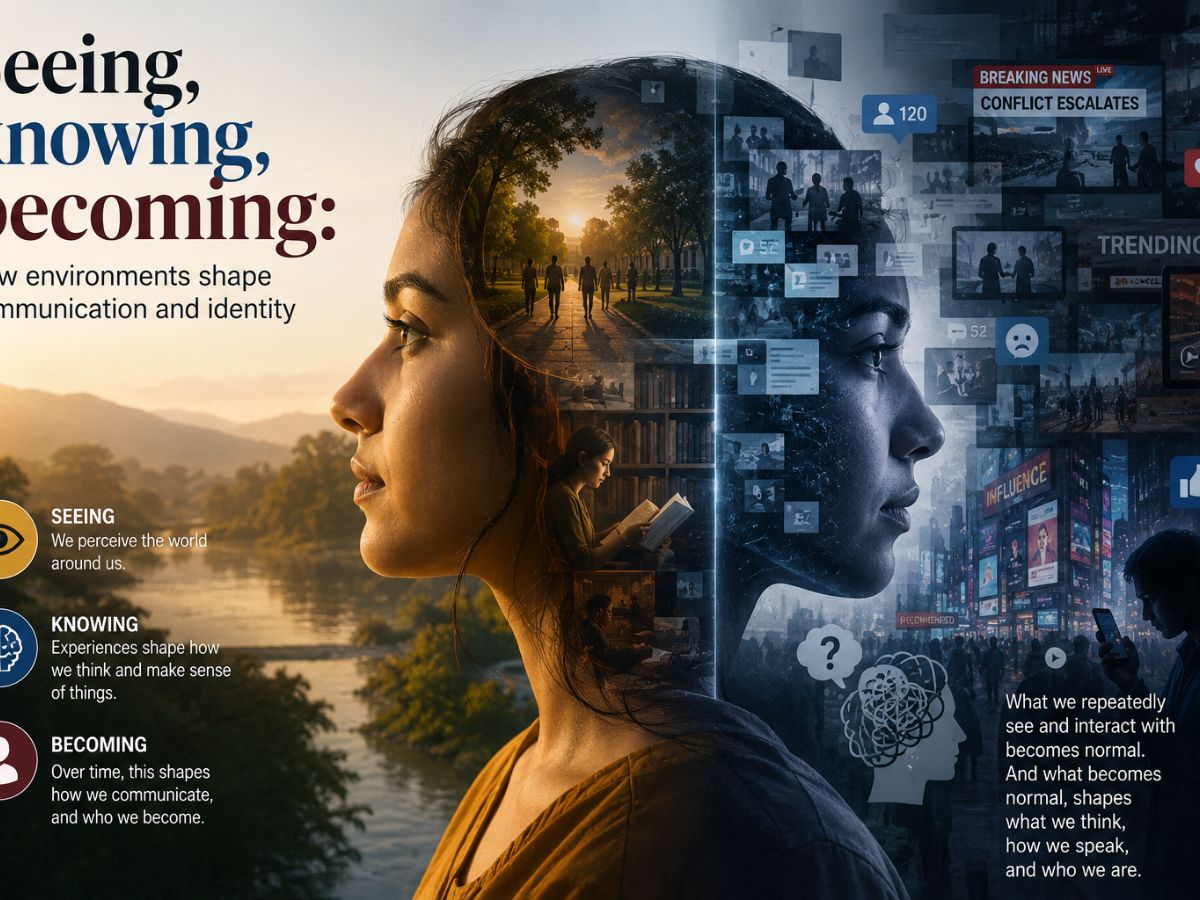)
This sensory input, however, is not merely a passive reception of data. It actively structures our cognitive frameworks. The Yoga Sutra further elaborates on this by defining the mind as a flux of "vrittis" – mental fluctuations or modifications. These fluctuations, it explains, arise from impressions formed through sensory engagement. With consistent exposure to particular experiences or information, these impressions deepen, solidifying into "samskaras" – ingrained tendencies, preferences, and predictable patterns of response. In this light, identity is not a static, self-generated entity but an accumulated tapestry woven from these recurring external influences.

The Modern Crucible: Amplified Exposure in a Digital Age
The contemporary media landscape has taken this ancient wisdom and amplified it to an unprecedented degree. We are constantly bombarded with information from a multitude of sources: social media feeds, algorithmically curated content, digital platforms, and an endless stream of news and entertainment. This environment is far from neutral; it actively prioritizes certain forms of expression, amplifies specific vocabularies, and normalizes particular ways of interpreting the world.
)
The impact of this constant exposure is multifaceted. On a linguistic level, we witness an increasing standardization of language across platforms. Words, phrases, and expressions circulate with remarkable speed, quickly acquiring shared meanings and acting as signals of belonging. What might begin as a descriptive term or a casual observation can, through repeated use and association, morph into a marker of self-definition. Terms that once denoted a preference or an activity now function as powerful identifiers, shaping how individuals perceive themselves and how they wish to be perceived by others. This phenomenon underscores how deeply ingrained linguistic patterns, born from sustained exposure, can come to feel natural, expected, and even essential for social participation.
)
The Erosion of Nuance: Opinion Formation in Curated Realities
The influence extends beyond language to the very formation of opinions and worldviews. When individuals are primarily exposed to a narrow range of perspectives, it can foster an illusion of widespread consensus, even when dissenting voices are abundant but unseen. Similarly, consistent engagement with specific narratives can powerfully shape what is deemed credible, legitimate, or even factual.
)
Drawing back to the Nyaya Sutra’s emphasis on perception, if the scope of what we perceive is deliberately narrowed, then the scope of our reasoning capabilities can also contract. Our ability to engage in nuanced thought and to consider alternative viewpoints is directly correlated with the diversity of information and experiences we are exposed to. In essence, our thoughts begin to follow our exposure.
)
The Yoga Sutra’s insights on "samskaras" further illuminate this process. A single exposure might offer information, but sustained exposure actively forms our cognitive and emotional landscapes. These repeated interactions leave behind lasting residues that influence our behavior, shape our preferences, and ultimately, contribute to our sense of identity. What might initially feel like an intrinsic personal belief or preference is often the product of accumulated environmental influences, leading to an appearance of stability in an identity that is, in reality, in constant flux.
)
Institutional Responsibility: Designing Environments for Informed Minds
This profound connection between environment and cognition places a significant responsibility on institutions, particularly those involved in education and communication. If our thoughts, expressions, and even our identities are shaped by what we repeatedly encounter, then the deliberate design of these environments becomes paramount. What is presented, what is emphasized, and what is reiterated will inevitably influence not only what individuals know but also how they think and how they articulate those thoughts.
)
Higher education, for example, often focuses on curriculum delivery and skill acquisition. However, the communicative environment within which learning occurs is equally critical. The quality of discourse, the genuine diversity of perspectives represented, and the nature of intellectual engagement are not peripheral to education; they are central to its effectiveness. When learning environments foster critical thinking, encourage respectful debate, and expose students to a wide spectrum of ideas, they are actively shaping more robust and independent minds.
)
Similarly, the media and public communication spheres face this challenge. The relentless drive for brevity and easily digestible content, while enhancing accessibility, carries the inherent risk of oversimplification. When our exposure is limited to simplified representations of complex issues, our capacity for nuanced thought and critical analysis can diminish. Communication may become more efficient, but it risks losing its substantive depth and its ability to foster genuine understanding.
)
Navigating the Influence: Towards Conscious Engagement
The challenge, therefore, is not to eliminate external influence altogether – an impossible feat in any social context. Instead, the imperative lies in cultivating awareness of this influence. It requires a conscious recognition that repeated exposure shapes our thoughts, and our thoughts, in turn, shape our expressions. In a world where our environments are increasingly mediated and curated by unseen forces, this heightened awareness is not just beneficial; it is essential for intellectual autonomy.
)
Communication and identity do not arise in a vacuum. They are forged at the intricate intersection of what we are exposed to, how we interpret that exposure, and the patterns of repetition that solidify these interpretations. The fundamental question is not whether we are influenced by our surroundings, but rather, how attentive we are to the mechanisms of that influence. It is about our capacity to critically examine the environments that shape us and, where possible, to actively and deliberately shape those environments in return, fostering a more informed, nuanced, and authentic sense of self and society. The ongoing dialogue about our digital and physical spaces must therefore extend beyond mere content consumption to a deeper consideration of the very architecture of our cognitive and communicative realities.
