

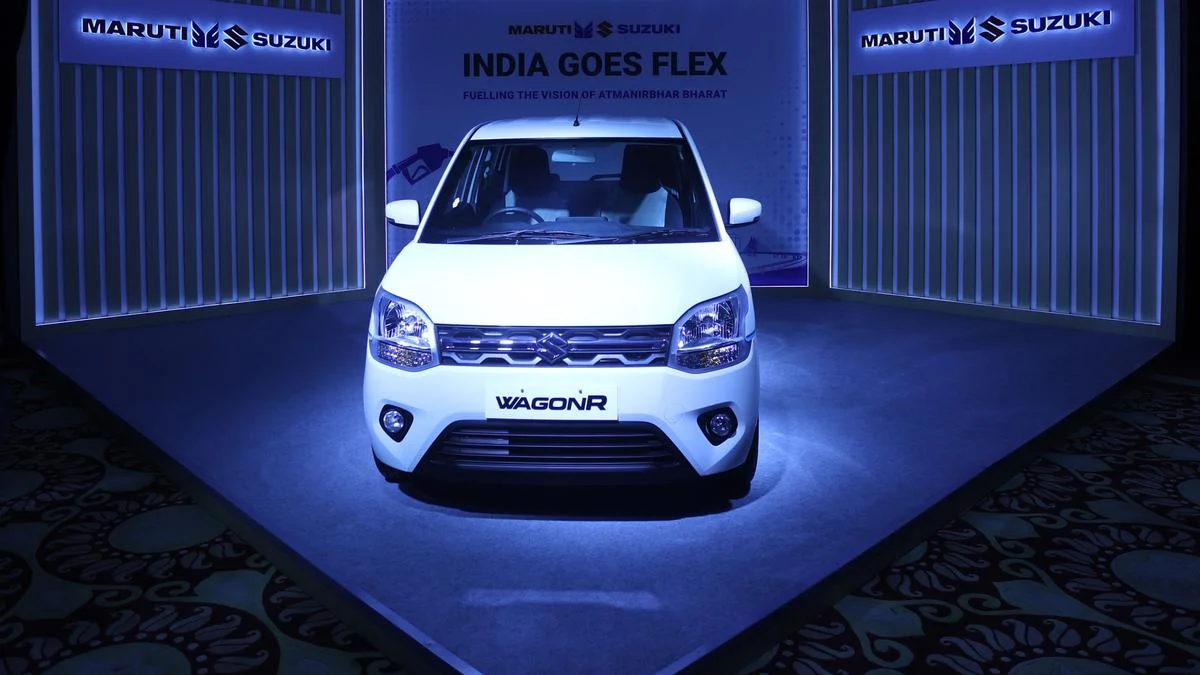
The Indian automotive landscape is currently undergoing a tectonic shift, driven by a dual necessity: the urgent requirement to meet international carbon emission standards and the economic imperative to slash a staggering crude oil import bill. While the global narrative has largely centered on the "EV-only" route, India is carving out a more nuanced, multi-dimensional strategy. At the heart of this transition lies the recent unveiling of the Maruti Suzuki Wagon R Flex Fuel—a vehicle that signifies more than just a new engine variant; it represents a strategic pivot toward domestic energy security and sustainable mass mobility.
Main Facts: Engineering the Democratization of Green Technology
The Maruti Suzuki Wagon R Flex Fuel is a technological milestone for India’s largest carmaker. Unlike standard internal combustion engine (ICE) vehicles that are tuned for E10 or E20 (10% or 20% ethanol blend), this prototype is designed to operate on any ethanol-petrol blend ranging from E20 to E100. This means the vehicle can run on fuel containing up to 100 percent ethanol, a biofuel primarily derived from sugarcane and food grains.
Technical Specifications and Innovations
The core of this advancement lies in the sophisticated Engine Control Unit (ECU). Ethanol has different caloric values and combustion properties compared to pure gasoline. To manage this, Maruti Suzuki has integrated an advanced ECU that utilizes sensors to monitor the ethanol concentration in the fuel line in real-time. The system then automatically adjusts ignition timing and fuel injection parameters to ensure optimal performance and engine longevity, regardless of the blend.
Beyond the software, the physical hardware has undergone a significant overhaul. Ethanol is hygroscopic (absorbs water) and can be corrosive to certain metals and rubber components found in traditional engines. Consequently, Maruti Suzuki has upgraded the fuel pumps, fuel injectors, and engine valves, while utilizing ethanol-compatible materials for the fuel tank and hoses.
Strategic Product Choice
By choosing the Wagon R—a perennial bestseller and a staple of the Indian middle class—Maruti Suzuki is signaling that flex-fuel technology is intended for the mainstream, not just niche premium segments. With an expected price point between INR 7.50 and 8.00 lakh, the company is positioning this as an accessible alternative to more expensive Electric Vehicles (EVs) and Strong Hybrids.
Chronology: India’s Decades-Long Biofuel Journey
The road to the Wagon R Flex Fuel began long before its recent showcase. India’s pursuit of ethanol blending has been a phased, multi-decade endeavor.

- The Pilot Phase (2003-2013): The Indian government launched the Ethanol Blended Petrol (EBP) program in 2003 with a modest target of 5% blending. However, inconsistent supply and pricing issues between the oil marketing companies (OMCs) and sugar mills led to slow progress.
- The Policy Revitalization (2018): The National Policy on Biofuels was introduced, broadening the scope of raw materials allowed for ethanol production. It moved beyond just sugarcane molasses to include damaged food grains, maize, and cellulosic materials.
- The Acceleration (2020-2022): In a landmark move, the Indian government advanced the target for 20% ethanol blending (E20) from 2030 to 2025. This sent a clear signal to the automotive industry to begin re-engineering their platforms.
- The Prototype Era (2023-Present): Following the successful rollout of E20 fuel at select pumps across the country, manufacturers began showcasing Flex-Fuel Strong Hybrid Electric Vehicles (FFV-SHEV). Maruti Suzuki’s showcase of the Wagon R Flex Fuel serves as the latest chapter, moving the technology into the mass-market hatchback segment.
Supporting Data: The Socio-Economic Calculus
The push for flex-fuel is backed by compelling economic and environmental data. India is the world’s third-largest consumer of energy, and its transport sector is a primary driver of demand.
Reducing Import Dependency
India currently imports over 85% of its crude oil requirements. According to data from the Ministry of Petroleum and Natural Gas, this results in an annual foreign exchange outflow exceeding $150 billion. Transitioning to E20 blending alone is estimated to save the country approximately INR 30,000 crore (roughly $3.6 billion) annually in foreign exchange. Moving toward E85 and E100 could potentially double or triple these savings over the next decade.
The Agricultural Linkage
Unlike the lithium-ion batteries required for EVs, which depend on supply chains dominated by foreign nations, ethanol is a domestically produced resource. India is one of the world’s largest producers of sugar. A robust flex-fuel ecosystem creates a "circular economy" where the money spent at the fuel pump flows back to Indian farmers. This provides a price floor for sugarcane and grain farmers, insulating them from global commodity price crashes.
Environmental Impact
From a "well-to-wheel" perspective, ethanol can significantly reduce greenhouse gas emissions. While an engine running on E100 still emits CO2 at the tailpipe, the plants used to create the ethanol absorb CO2 during their growth, making the overall cycle much closer to carbon-neutral than fossil fuels. Studies suggest that E100 can reduce carbon monoxide emissions by up to 30-40% compared to neat petrol.
Official Responses: Government and Industry Perspectives
The development of the Wagon R Flex Fuel has been met with a mix of high-level political support and cautious industry optimism.
The Government’s Stance
Union Minister for Road Transport and Highways, Nitin Gadkari, has been the most vocal proponent of flex-fuel technology. He has repeatedly urged carmakers to move away from fossil fuels, citing the "Brazil model" where flex-fuel vehicles are the norm. Government officials have emphasized that flex-fuel is a key pillar of the Atmanirbhar Bharat (Self-Reliant India) initiative. The government is also considering tax incentives for flex-fuel vehicles, similar to the lower GST rates enjoyed by EVs, though no formal announcement has been made yet.

Maruti Suzuki’s Corporate Vision
Hisashi Takeuchi, Managing Director and CEO of Maruti Suzuki India, has maintained that the company’s strategy is "technology-agnostic." In various statements, the leadership has clarified that while they are working on their first high-profile EV for 2025, they believe a single solution cannot solve India’s complex mobility needs. "Our objective is to reduce the carbon footprint and oil imports. Whether it is through CNG, Hybrids, EVs, or Flex-Fuel, we want to provide the consumer with choices that fit their budget and usage," a company spokesperson noted during the showcase.
Industry Watchdogs and Analysts
Automotive analysts have praised the engineering but raised questions regarding the "Ethanol Ecosystem." Organizations like the Society of Indian Automobile Manufacturers (SIAM) have pointed out that while the cars are ready, the availability of E100 fuel remains localized. Analysts suggest that for the Wagon R Flex Fuel to be a commercial success, the government must ensure a price differential—ethanol must be significantly cheaper than petrol to compensate for the lower fuel efficiency (caloric value) of ethanol.
Implications: Challenges and the Road Ahead
The introduction of the Wagon R Flex Fuel is a bold step, but its success is far from guaranteed. Several critical implications must be addressed for this technology to move from "showcase" to "showroom."
The Consumer Awareness Gap
There is a prevailing "trust deficit" regarding ethanol. Many car owners fear that ethanol blends will damage their engines, lead to starting trouble in cold weather, or result in higher maintenance costs. Maruti Suzuki faces the gargantuan task of educating the public on how their new engineering—specifically the modified fuel lines and ECU—mitigates these risks. Without a massive public awareness campaign, buyers may stick to traditional petrol or CNG variants.
The Infrastructure Bottleneck
The greatest hurdle remains the fuel station. Currently, India is still in the process of making E20 available nationwide. A consumer buying a Wagon R Flex Fuel today would struggle to find an E85 or E100 dispensing station outside of a few pilot cities in Maharashtra or Uttar Pradesh. The "chicken-and-egg" problem persists: OMCs are hesitant to install E100 pumps without enough cars on the road, and consumers won’t buy the cars without the pumps.
Maintenance and Total Cost of Ownership (TCO)
Ethanol has a lower energy density than petrol, meaning a car will typically deliver 20-30% lower mileage when running on E100 compared to pure gasoline. For the Wagon R Flex Fuel to be economically viable for the end-user, the price of E100 fuel must be at least 30% lower than petrol. Furthermore, the long-term impact on engine oil life and service intervals needs to be transparently communicated to prevent "sticker shock" during the first few years of ownership.

Conclusion: A Parallel Path to Progress
The Maruti Suzuki Wagon R Flex Fuel is a testament to Indian engineering’s ability to adapt to local realities. It acknowledges that while the "Electric Dream" is the ultimate goal, the internal combustion engine—when powered by domestic biofuels—still has a vital role to play in decarbonizing the nation.
The product is ready, and the engineering is sound. However, the true test of India’s flex-fuel ambitions will not happen in the factory, but in the fields of the farmers, the boardrooms of oil companies, and the hearts of the Indian middle class. If the ecosystem can evolve to support the technology, the Wagon R Flex Fuel may very well be remembered as the vehicle that sparked a quiet revolution in India’s energy history.
Maruti Suzuki Wagon R Flex Fuel expected price: (INR 7.50 – 8.00 lakh)
Motorscribes, in association with The Hindu, brings you the latest in cars and bikes. Follow them on Instagram @motorscribes
