

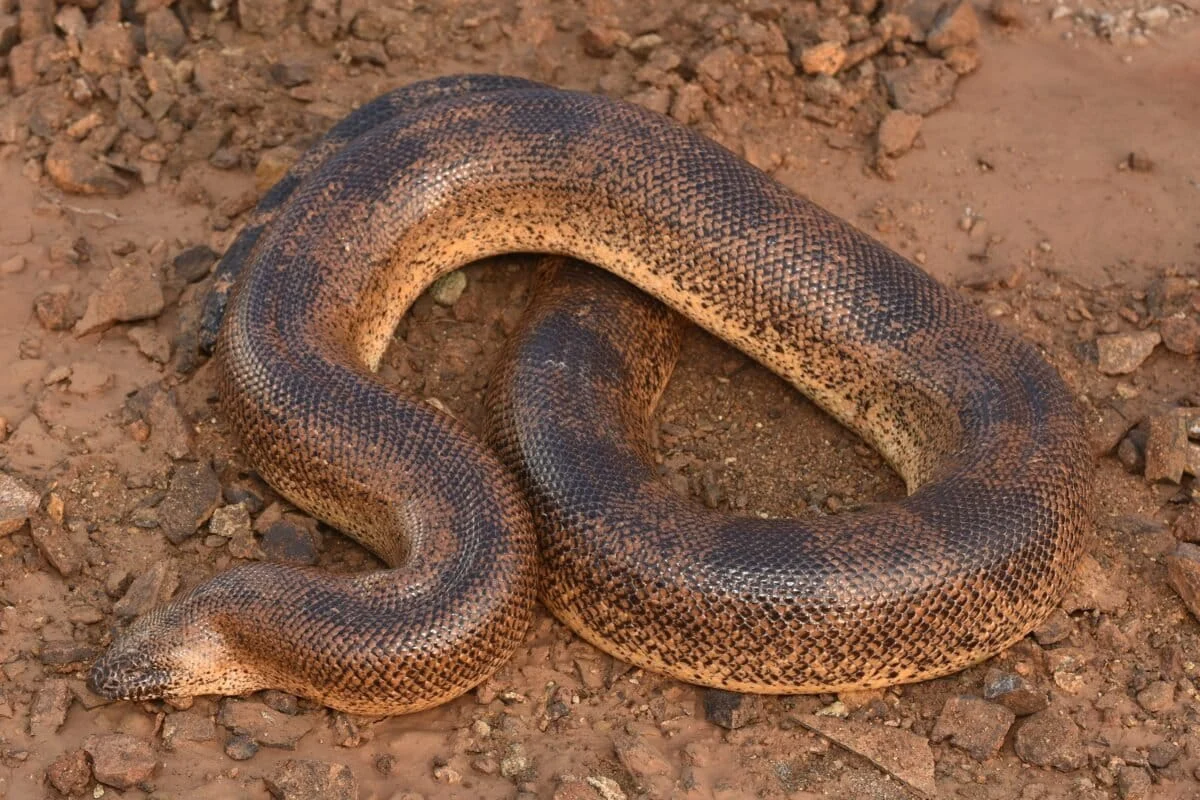
RAJASTHAN, India – In a significant development for Indian herpetology, researchers have confirmed the first-ever record of the Sistan sand boa (Eryx sistanensis) within India’s borders. This discovery, documented in the northern reaches of the Thar Desert in Rajasthan, adds a fourth member to the country’s roster of sand boa species. While the snake was formally described by scientists only as recently as 2020—based on specimens from Iran and Pakistan—its presence in India suggests that the species has been overlooked for decades, often mistaken for its more famous relative, the Red sand boa.
The findings, published in the Journal of Threatened Taxa, highlight the complexities of reptile conservation in a landscape increasingly dominated by human activity. Led by conservation biologist Vivek Sharma, the study documented three live individuals, providing definitive proof that this elusive serpent is a resident of the Indian subcontinent’s arid northwestern corridor.
Main Facts: A New Addition to India’s Biodiversity
The Sistan sand boa is a member of the Boidae family, a group of non-venomous constrictors. Until this confirmation, India was known to host three primary species of sand boas: the Red sand boa (Eryx johnii), the Rough-scaled sand boa (Eryx conicus), and Whitaker’s boa (Eryx whitakeri). The inclusion of Eryx sistanensis expands the ecological map of the genus Eryx and raises urgent questions regarding the conservation of snakes in "human-dominated" landscapes.
The Sistan sand boa is characterized by its unique physical markings and habitat preferences. Unlike the Red sand boa, which is often found in deep, loose sand, the Sistan variety appears to favor more compact soils and is frequently found in close proximity to human settlements.
Key Distinctions
The primary reason the Sistan sand boa remained "hidden" for so long is its superficial resemblance to the Red sand boa. However, the study outlines several key morphological differences:
- Tail Structure: The Sistan sand boa possesses a tail that gradually tapers toward the tip, whereas the Red sand boa is famous for its blunt, rounded tail that mimics the shape of its head.
- Coloration and Patterning: One of the most striking differences lies in their ontogenic changes—or lack thereof. Red sand boas are born with bands that eventually fade as they reach adulthood, resulting in a uniform reddish-brown or chocolate color. In contrast, the Sistan sand boa retains dark, sooty bands throughout its entire life.
- Growth Stages: Juveniles typically exhibit a buff-colored base, while subadults and adults transition to a tan or tan-brown hue, always maintaining their distinctive dark banding.
Chronology: From Iranian Deserts to Indian Farmlands
The journey to identifying the Sistan sand boa in India is a story of taxonomic detective work.
2020: Formal Description
The species was first officially described by a team of international researchers who identified it as a distinct lineage separate from Eryx johnii. The initial type specimens were located in the Sistan region, which straddles the border of Iran and Pakistan.
Early Anecdotal Evidence
While the 2020 description provided the scientific framework, Vivek Sharma’s study suggests that the snake has been in India for a long time. Early observations of what appeared to be "unusual" Red sand boas were noted among snake charmers in states as far-flung as Punjab, West Bengal, and Chhattisgarh. Because snake charmers are migratory and trade animals across state lines, these sightings were initially dismissed as geographical variations or anomalies.
The Rajasthan Discovery
The definitive breakthrough occurred recently when Sharma and his team documented three live individuals in the northern Thar Desert of Rajasthan. By analyzing the physical characteristics of these specimens and comparing them with the 2020 description of Eryx sistanensis, the team was able to confirm that these were not Red sand boas, but the newly recognized Sistan species. This confirmed that the species’ range extends significantly further east than previously thought.
Supporting Data: Habitat and Ecology
The study provides crucial data on where these snakes live and how they interact with their environment. Contrary to the popular image of sand boas living in pristine, untouched dunes, the Sistan sand boa appears to be a "synanthropic" species—one that benefits from living near humans.
Habitat Preferences
The researchers recorded the majority of sightings in:
- Agricultural Lands: Farmlands with compact soil.
- Scrublands: Areas with low-density vegetation and hardy shrubs.
- Human Structures: Suburban gardens, cowsheds, and even residential courtyards.
The preference for compact soil rather than loose dunes suggests that the Sistan sand boa occupies a different ecological niche than the Red sand boa. This habitat overlap with humans, however, is a double-edged sword. While the snakes may find abundant prey (such as rodents) in agricultural areas, they are also more vulnerable to human-induced threats.
Population Distribution
Though the study focused on Rajasthan, the historical presence of the species in the hands of snake charmers in other states suggests a potentially wider distribution across northwestern India. The researchers hypothesize that the species may exist throughout the semi-arid belts of Haryana and Gujarat, though further field surveys are required to map the exact boundaries.

Official Responses and Expert Insights
Vivek Sharma, the lead author of the study and a prominent conservation biologist, emphasizes that the recognition of the Sistan sand boa is only the first step.
"The species may face many of the same threats as the better-known Red sand boa," Sharma warned. He pointed out that all sand boas in India are victims of a pervasive and damaging illegal wildlife trade. "They are used by snake charmers and are traded across the country, often transported far beyond their natural range."
The Problem with "Well-Intentioned" Releases
One of the most significant issues raised by the study is the protocol—or lack thereof—regarding the release of confiscated snakes. Forest departments across India frequently seize sand boas from snake charmers and illegal traders.
"While well-intentioned, such releases can create ecological problems," Sharma noted. "If snakes are released far from their native range, the animals may survive, but they often struggle to adapt to unfamiliar habitats. Furthermore, releasing a Sistan sand boa into a habitat meant for a Red sand boa could disrupt local genetics or introduce diseases."
Conservation Status
Currently, the Sistan sand boa has not been evaluated by the International Union for Conservation of Nature (IUCN) for a Red List status. However, in India, it falls under the protection of the Wildlife Protection Act (WPA). Following the 2022 amendment to the Act, sand boas are generally protected under Schedule II, which mandates strict penalties for hunting or trading them.
Implications: The Road Ahead for Conservation
The discovery of a "new" species in a well-traveled region like Rajasthan has profound implications for Indian wildlife policy and the burgeoning "herping" community.
The Threat of Illegal Trade and Superstition
In India, sand boas are often called "two-headed snakes" because of their blunt tails. This morphological quirk has given rise to a host of superstitions, including the belief that the snakes possess medicinal properties or can bring good luck and wealth. These myths fuel a massive black market. The Sistan sand boa, with its docile nature and striking patterns, is equally at risk of being swallowed by this illicit trade.
The "Herping" Tourism Challenge
The study also highlights a modern threat: the rise of herping tourism. Enthusiasts often travel to remote areas to photograph rare reptiles.
"Recognition of the Sistan sand boa as a distinct species brings new conservation challenges," Sharma said. "Its docile nature, tolerance to temperature variation, and low maintenance requirements may also make it attractive to the pet trade. Now that we’ve identified it as a separate species, separate conservation attention is needed."
The fear is that "herpers" might disturb the snakes’ natural behavior or, in extreme cases, move animals between locations to get the "perfect shot," further complicating the species’ natural distribution data.
Agricultural Intensification
Because the Sistan sand boa thrives in farmlands, the intensification of agriculture in the Thar Desert—driven by increased irrigation and chemical use—poses a long-term threat. Habitat alteration and the loss of traditional scrublands could lead to a silent decline in population numbers before scientists even have a chance to estimate their baseline density.
Conclusion: A Call for Targeted Research
The confirmation of the Sistan sand boa in India is a reminder of how much remains to be discovered within the country’s diverse landscapes. Moving forward, the study calls for:
- Systematic Surveys: To determine the full extent of the species’ range in India.
- Training for Officials: To help Forest Department personnel distinguish between the different species of sand boas to ensure proper relocation protocols.
- Public Awareness: To debunk the myths surrounding sand boas and reduce the demand in the illegal wildlife trade.
As Vivek Sharma concludes, identifying the species is just the beginning. The real work lies in ensuring that this "new" Indian resident does not vanish before its role in the ecosystem is fully understood.
