

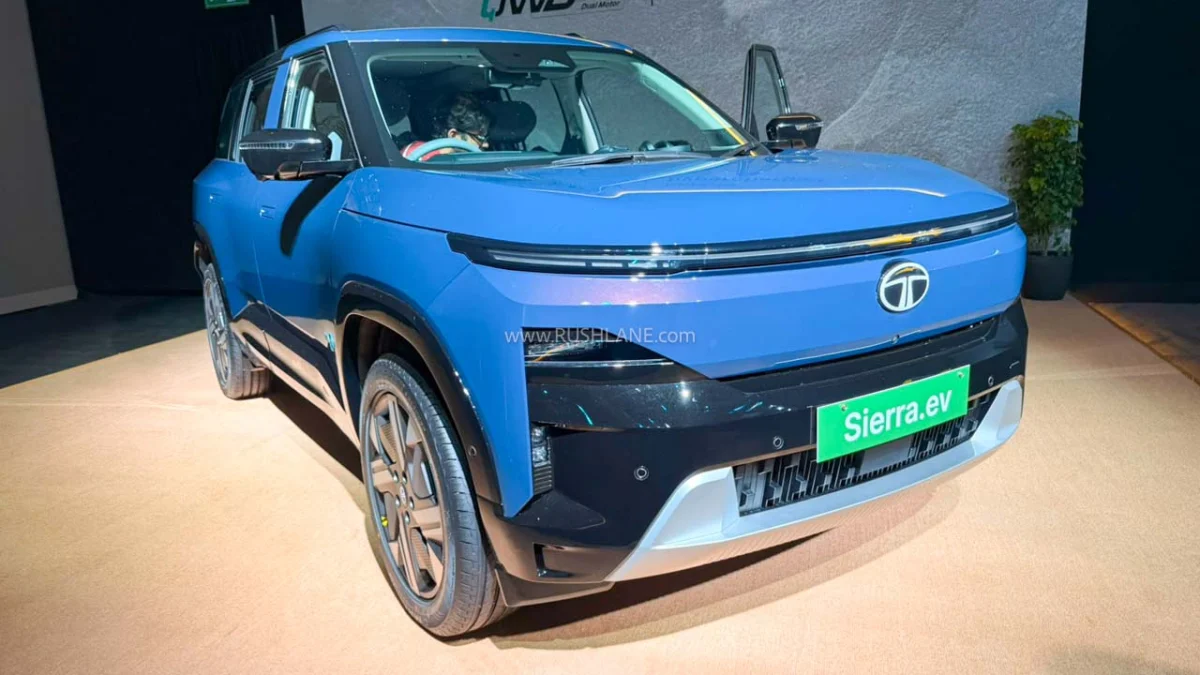
The automotive world is rarely a place where "more" equals "less." Usually, in the hierarchy of vehicle variants, paying a premium for a larger battery pack or a higher trim level guarantees an upgrade across all performance metrics. However, with the launch of the highly anticipated Tata Sierra EV, the Indian automotive giant has introduced a technical anomaly that has left enthusiasts and industry analysts scratching their heads.
The core of the mystery lies in the Rear-Wheel Drive (RWD) specifications: the entry-level 63 kWh variant produces significantly more horsepower than the flagship 75 kWh variant. In an industry where "bigger is better" is the standard marketing mantra, Tata Motors has taken a path dictated by cold, hard chemical engineering and range optimization.
Main Facts: The Specification Discrepancy
When the official technical specification sheets for the Tata Sierra EV were released, one detail stood out with jarring clarity. The Sierra EV equipped with the 63 kWh battery pack is rated at a peak power output of 238 PS (175 kW). In contrast, the 75 kWh RWD variant—the model positioned as the premium, long-range choice—is rated at 209 PS (154 kW).
This represents a power deficit of 29 PS, or approximately 12.2%, for the more expensive model. The 75 kWh variant commands a price premium of roughly Rs 1 lakh over comparable 63 kWh trims, yet it offers less "muscle" on paper.
Despite this divergence in peak power, there are several constants across the RWD lineup:
- Peak Torque: Both the 63 kWh and 75 kWh variants produce an identical 315 Nm of torque in Sport Mode.
- Drive Layout: Both utilize a rear-mounted motor.
- Platform: Both are built on Tata’s dedicated Acti.ev (Advanced Connected Tech-Intelligent Electric Vehicle) architecture.
The trade-off for the lower power in the 75 kWh model is, of course, the range. The 75 kWh version delivers an ARAI-certified range of 665 km, a substantial 99 km increase over the 63 kWh version’s 565 km.
Chronology: From Concept to Technical Revelation
The journey of the new Sierra EV began as a design study at the 2020 Auto Expo, where Tata Motors revived the iconic "Sierra" nameplate. The original Sierra, launched in the early 1990s, was a cult classic known for its unique three-door design and massive rear alpine windows.
By the 2023 Auto Expo, the concept had evolved into a near-production-ready five-door SUV. Throughout its development, Tata promised that the Sierra would be the "crown jewel" of its EV portfolio, sitting above the Nexon EV and Harrier EV.
When the launch details finally emerged in mid-2024, the focus was initially on the design, the "lounge" seating configuration, and the luxury features. However, as technical reviewers delved into the fine print of the powertrain options, the power paradox was discovered. The subsequent dialogue between automotive journalists and Tata Motors’ engineering team has since shed light on the complex balancing act required when designing modern electric vehicles.
Supporting Data: The Science of Battery Packaging
To understand why a larger battery results in lower peak power, one must look at the constraints of vehicle packaging and the physics of electrical discharge. Tata Motors provided specific data points to explain this phenomenon.
1. The Volumetric Constraint
Both the 63 kWh and 75 kWh battery packs must fit into the exact same physical "envelope" or volume under the floor of the Sierra EV. To increase the energy capacity by 12 kWh without increasing the size of the battery casing, Tata had to change the internal architecture and the type of cells used.
2. Cell-to-Pack (C2P) Architecture
The 75 kWh variant utilizes a "Cell-to-Pack" (C2P) architecture. Traditional EV batteries are organized into modules, which are then placed into a pack. C2P eliminates the intermediary module step, allowing more cells to be packed into the same space. While this increases energy density, it alters the electrical characteristics of the pack.
3. Packaging and Energy Efficiency
The 75 kWh pack boasts a class-leading packaging efficiency of 141 Wh/kg. Furthermore, the vehicle achieves an energy efficiency of 8.9 km/kWh. This high efficiency is the primary driver behind the 665 km range, but it comes at a cost to high-voltage discharge rates.

4. Voltage and Power Relationship
In electrical terms, Power (kW) = Voltage (V) x Current (A). Tata confirmed that the higher-capacity cells used in the 75 kWh pack resulted in a "marginal drop in operating voltage." To protect the longevity of these high-density cells and maintain thermal stability, the peak power draw is electronically capped at a lower level than the 63 kWh pack, which likely uses cells capable of higher instantaneous discharge rates.
Official Responses: Tata Motors Explains the Strategy
Responding to intense scrutiny regarding these figures, Tata Motors clarified that this was not a mistake but a deliberate engineering choice. The company’s philosophy for the Sierra EV was to create two distinct "personalities" for the RWD platform.
"The two RWD variants have been engineered with different customer priorities in mind," a Tata Motors spokesperson explained. "The 75 kWh RWD variant is aimed at buyers who prioritise maximum driving range and long-distance touring. The 63 kWh RWD, on the other hand, has been positioned as the more performance-oriented variant for those who want a more spirited driving experience without sacrificing reasonable range."
Tata further emphasized that the "real-world" feel of the two cars would be more similar than the numbers suggest. Because the peak torque remains identical at 315 Nm, the initial "shove" or off-the-line acceleration felt by the driver in city traffic or during overtaking maneuvers is expected to be nearly indistinguishable. The 29 PS difference in peak power typically manifests at higher RPMs—meaning the 63 kWh version will likely have a higher top speed or pull more strongly as it approaches triple-digit speeds.
Implications: What This Means for the Consumer
This revelation creates a unique dilemma for the Indian EV buyer. For the first time in this segment, the "top-end" battery does not represent the "top-end" performance in terms of raw horsepower.
The Case for the 63 kWh Variant (The "Sprinter")
- Performance: With 238 PS, this variant offers a power-to-weight ratio that likely makes it one of the quickest SUVs in its price bracket.
- Value: It is expected to be priced approximately Rs 1 lakh lower than the 75 kWh equivalent.
- Adequate Range: A 565 km ARAI range is still more than enough for most weekly commutes and moderate inter-city travel.
The Case for the 75 kWh Variant (The "Marathoner")
- Range Anxiety Cure: The 665 km range is a psychological milestone for many buyers, potentially offering a real-world range of 450-500 km even under harsh conditions.
- Efficiency Focus: This variant is optimized for the long haul, using the most advanced C2P packaging Tata currently offers.
- Luxury Positioning: Buyers of this variant are paying for the convenience of fewer charging stops, not 0-100 km/h bragging rights.
Market Implications
Tata’s move highlights a maturing EV market. In the early days of EVs, manufacturers tried to make every model "the fastest." Now, we are seeing a shift toward "fit-for-purpose" engineering. By offering a high-power/mid-range option and a mid-power/high-range option, Tata is acknowledging that the EV buyer persona is no longer a monolith.
Some Questions Still Remain
Despite the detailed explanations regarding battery chemistry and voltage, some questions put forth by the automotive community remain unanswered by Tata Motors.
1. Why not offer an efficiency-tuned 63 kWh variant?
If the lower-power calibration used in the 75 kWh model was successful in maximizing efficiency, critics ask why Tata didn’t offer a similar "efficiency-first" tune for the 63 kWh battery. This could have potentially boosted the 63 kWh range from 565 km to perhaps 600 km, offering a "long-range lite" version at a lower price point.
2. What are the actual 0-100 km/h times?
While torque is the same, horsepower determines how long that torque can be sustained. Tata Motors has notably withheld the 0-100 km/h acceleration times for both variants. Without these figures, it is difficult for consumers to quantify exactly how much "slower" the 75 kWh version is in a sprint. In an industry where performance is often sold through these metrics, the absence of data is conspicuous.
3. Thermal Management and Weight?
The 75 kWh pack is denser, but it is also likely heavier. The added weight of the extra cells, combined with the lower power output, suggests that the 75 kWh Sierra EV will have a notably different handling dynamic compared to the 63 kWh version.
Conclusion
The Tata Sierra EV represents a bold step forward for Indian engineering, proving that local manufacturers are now navigating the same complex trade-offs as global giants like Tesla or Hyundai. By choosing to prioritize range in its flagship battery pack, Tata is betting that the Indian luxury buyer values "peace of mind" over "peak power."
However, the 238 PS output of the 63 kWh version remains a tempting proposition for the enthusiast. As the Sierra EV hits the showrooms, the ultimate test will be in the test drives. Will consumers feel the 29 PS deficit, or will the identical 315 Nm torque curve be enough to mask the difference? For now, the Sierra EV stands as a fascinating case study in how the transition to electric power is rewriting the rules of the automotive hierarchy.
