

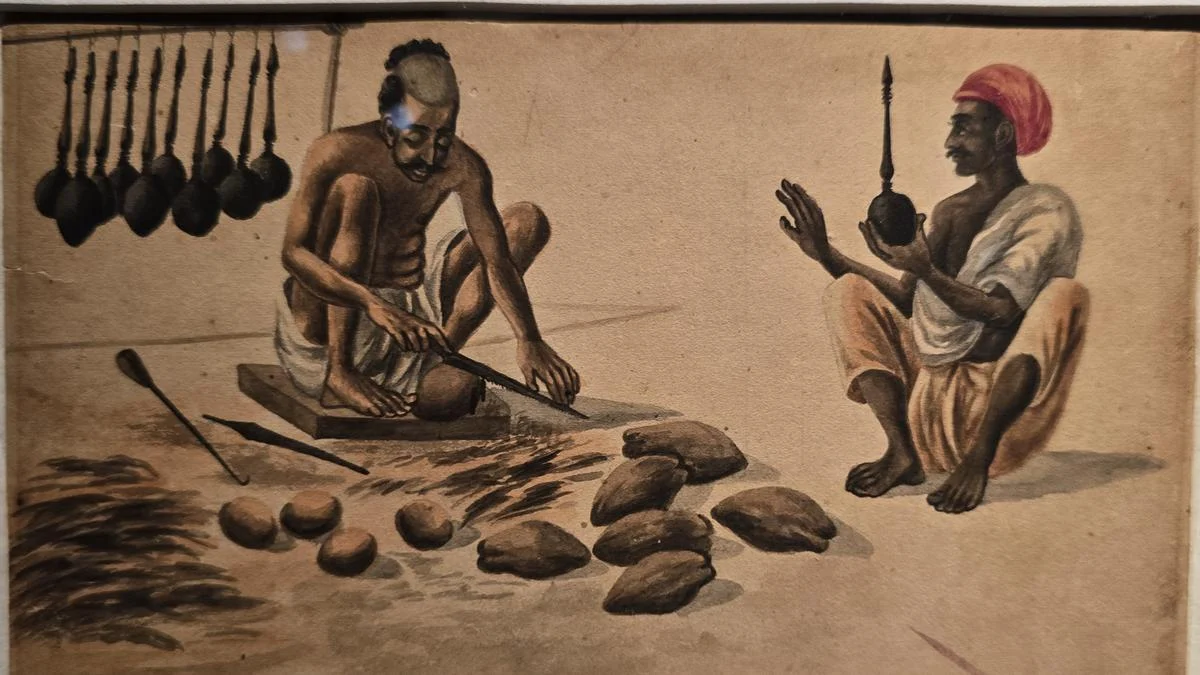
In the quiet, delicate strokes of an 18th-century watercolor, a history of the ordinary unfolds. There are no grand coronations here, no divine deities, and no sprawling battlefields. Instead, one finds the stark, honest image of two men in dhotis working diligently in a distillery. In another frame, a woman dressed in a vibrant blue-and-yellow ghaghra and dupatta dances in a palace hall, her movements captured in a pre-photographic freeze-frame while musicians play in the periphery.
These artworks are the hallmarks of Patna Kalam, a unique Indian painting tradition that flourished in the 18th and 19th centuries. Once a thriving visual documentation of daily life in Bihar, the art form eventually faded into the shadows of history, eclipsed by the advent of photography and the mass production of lithographs. However, a recent surge of interest—catalyzed by high-profile exhibitions and state-led workshops—is bringing this "lost" school of art back into the public consciousness.

Main Facts: The Aesthetics of the Ordinary
Patna Kalam is often described as the world’s first independent school of painting that focused exclusively on the common man. While its contemporary styles, such as the Mughal or Rajput schools, were preoccupied with the lives of royalty and the supernatural, Patna Kalam turned its gaze toward the street. It captured vegetable sellers, blacksmiths, servants fetching groceries, and the nuanced rituals of the local bazaar.
Technical Characteristics
Technically, Patna Kalam is a sophisticated hybrid. It represents a stylistic synthesis where Mughal miniature precision meets European naturalism. According to Bhairav Lal Das, the Patna chapter convenor of the Indian National Trust for Art and Cultural Heritage (INTACH), the style employed the techniques of the "Company School of Painting" but remained intrinsically rooted in the culture of Patna.

The artworks are characterized by:
- Delicate Brushwork: The paintings were often executed directly with the brush without a pencil sketch, a technique known as Kajli Syahi.
- Pale, Bare Backgrounds: Unlike the ornate, busy backgrounds of Mughal art, Patna Kalam focuses entirely on the subject, leaving the background stark or minimally detailed to emphasize the human figure.
- Unique Mediums: While many works used imported paper, artists also painted on mica (locally known as abrak or sunmica). This gave the paintings a translucent, ethereal quality, especially when depicting subjects like a purdah-nasheen woman peeking from the red curtains of her palanquin.
- Naturalistic Color Palette: The colors were derived from natural sources—plants, minerals, and earths—blended to create realistic skin tones and fabric textures without the dramatic play of light and shadow found in Western oil paintings.
Chronology: From the Mughal Court to the Streets of Patna
The trajectory of Patna Kalam is a story of migration, adaptation, and eventual decline. Its roots are inextricably linked to the shifting political tides of 18th-century India.

The Migration (1750–1760)
As the Mughal Empire began to crumble in the mid-18th century, the royal court in Delhi could no longer sustain its vast guild of artists. These painters migrated in search of new patrons, moving first to Murshidabad in West Bengal under the Nawab’s patronage. However, the political upheaval following the Battle of Plassey in 1757 forced another exodus. By 1760, these artists began arriving in Patna, a thriving center of trade and a key outpost for the British East India Company.
The Golden Age (1790–1850)
In Patna, the artists found a new class of patrons: British officials and the rising Indian middle class. This period saw the rise of legendary artists like Sewak Ram and Hulas Lal. They pioneered the "firka" sets—series of small paintings depicting various occupations and social scenes. By the mid-19th century, the tradition was led by figures such as Shiva Lal and Shiva Dayal Lal, who managed organized workshops to meet the high demand from European collectors.

The Decline (Late 19th Century – 1947)
The decline of Patna Kalam was swift and multifaceted. The primary culprit was the invention of the camera. Photography offered a cheaper, faster, and more "accurate" way to document Indian life for the British. Simultaneously, the availability of cheap lithographs—many produced by Europeans like Charles D’Oyly—undercut the market for hand-painted works. By the time India gained independence in 1947, the last of the traditional Patna Kalam masters had either passed away or moved into other professions, leaving the art form to survive only in trunks and archives.
Supporting Data: Collections and Comparative Traditions
The survival of Patna Kalam today is largely due to the foresight of private collectors and the preservation efforts of international museums.

The Jalan Legacy
One of the most significant repositories of Patna Kalam is the Jalan collection, housed in the century-old Quila House (also known as Jalan House) in Patna. The collection was built by Dewan Bahadur Radha Krishna Jalan, a businessman who was so passionate about history that he famously purchased Napoleon’s bed during a 1935 trip to Europe.
His descendant, Aditya Jalan, recently opened "Planet Patna," a private museum that makes a portion of this collection accessible to the public for a nominal fee of ₹100. This is a significant shift, as many original Patna Kalam works remain locked in the administrative trunks of art colleges or are held in distant institutions like the British Museum and the Victoria & Albert Museum in London.

Comparison with Tikuli Art
To understand Patna Kalam’s struggle, it is often compared to Tikuli art, another tradition native to Patna. While Patna Kalam vanished from the public eye for decades, Tikuli art—known for its bright colors and use of enamel on hard surfaces—survived by evolving into a decorative craft for home décor and accessories.
Ashok Kumar Biswas, a Padma Shri awardee in 2024, notes that while Tikuli art is influenced by Patna Kalam, the latter’s reliance on high-level technical skill and its specific "Company School" aesthetic made it harder to mass-produce or adapt to modern commercial needs without losing its essence.

Official Responses: State-Led Revival Efforts
The Bihar government and cultural organizations have recognized that Patna Kalam is a vital part of the state’s heritage that is currently "surviving only behind glass."
The Bihar Museum Initiative
The Bihar Museum Biennale 2025 and the subsequent Patna Kalam: Ek Virasat exhibition (held between December 2025 and February 2026) marked a turning point. Anjani Kumar Singh, Director General of the Bihar Museum, expressed surprise at the overwhelming public interest. The museum now plans to:

- Establish a permanent gallery dedicated solely to Patna Kalam.
- Launch a "touring exhibition" model, similar to the successful Vaidehi Sita exhibition of 2024, to showcase the art across India and abroad.
- Recruit expert trainers to teach the technical skills of the tradition to a new generation of artists.
The Role of INTACH
INTACH’s Patna chapter has been instrumental in grassroots revival, organizing nine workshops since 2023. These workshops have targeted young fine arts students and traditional folk artists. Interestingly, instructors like Jitendra Mohan have observed that contemporary students often perform better at Patna Kalam than traditional Madhubani artists because the style requires a specific understanding of human anatomy and realistic proportions rather than symbolic patterns.
Implications: The Challenges of a Modern Renaissance
While the revival of interest is promising, the path to a sustainable future for Patna Kalam is fraught with challenges.

The Conflict of Pace
In the 18th century, Patna was a hub where artists could sit and observe the slow rhythm of life. Today’s Patna is a chaotic urban center. Aditya Kumar Singh, an architect and member of the Urban Sketchers community, points out the logistical difficulty: "Sketching a contemporary building takes half an hour, but a Patna Kalam painting requires three days of absolute dedication." In a fast-paced digital world, finding artists willing to commit to such a labor-intensive process is difficult.
Commercial Viability
For Patna Kalam to survive outside of a museum, it must find a market. Some designers, like Sunita Prakash of the textile company Bandhani, have begun integrating Patna Kalam motifs into block-printing and fabric design. This provides a "living" application for the art, though purists argue that the transition from mica and paper to fabric changes the fundamental nature of the school.

Educational Gaps
The fact that original paintings remain locked in storage at institutions like Patna University’s College of Arts and Crafts highlights a systemic issue. Students are often forced to learn from reference photobooks rather than studying the original brushstrokes. For a true renaissance, the "glass wall" between the public and the heritage must be dismantled.
Conclusion
Patna Kalam is more than just an aesthetic style; it is a historical record of a time when the common man became the protagonist of Indian art. The current efforts by the Bihar Museum, INTACH, and private collectors like the Jalans represent a critical rescue mission. Whether Patna Kalam can transition from a "hidden treasure" to a contemporary practice remains to be seen, but the renewed interest suggests that the world is finally ready to look back at the ordinary lives that these 18th-century masters so lovingly documented.
