

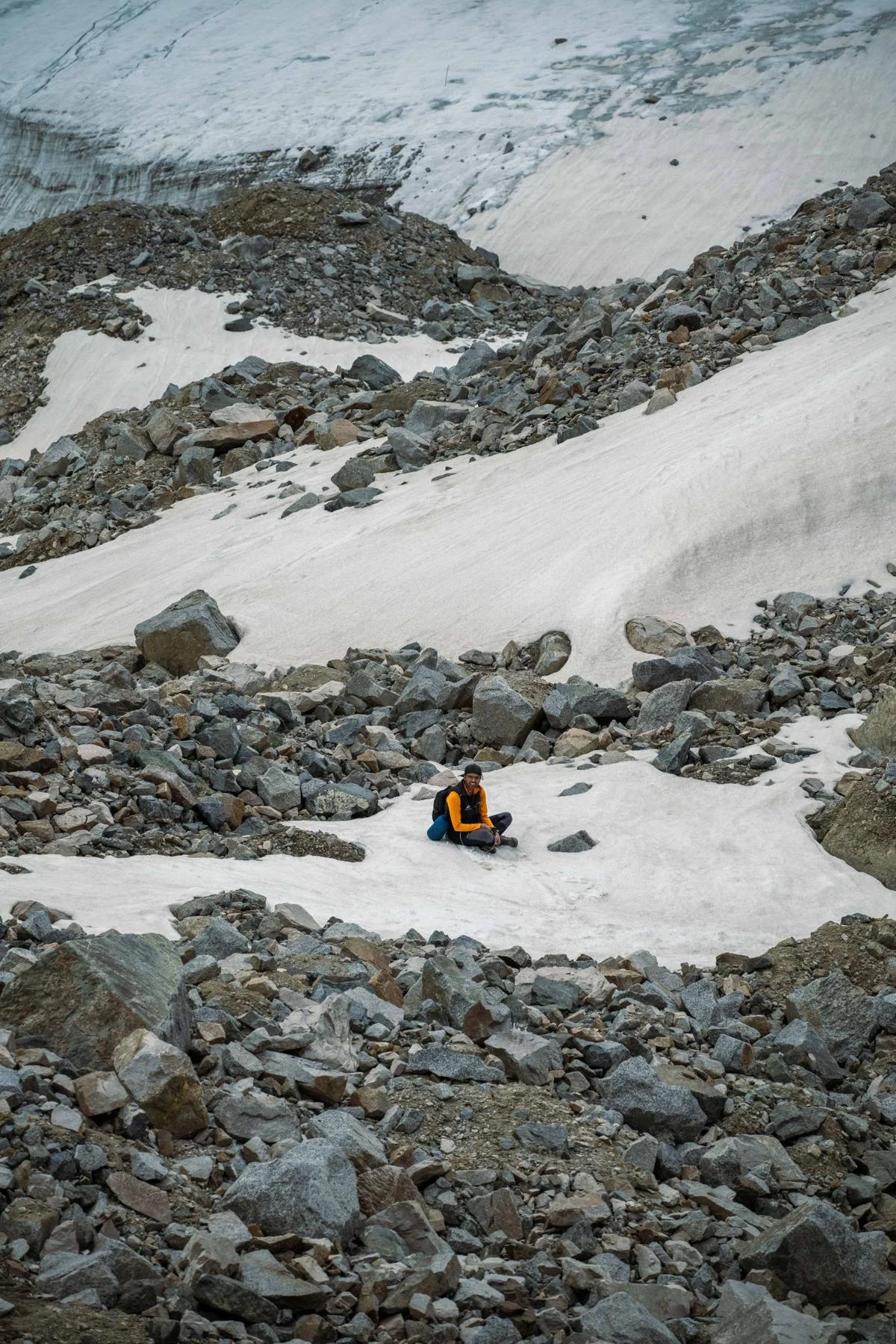
By [Your Name/Journalist Name]
In the high-altitude theater of the Himalayas, where the air is thin and the margin for error is non-existent, stories of survival are often told in whispers. Yet, the story of Anurag Maloo is not just a tale of human endurance against the elements; it is a profound narrative of resurrection with a singular, urgent purpose. Having survived a fall into a 70-meter deep crevasse on Mount Annapurna—an ordeal that left him clinically dead for nearly four hours—Maloo has emerged not as a victim of the mountains, but as their most fervent advocate.
Through his newly established "The Voice of Glaciers Foundation" (TVGF), Maloo is pivoting from the personal victory of survival to a global battle against the catastrophic melting of the world’s "Third Pole." His mission is clear: to ensure that the frozen giants that nearly claimed his life do not disappear, taking the water security of billions with them.
The Anatomy of a Miracle: A Chronology of Survival
The events of April 2023 remain etched in the annals of mountaineering history as one of the most improbable rescues ever recorded. Anurag Maloo, an experienced social impact professional and mountaineer, was attempting to summit Mount Annapurna, the world’s tenth-highest peak and arguably its most dangerous.
The Descent and the Disappearance
On April 17, 2023, Maloo was approximately 150 meters from the summit when worsening weather conditions forced a difficult decision: to turn back. During the descent from Camp 3, at an altitude of nearly 6,000 meters, a momentary lapse—clipping into the wrong fixed rope—led to a catastrophic fall. Maloo vanished into a crevasse, a jagged, lightless wound in the glacier’s surface.

For 72 hours, Maloo remained trapped 70 meters deep within the glacier’s "frozen gut." In temperatures plummeting to -40°C, without food, water, or any means of communication, he waited. His only companion was his GoPro camera, which he used to record his final thoughts, documenting a harrowing vigil in the dark.
The Rescue and the Medical Resurrection
On the fourth day, a specialized team of Polish rescuers, including renowned climbers Adam Bielecki and Mariusz Hatala, along with a dedicated team of Nepali Sherpas, located Maloo. They performed a daring technical extraction, pulling his unresponsive body from the depths of the ice.
When he arrived at the hospital in Pokhara, the outlook was grim. Doctors declared him clinically dead; his heart had stopped, and his body temperature was dangerously low. However, in a feat of medical tenacity, a team of doctors performed cardiopulmonary resuscitation (CPR) for nearly four hours. This extraordinary effort succeeded in restarting his heart, marking one of the longest successful CPR interventions in documented medical history.
Maloo’s recovery was a slow, grueling process involving multiple surgeries and months of rehabilitation. His case has since become a landmark in wilderness medicine, featured in prestigious publications such as the Air Medical Journal and ScienceDirect.
The Foundation Built on Ice: From Reflection to Action
For Maloo, the months spent in hospital beds were not merely for physical recuperation but for existential reflection. "In the hospital, I realized that this life doesn’t just belong to me but is meant for something larger than myself," he recalls. That "something larger" manifested in 2025 as The Voice of Glaciers Foundation (TVGF).

The foundation is built on the premise that glaciers are the world’s most vital, yet most ignored, infrastructure. For millions across South Asia, these ice masses are "upstream water towers" that regulate river flows, sustain agriculture, and power the hydropower systems that drive modern economies.
The Three Pillars of TVGF
To address the glacial crisis, Maloo has outlined three strategic objectives for the foundation:
- Public Consciousness: Moving glaciers from scientific abstractions to the forefront of public attention. Through glacier festivals, art installations, and awareness campaigns, TVGF seeks to make the ice relevant to the urban dweller whose drinking water depends on mountain runoff.
- Digital Public Infrastructure: Recognizing the need for data-driven solutions, the foundation is developing glacier risk intelligence platforms. This includes multi-hazard warning systems, glacier monitoring tools, and "digital twins" of glacier systems to predict and mitigate the impact of GLOFs (Glacial Lake Outburst Floods).
- Capital Mobilization: Maloo aims to bring Corporate Social Responsibility (CSR) and philanthropic capital into the fold of mountain ecosystem preservation. His goal is to elevate glacier conservation to the same level of priority as forestation, ocean health, and air quality.
Supporting Data: The Stark Reality of a Melting World
The urgency of Maloo’s mission is underscored by chilling scientific data. The Himalayas, which contain the largest volume of ice outside the polar regions, are melting at an unprecedented rate.
- Massive Ice Loss: Himalayan glaciers have lost more than 40% of their ice volume since the year 2000.
- Doubling Decay: Across the Hindu Kush Himalaya (HKH) region, the rate of ice loss has doubled in the last two decades compared to the period between 1970 and 2000.
- The 2100 Deadline: Current projections suggest that if global warming continues at its present trajectory, up to 75% of the glaciers in the Hindu Kush Himalaya could disappear by the end of the century.
- Downstream Impact: The retreat of these glaciers threatens the water security of nearly 2 billion people who live in the river basins of the Indus, Ganges, and Brahmaputra.
Maloo’s perspective is uniquely poignant: "I was fortunate to have those 72 hours [in the crevasse]. But probably these glaciers may not even have 72 years."
Official Responses and Global Recognition
The significance of Maloo’s survival and his subsequent advocacy has not gone unnoticed by the international community. In 2025, he was named a Young Global Leader by the World Economic Forum (WEF), a testament to his potential to influence global policy and environmental stewardship.

Medical and Scientific Community
The medical community continues to study Maloo’s case as a "miracle of modern resuscitation." Experts in hypothermia and high-altitude medicine point to his recovery as a catalyst for rethinking the limits of human viability in extreme conditions.
Environmental Policy Advocates
Climate scientists have lauded the formation of TVGF for its focus on "actionable community intelligence." By translating complex satellite and AI data into tools that local communities can use to prepare for floods or water shortages, Maloo is bridging the gap between high-level science and grassroots survival.
Implications: A Civilizational Emergency
The implications of Anurag Maloo’s mission extend far beyond the borders of Nepal or India. The melting of the world’s glaciers is not a "mountain problem"; it is a civilizational emergency.
Water and Food Security
As glaciers retreat, the seasonal flow of rivers becomes unpredictable. Initial increases in meltwater lead to flooding, followed by long-term "peak water" scenarios where river levels drop significantly. This threatens the agricultural output of the Indo-Gangetic plain, one of the world’s most productive breadbaskets.
Geopolitical Stability
Water scarcity is a known driver of conflict. In South Asia, where multiple nuclear-armed nations share river systems originating in the Himalayas, the disappearance of glaciers could lead to unprecedented regional instability. Maloo’s work in mobilizing capital and data seeks to provide the transparency needed for cooperative water management.

The Role of Technology
TVGF’s emphasis on "Digital Twins" and AI-driven monitoring represents a new frontier in climate adaptation. By creating virtual models of glaciers, scientists can simulate the impact of rising temperatures and provide early warnings to downstream populations, potentially saving thousands of lives from sudden glacial lake collapses.
Conclusion: The Survivor’s Responsibility
Anurag Maloo’s journey from the depths of an Annapurna crevasse to the halls of the World Economic Forum is a story of "survivor’s responsibility." During his long recovery, when even standing seemed an insurmountable task, Maloo focused on the "next immediate step."
Today, that step is ensuring that the global community does not look away from the melting ice. TVGF serves as a bridge between the harrowing silence of the glacier’s gut and the noisy urgency of climate policy. It takes a man who has been "clinically dead" to remind a complacent world that its life-support system—the glaciers—is currently on the brink of failure.
The ice is melting in plain sight. Through Maloo’s voice, the glaciers are finally speaking back. The question remains whether the world will listen before the silence becomes permanent.
