

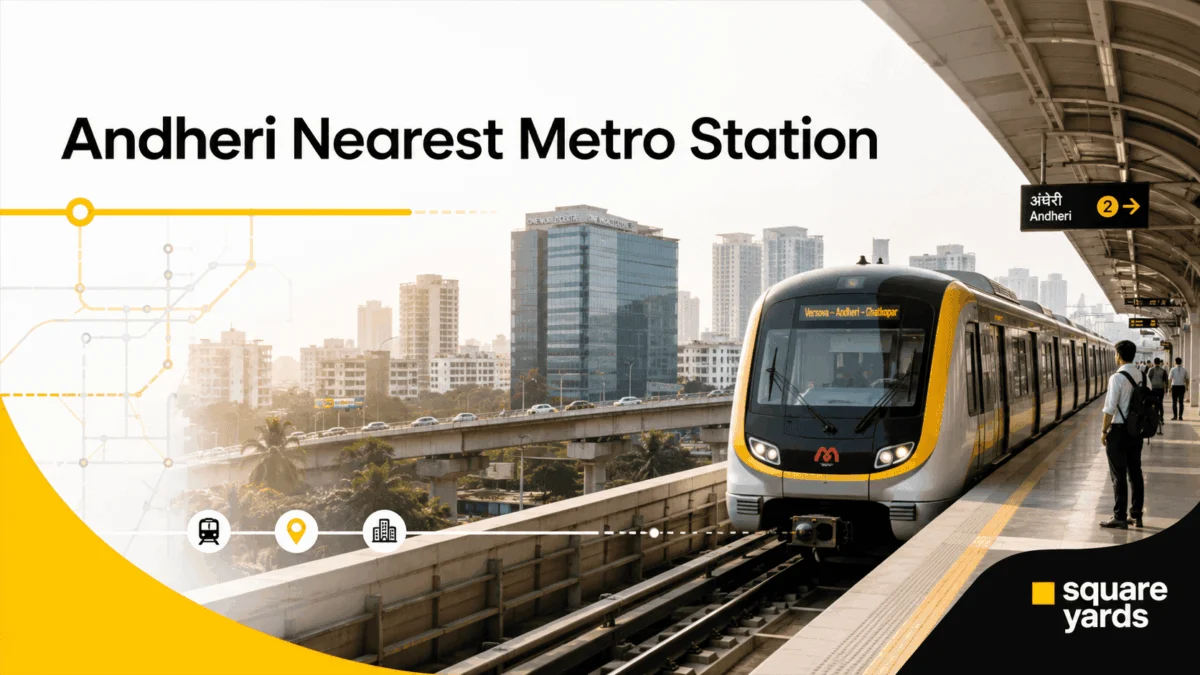
Andheri, a sprawling microcosm of Mumbai, represents the city’s transition from a collection of residential suburbs to a sophisticated, multi-polar urban center. Once regarded primarily as a dormitory town for the south-bound workforce, Andheri has evolved into what urban planners describe as a "second downtown." Today, it serves as a high-octane engine for the city’s economy, housing corporate behemoths in the East, a thriving media and film industry in the West, and a hospitality sector that remains active long after the traditional workday ends.
What anchors this massive socio-economic engine is its infrastructure. Andheri stands as one of the few metropolitan pockets in India where three distinct metro lines converge with two major suburban railway networks (Western and Central). This article provides an in-depth analysis of Andheri’s metro ecosystem, its chronological development, and the far-reaching implications for the city’s real estate and commercial landscape.
1. Main Facts: The Multi-Modal Hub of Mumbai
The defining characteristic of Andheri’s current infrastructure is the "Transit-Oriented Development" (TOD) model. Unlike other suburbs that rely on a single artery, Andheri is served by a web of connectivity that facilitates both East-West and North-South movement.
The Connectivity Matrix
Currently, four key metro stations act as the primary gateways to the suburb:
- Andheri (Line 1 – Blue Line): The central interchange connecting the Metro to the Western Railway.
- Andheri West (Line 2A – Yellow Line): The southern terminus of the line serving the northern residential belt.
- D.N. Nagar (Interchange): The vital junction where the Blue and Yellow lines meet.
- Gundavali (Line 7 – Red Line): The gateway to the Western Express Highway (WEH) and the commercial hubs of SEEPZ and MIDC.
Quick Reference: Metro Access in Andheri
| Metro Station | Metro Line | Primary Location | Best For |
|---|---|---|---|
| Andheri | Line 1 (Blue) | Andheri East (Railway Stn) | Inter-suburban travel and Railway transfer |
| Andheri West | Line 2A (Yellow) | Near Yari Road / Link Road | Residents of Lokhandwala and Versova |
| D.N. Nagar | Lines 1 & 2A | Andheri West (Link Road) | Switching between East-West and North-South lines |
| Gundavali | Line 7 (Red) | Andheri East (WEH) | Accessing Goregaon, Dahisar, and SEEPZ |
| Marol Naka | Line 1 (Blue) | Andheri East (Marol) | Corporate parks and upcoming Metro 3 interchange |
2. Chronology: From Road Congestion to Rail Seamlessness
The evolution of Andheri’s metro network is a decade-long saga of engineering and urban renewal.
2014: The Blue Line Breakthrough
The inauguration of Metro Line 1 (Versova-Andheri-Ghatkopar) in June 2014 was a seminal moment. Before this, the East-West commute in Andheri was a notorious bottleneck, often taking 60 to 90 minutes via the Andheri-Kurla Road. The Blue Line slashed this to 21 minutes. The construction of the Andheri Metro Station—physically connected to the Western Railway station via a skywalk—set the standard for multi-modal integration in India.
2022–2023: The North-South Expansion
For nearly nine years, the Blue Line operated as an isolated East-West corridor. This changed in 2022 and early 2023 with the commissioning of Line 2A (Yellow Line) and Line 7 (Red Line).
- Phase 1 (April 2022): Partial operations began in the northern stretches.
- Phase 2 (January 2023): The full corridors were opened, finally connecting Andheri West to Dahisar (Line 2A) and Gundavali to Dahisar (Line 7). This effectively bypassed the over-congested Western Railway for those traveling within the western suburbs.
3. Supporting Data: Operational Dynamics and Efficiency
To understand why Andheri is the most sought-after transit hub, one must look at the operational data that keeps the suburb moving.
Metro Timings and Frequency
The Mumbai Metro operates with high-frequency intervals designed to cater to the "rush hour" culture of the corporate world.
| Metro Line | First Train | Last Train | Peak Frequency | Off-Peak Frequency |
|---|---|---|---|---|
| Line 1 (Blue) | 5:30 AM | ~11:50 PM | 3.5 Minutes | 6-8 Minutes |
| Line 2A (Yellow) | 5:55 AM | 11:00 PM | 6-8 Minutes | 10 Minutes |
| Line 7 (Red) | 5:30 AM | 11:00 PM | 6-8 Minutes | 10 Minutes |
Note: Timings are subject to operational adjustments by MMMOCL.
The "Last-Mile" Ecosystem
Data suggests that a metro station’s utility is only as good as its last-mile connectivity. In Andheri, this is facilitated by:
- The Skywalk System: The 600-meter skywalk at Andheri Station allows thousands of commuters to transition from the Western Railway to the Blue Line without touching the ground level, avoiding the chaotic traffic of Andheri East.
- BEST Feeder Routes: The Brihanmumbai Electric Supply and Transport (BEST) has synchronized several bus routes to terminate at D.N. Nagar and Gundavali.
- The Rickshaw Hubs: Andheri West and East stations host the city’s largest organized auto-rickshaw stands, catering to interior localities like Seven Bungalows, Lokhandwala, and MIDC.
4. Official Responses and Urban Planning Perspectives
The Maha Mumbai Metro Operation Corporation Ltd (MMMOCL) and the MMRDA (Mumbai Metropolitan Region Development Authority) have frequently highlighted Andheri as the "proof of concept" for integrated urban mobility.
According to MMRDA officials, the goal was never just to build tracks but to create a "seamless commute." In official statements during the Phase 2 launch of Lines 2A and 7, authorities emphasized that the convergence in Andheri was designed to reduce the load on the Western Express Highway by at least 25%.
Urban planners note that the success of Andheri’s metro lies in its Interchange Strategy:
- The D.N. Nagar Interchange: Designed to handle a footfall of over 100,000 daily, this station allows a commuter from Dahisar to reach Ghatkopar with a single, air-conditioned switch.
- The WEH Junction: The proximity of Gundavali (Line 7) to the Western Express Highway Metro station (Line 1) creates a secondary East-West-North-South grid that services the airport-adjacent commercial belt.
5. Implications: Real Estate, Economy, and Lifestyle
The enrichment of the metro network has fundamentally altered the socio-economic fabric of Andheri.
Real Estate: The "Metro Premium"
The "Nearest Metro Station to Andheri" has become the primary search filter for home buyers and commercial tenants.
- Andheri West (The Residential Gold Standard): Localities like Lokhandwala and Versova have seen a sustained price appreciation of 15-20% since the completion of Line 2A. The ability to reach the northern suburbs without facing the traffic at Juhu Circle has made these areas more attractive to high-net-worth individuals.
- Andheri East (The Commercial Powerhouse): In the East, the metro has democratized the workforce. Employees living as far as Ghatkopar or Dahisar can now reach SEEPZ or MIDC in under 40 minutes. This has led to a surge in demand for "Grade A" office spaces, with rental yields in Andheri East remaining among the most stable in Mumbai.
The Shift in Commuter Behavior
The metro has triggered a cultural shift. Historically, Andheri residents were divided by the "East-West Divide"—the railway tracks acted as a barrier. The Blue Line effectively erased this. Today, it is common for a professional to work in an IT park in Andheri East and dine in a cafe in Versova (West), a transition that takes less than 15 minutes by metro but would take an hour by car.
Future Implications: Metro Line 3 (The Aqua Line)
The next phase of Andheri’s evolution is the upcoming Line 3 (Colaba-Bandra-SEEPZ). This underground line will provide Andheri with direct connectivity to the financial district of BKC and South Mumbai. When the Marol Naka and SEEPZ stations become operational on this line, Andheri will arguably become the most connected 30-square-kilometer patch of land in South Asia.
Conclusion: A Blueprint for the Future
Andheri is no longer just a suburb; it is a case study in how transit infrastructure can reinvent a city. By integrating three metro lines with the existing railway backbone, Andheri has solved the "last-mile" and "cross-town" puzzles that plague most Indian metros.
Whether you are a professional navigating the corporate corridors of MIDC, a creative in the studios of Lokhandwala, or an investor looking for the next growth pocket, the metro system is the common denominator. As Mumbai continues to expand, Andheri’s model of multi-modal convergence stands as a blueprint for the future of urban India—proving that when you move people efficiently, the economy and lifestyle of the region follow suit.
Frequently Asked Questions
- Which station is best for the International Airport?
Gundavali (Line 7) and Airport Road (Line 1) are the primary access points, though a short rickshaw ride is still required for the final terminal approach. - How do I switch from the Yellow Line to the Blue Line?
The most efficient interchange is at D.N. Nagar Station in Andheri West. - Is the metro faster than the local train?
For North-South travel (e.g., Borivali to Andheri), the "Fast" local train is often quicker, but the Metro offers superior comfort, air conditioning, and better proximity to the Western Express Highway and Link Road.
