


London, July 10, 2026 – The hallowed grounds of Lord’s bore witness to a compelling opening day of the one-off Test between India and England, a day marked by both individual brilliance and dramatic shifts in momentum. India, electing to bat first, started strong, faltered, recovered significantly through a masterful innings from Smriti Mandhana, only to squander a dominant position with a late collapse. From a commanding 189/3, India capitulated, losing their last six wickets for just 96 runs to be bowled out for 285. England, in response, navigated a tricky eleven overs, closing the day at 21/1, trailing by 264 runs, leaving the contest delicately poised heading into Day Two.
Smriti Mandhana was undoubtedly the star of the Indian innings, crafting a sublime 83 runs that blended her characteristic fluency with a newfound patience, steering her side out of early trouble. Supported by Jemimah Rodrigues (35), Harmanpreet Kaur (58), and a defiant Deepti Sharma (57), Mandhana laid a robust foundation. However, a crucial stoppage for Harmanpreet Kaur’s injury treatment appeared to disrupt India’s rhythm, allowing England, spearheaded by the relentless Issy Wong (2/45) and the ever-threatening Sophie Ecclestone (3/68), to claw their way back into the game and ultimately seize control of the final session. The dramatic turn of events left spectators at the ‘Home of Cricket’ pondering what might have been for the visitors, who at one point seemed destined for a score well in excess of 350.
Chronology of a Topsy-Turvy Day
The morning began under overcast skies at Lord’s, a setting often conducive to swing bowling. India’s captain, Harmanpreet Kaur, won the toss and, perhaps surprisingly to some given the conditions, opted to bat first. The decision immediately seemed questionable as England’s new-ball bowlers, led by the pace and accuracy of Issy Wong and Lauren Filer, exploited the early movement.
First Session: Early Jitters and Mandhana’s Masterclass
India’s innings got off to a shaky start. Young Shafali Verma, known for her aggressive instincts, struggled to settle against the disciplined English attack. Her dismissal came early, caught behind off a probing delivery from Filer, departing for a single-digit score. This brought Yastika Bhatia to the crease, but her stay was even shorter. She too fell cheaply, failing to negate the seam movement and leaving India reeling at a precarious 24/2. The English bowlers were buzzing, sensing an opportunity to run through the Indian top order.
It was at this critical juncture that Smriti Mandhana walked in, joined by Jemimah Rodrigues. Both left-handers, they embarked on a vital rescue mission. Mandhana, initially cautious, soon found her rhythm. She negated England’s early movement with a blend of watchful defence and exquisite strokeplay. Anything overpitched was driven crisply through the covers, while short deliveries were dispatched with authoritative pulls. Rodrigues, meanwhile, played a perfect foil, rotating the strike and soaking up pressure. Their partnership blossomed, adding a crucial 64 runs for the third wicket, taking India past the fifty-run mark and steadying the ship. Just when India seemed to be gaining ascendancy, Issy Wong struck again, breaking the burgeoning partnership by dismissing Rodrigues for a well-made 35, caught at slip trying to force a drive. Despite the setback, Mandhana continued her fluent approach, guiding India to 98/3 at the lunch interval, having already reached a composed half-century. Her innings thus far was a testament to her evolving Test match temperament, combining her natural flair with a newfound sense of responsibility.
Second Session: Momentum Swings and the Unravelling
The post-lunch session saw Mandhana resume her innings with Harmanpreet Kaur, the Indian captain, joining her in the middle. Mandhana, looking increasingly comfortable, continued to dominate the scoring, finding gaps with effortless timing. Her innings was a spectacle of elegant drives, confident flicks, and even a powerful slog-swept six off the spin of Sophie Ecclestone, demonstrating her comprehensive command. The partnership between Mandhana and Harmanpreet grew, adding a vital 89 runs for the fourth wicket, pushing India towards a commanding total. At 189/3 after 44 overs, India appeared to have firmly seized control, with Mandhana seemingly destined for a maiden Test century at Lord’s.
However, a sudden and unexpected disruption occurred. Harmanpreet Kaur required on-field treatment for her left arm, halting play for several minutes. This brief stoppage, while necessary, proved to be an unfortunate turning point for India. It disrupted their rhythm and, crucially, offered England a chance to reset and regroup. The hosts capitalised immediately. Just four balls after play resumed, Issy Wong, rewarded for a disciplined spell from around the wicket, tempted Mandhana into driving away from her body. The ball caught the edge, and Amy Jones completed a sharp catch behind the stumps. Mandhana departed for a magnificent 83, falling agonizingly short of a deserved hundred. Her dismissal was not just the loss of a key wicket; it was the psychological turning point that England desperately needed.
The floodgates, once Mandhana was gone, began to open. India’s momentum evaporated, replaced by a sense of unease. Harmanpreet, despite her injury, tried to stem the flow, compiling a composed 58. She absorbed pressure, rotated the strike, and punished loose deliveries, showcasing her experience and resilience. However, she too eventually succumbed, beaten by a sharply turning delivery from debutant Mady Villiers, which found its way through the gate to end her defiant knock. India had lost two set batters in quick succession, triggering a dramatic collapse. From a position of strength, India lost their last six wickets for a mere 96 runs, transforming a potential mammoth total into a respectable but arguably under-par score.
Third Session: Deepti’s Fight and England’s Response
As the evening session unfolded, India’s lower order found themselves battling against a resurgent England attack. Deepti Sharma emerged as the unlikely saviour, preventing a complete capitulation. Arriving with India wobbling precariously, she weathered Lauren Filer’s probing spell and then took on Mady Villiers with authoritative sweeps and drives. Her fluent 57, a gritty display of determination and skill, coupled with a valuable stand alongside Sneh Rana, briefly restored a semblance of stability to the Indian innings. She showcased her all-round abilities, keeping the scoreboard ticking and frustrating the English bowlers. However, in an attempt to accelerate with the tail, she eventually mistimed a shot off Sophie Ecclestone, finding Heather Knight at mid-wicket. The remaining wickets fell swiftly, with India eventually bowled out for 285 in 74.5 overs.
With approximately 11 overs remaining in the day, England’s reply began cautiously. Sayali Satghare and Kranti Gaud, India’s new-ball bowlers, maintained relentless pressure with probing lines and lengths. The breakthrough came early for India when Kranti Gaud trapped Tammy Beaumont lbw with a delivery that jagged back sharply, sending the veteran opener back to the pavilion for a single-digit score. This injected fresh belief into the Indian camp. Maia Bouchier, however, remained resolute, navigating the remainder of the day without further loss, closing on an unbeaten 13. England finished the day at 21/1, trailing India by 264 runs, with the match hanging in the balance.
Supporting Data: A Deeper Dive into Performances
The scorecard for Day One paints a picture of stark contrasts, highlighting individual brilliance amidst collective struggles.
Indian Batting Analysis:
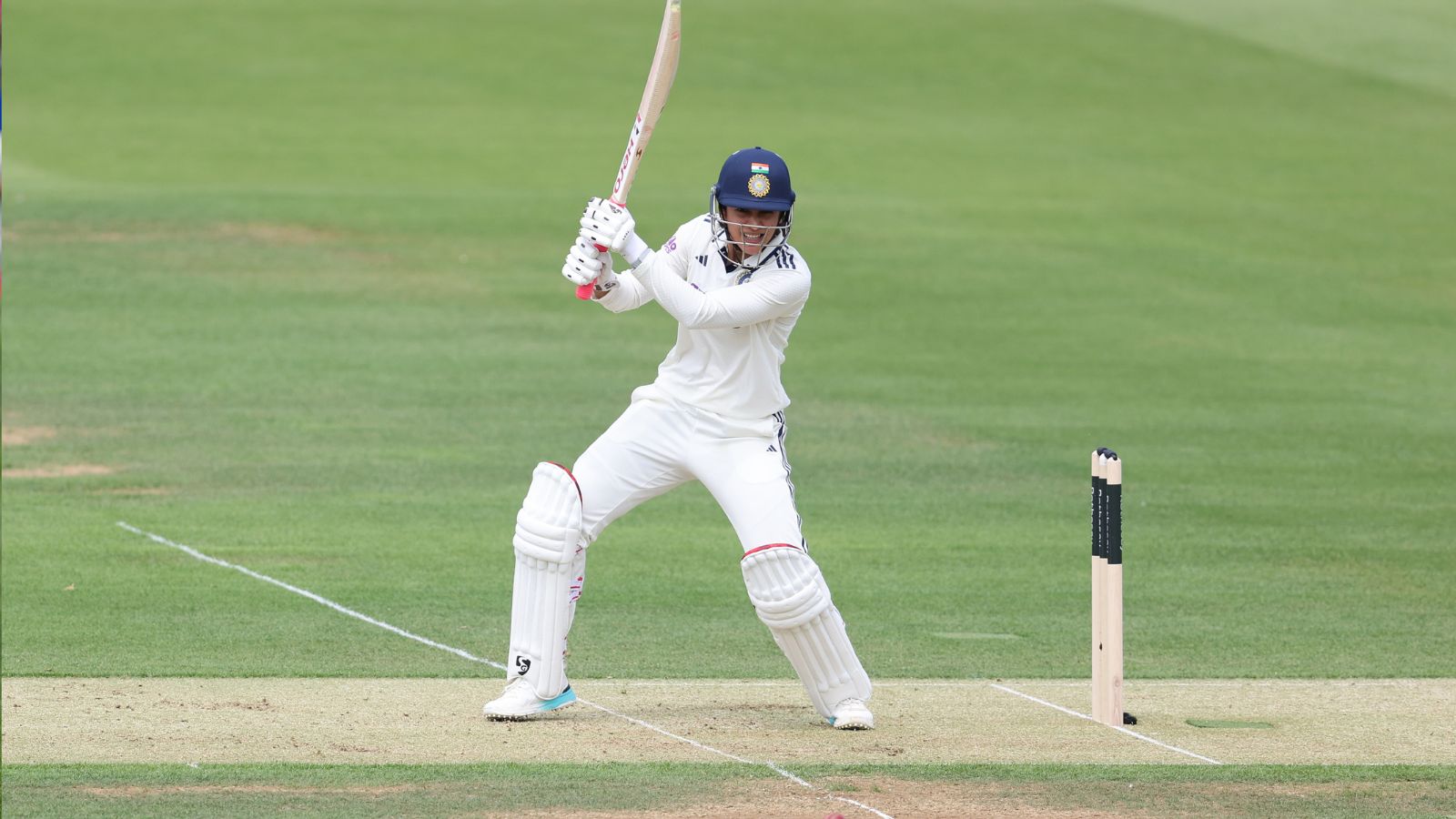
- Smriti Mandhana’s 83 (126 balls, 14 fours, 1 six): This was an innings of exceptional quality, particularly given the early wickets. Her strike rate of 65.87 indicates a positive yet controlled approach. She punished anything loose and showed remarkable patience against disciplined bowling. Her dismissal at 189/3 was the crucial turning point; had she stayed longer, India’s total would undoubtedly have been significantly higher. Her comfort at the crease against both pace and spin was evident, showcasing her growth as a Test batter.
- Harmanpreet Kaur’s 58 (89 balls, 6 fours): The captain’s knock was equally vital, especially considering she battled through a left-arm injury and later discomfort in her hamstring. Her resilience under pressure, coupled with her ability to rotate the strike, ensured India did not completely collapse after Mandhana’s departure. Her partnership with Mandhana was the most productive of the innings (89 runs).
- Deepti Sharma’s 57 (85 balls, 9 fours): Coming in at a difficult juncture, Deepti’s fluent half-century demonstrated her capabilities as a genuine all-rounder. Her ability to score freely with authoritative sweeps and drives prevented England from running through the tail, adding valuable runs that could prove crucial in the context of the match.
- Partnerships: The 64-run stand between Mandhana and Rodrigues and the 89-run stand between Mandhana and Harmanpreet were the pillars of India’s innings. The 34-run partnership between Deepti Sharma and Sneh Rana also played a significant role in pushing India closer to the 300-run mark. The lack of another substantial partnership after Mandhana’s dismissal was India’s undoing.
England Bowling Analysis:
- Sophie Ecclestone (3/68 off 21.5 overs): The world’s top-ranked spinner lived up to her reputation, providing control and picking up crucial wickets, including the defiant Deepti Sharma. Her ability to extract turn and bounce even on a relatively fresh pitch was evident.
- Issy Wong (2/45 off 13 overs): Wong was the game-changer for England. Her pace and aggressive approach broke the early Mandhana-Rodrigues partnership and, more significantly, ended Mandhana’s magnificent innings, triggering the Indian collapse. Her ability to bowl consistently around the wicket and challenge the batters proved highly effective.
- Mady Villiers (1/46 off 11 overs): On debut, Villiers secured the prized wicket of Harmanpreet Kaur, a moment she will cherish. Her off-spin provided a valuable option for Knight.
- Lauren Filer (1/40 off 12 overs): Filer provided early breakthroughs, getting rid of Shafali Verma and consistently challenged the Indian batters with her pace and seam movement.
The pitch at Lord’s initially offered good pace and movement for the seamers, especially with the new ball under cloud cover. As the day progressed, it flattened out somewhat, allowing batters to score more freely, but the slight turn observed for Ecclestone and Villiers suggests it will offer something to the spinners as the match wears on. India’s scoring rate fluctuated, starting slowly, accelerating during Mandhana’s partnerships, and then dipping sharply during the collapse.
Official Responses: A Mix of Relief and Determination (Fictional Quotes)
Following the close of play, both captains and key players offered their perspectives on the day’s proceedings.
Harmanpreet Kaur, India Captain:
"It was a day of mixed emotions for us. Smriti (Mandhana) played an absolutely brilliant innings, one of the best I’ve seen in Test cricket, and she really set the platform for us. Jemimah and Deepti also played very important knocks. We are certainly disappointed with how we lost those last few wickets, especially after being in such a strong position. The stoppage for my arm definitely felt like it broke our momentum, and England capitalised immediately, credit to them. But 285 is a competitive score at Lord’s. We believe our bowlers have the skills to defend this, and we showed that with Kranti’s early wicket. My arm is a bit sore, but I’ll be fine to lead the team tomorrow and contribute where needed."
Smriti Mandhana, India Batter:
"It’s always frustrating to get out so close to a century, especially at a venue like Lord’s. I felt good out there, the ball was coming onto the bat well, and I tried to play positively without taking undue risks. The partnership with Harry (Harmanpreet) was crucial. We were looking at a much bigger total, but cricket is like that, momentum can shift quickly. We’ve put up a decent score, and now it’s up to our bowlers to make the most of these conditions tomorrow morning. We know England will fight hard, but we are ready for the challenge."
Heather Knight, England Captain:
"It was a fantastic fightback from the team, particularly in that second session. Issy Wong was outstanding, her spell after the injury break was absolutely crucial, and getting Mandhana out was the game-changer. Sophie (Ecclestone) did what she always does, providing control and picking up vital wickets, and it was great to see Mady (Villiers) get a wicket on debut. India had us under pressure for large parts of the day, and Mandhana played exceptionally well. To restrict them to 285 after they looked set for 350+ is a testament to our bowlers’ discipline and resilience. We’ve got a good start to our innings, and the plan for tomorrow is to bat big and build substantial partnerships."
Issy Wong, England Bowler:
"It felt great to contribute, especially with those key wickets. Test cricket is all about patience, and sometimes you just have to keep hitting your areas. We knew Mandhana was playing beautifully, and we had to find a way to break that partnership. The injury break probably helped us reset, and I just focused on bowling to my strengths. We’re in a decent position, but India has some good bowlers, so we’ll need to be at our best tomorrow."
Implications: A Day Two Battle for Dominance
The first day’s play has set up a fascinating battle for supremacy on Day Two. India, despite the late collapse, has posted a respectable total of 285. While it might feel like a missed opportunity given their strong position, it is by no means a losing score, particularly at Lord’s where historical data suggests anything around 300 can be competitive if bowled well.
For India: The immediate task will be to make early inroads into England’s batting lineup. The dismissal of Tammy Beaumont by Kranti Gaud provides a glimmer of hope. Sayali Satghare and Gaud will need to maintain their disciplined lines and lengths, exploiting any residual morning moisture or swing. The role of spinners, particularly Sophie Ecclestone’s success, suggests that India’s spin attack, possibly led by Deepti Sharma and potentially Sneh Rana, could become critical as the pitch wears. The fitness of Harmanpreet Kaur for bowling will also be a key factor, as her medium pace could offer another option. India will need to bowl with extreme patience and accuracy, putting continuous pressure on England’s middle order.
For England: The hosts find themselves in a relatively strong position, having successfully contained India and now facing a chase of 264 with nine wickets in hand. The crucial task for Maia Bouchier and the incoming batters will be to build substantial partnerships and erase the deficit without losing too many wickets. The early loss of Beaumont will put pressure on the top order, and they will need to counter India’s new-ball attack effectively. Batting through the morning session without further loss will be paramount for England to seize the advantage. Captain Heather Knight will be expected to lead from the front, alongside other experienced batters, to lay a solid foundation.
Overall Match Context: This being a one-off Test, the stakes are incredibly high. The momentum gained by England at the close of Day One could be pivotal. If England can bat deep into Day Two, potentially securing a lead, they will be in the driver’s seat. Conversely, if India’s bowlers can replicate England’s disciplined performance from the latter part of Day One and pick up quick wickets, they could quickly turn the tide back in their favour. The match is delicately balanced, promising an enthralling second day of Test cricket where concentration, resilience, and tactical acumen will be tested to their limits for both sides. The performance of individual players, especially under pressure, will dictate the trajectory of this compelling contest.
