

New Delhi, July 20, 2026 – The United Kingdom’s higher education sector is experiencing an unprecedented surge in demand, with official figures from the Universities and Colleges Admissions Service (UCAS) revealing a record-breaking number of undergraduate applications for the 2026 admissions cycle. This significant increase is largely propelled by a robust rise in international student interest, with India cementing its position as the second-largest source country for overseas applicants, trailing only China.
The latest data indicates a palpable enthusiasm among students globally to pursue higher education in the UK, underscoring the nation’s enduring appeal as a premier academic destination. The substantial growth in applications, particularly from international students, signifies a positive trend for UK universities, which are vital contributors to the country’s knowledge economy and cultural landscape.
Record-Breaking Application Numbers Signal Strong Global Interest
In 2026, a staggering 695,740 students submitted applications through UCAS for undergraduate admissions, marking a notable increase of 4.6% from the 665,070 applications received in the preceding year. This overall rise is significant, but it is the international segment that has truly set new benchmarks.
International applications witnessed a remarkable year-on-year surge of 7.1%, reaching a historic high of 148,350. This substantial growth among overseas applicants significantly outpaced that of domestic applicants, suggesting a widening global recognition of the quality and diversity of UK educational offerings. The addition of nearly 10,000 international applicants in a single admission cycle highlights the growing attractiveness of UK universities on the world stage.
This upward trajectory for international applications is not a recent phenomenon but rather a continuation of a sustained, decade-long trend. Back in 2017, international applications stood at 120,080. Over the past ten years, despite minor fluctuations in some admission cycles, the overall demand from international students has steadily climbed, culminating in the record figures observed this year. This consistent growth points to the UK’s strong and sustained reputation for academic excellence and research innovation.
China Leads the Pack, India’s Growing Influence
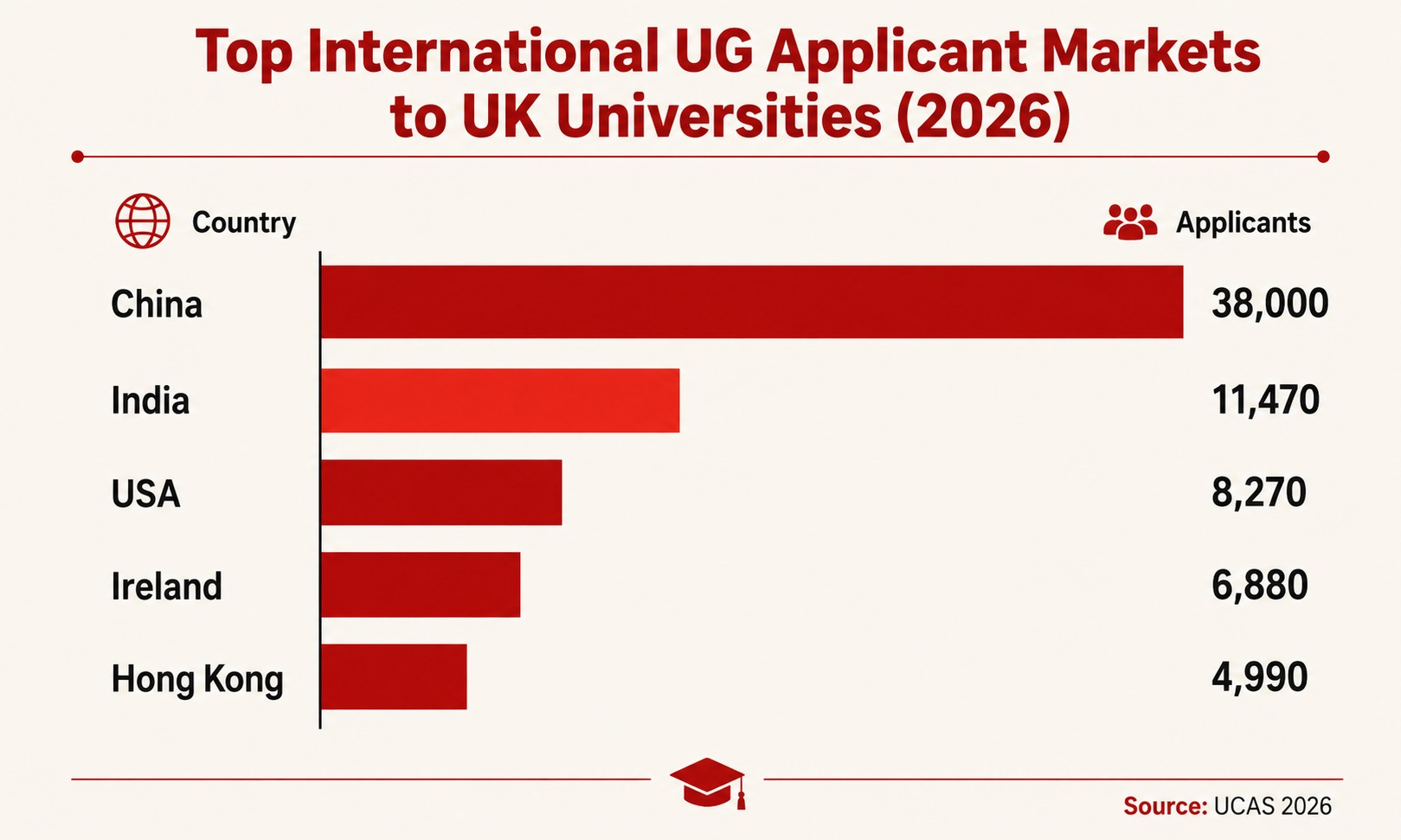
Among the diverse pool of international applicants, China continues to hold its position as the largest source market, with an impressive 38,000 students applying for undergraduate courses. However, India’s presence is increasingly significant, with 11,470 Indian students applying, solidifying its status as the second-largest contributor to the international applicant pool.
Following India, other prominent source countries include the United States with 8,270 applicants, Ireland with 6,880, and Hong Kong with 4,990. The year-on-year increase in applicants from China was also the most substantial, adding 4,140 applicants compared to the 2025 cycle. This growth is indicative of China’s burgeoning middle class and a strong emphasis on international education.
Several other countries also demonstrated significant year-on-year increases in their applicant numbers. Ireland and Iran each saw an addition of 810 applicants, while Nigeria contributed an additional 680 applicants, and Turkey saw an increase of 460. These figures highlight a broadening geographical base of interest in UK higher education, reflecting diverse global aspirations.
While the overall trend is positive, a few countries registered slight declines in their applicant numbers. Russia, Pakistan, and Canada each saw a decrease of around 100 applicants. The European Union collectively recorded a decline of 140 applicants, a trend that may be influenced by various geopolitical and economic factors post-Brexit. Saudi Arabia, among the listed countries, experienced the largest drop, with 350 fewer applicants compared to the previous year. These localized decreases, however, do not detract from the overall robust international demand.
Shifting Academic Preferences: Engineering and Healthcare in High Demand
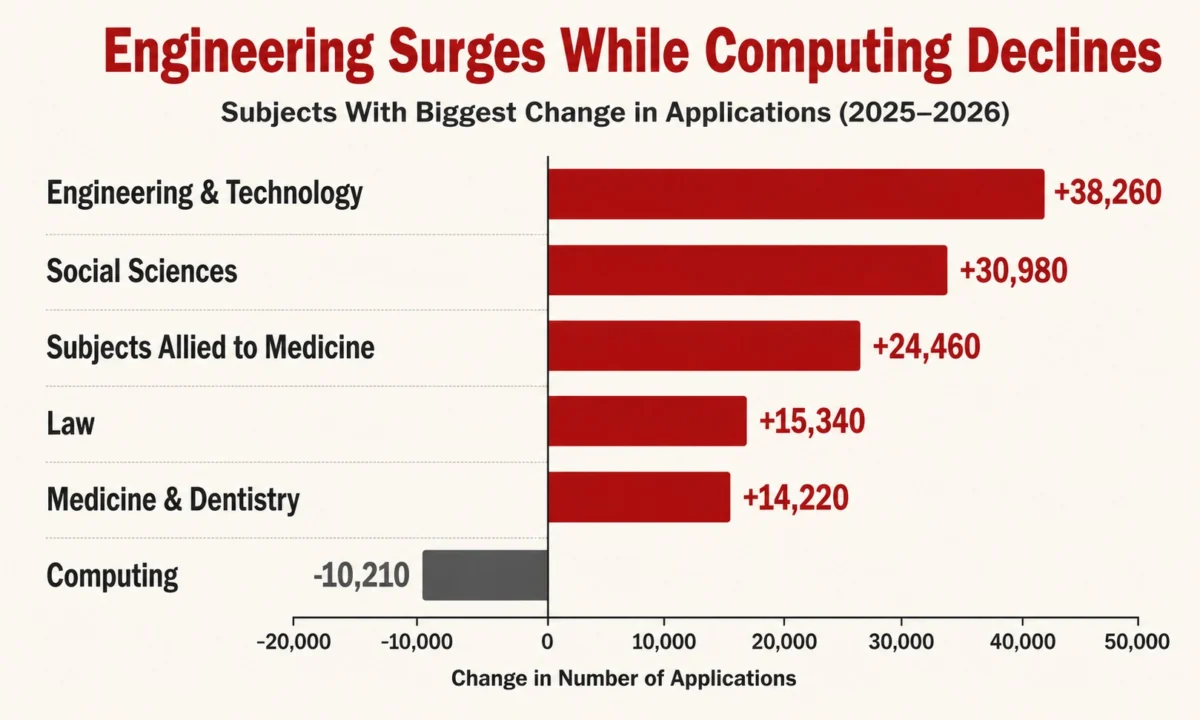
Beyond the geographical origins of applicants, the UCAS data also provides valuable insights into evolving student preferences regarding academic disciplines. Engineering and Technology emerged as the most sought-after field, witnessing the strongest growth in applications between 2025 and 2026. This subject area attracted an additional 38,260 applicants, underscoring a global surge in interest in STEM-related fields and the critical role of innovation and technological advancement.

Following closely behind, Social Sciences saw a significant increase of 30,980 applicants, reflecting a continued interest in understanding and addressing complex societal issues. Subjects Allied to Medicine also experienced a robust rise, with 24,460 additional applicants, indicating a growing demand for healthcare professionals and a strong societal emphasis on well-being and public health. Law and Medicine and Dentistry also demonstrated sustained interest, with increases of 15,340 and 14,220 applicants respectively. These figures collectively point towards a strong preference for professional and career-oriented programs that offer clear pathways to employment and societal contribution.
Conversely, Computing experienced the sharpest decline in applications, with 10,210 fewer applicants compared to the previous year. This downturn in a traditionally popular field might suggest a recalibration of student interests or a perceived saturation in certain areas of the tech industry, prompting a shift towards other burgeoning fields.
Other subjects that reported a decrease in application numbers include Language and Area Studies (-4,010), Design, Creative and Performing Arts (-1,470), Agriculture, Food and Related Studies (-600), and Combined and General Studies (-240). While these declines are notable, they are overshadowed by the significant growth in other key disciplines.
The latest UCAS figures paint a clear picture: while the allure of UK higher education remains exceptionally strong for international students, their academic aspirations are also evolving. The surge in interest for engineering, healthcare, and law, juxtaposed with the decline in computing applications, indicates a dynamic and adaptive student mindset, prioritizing fields perceived to offer greater future security and societal impact.
A Glimpse into the Past: The Evolution of UK Higher Education Admissions
The current record-breaking figures for undergraduate applications are a testament to the UK’s consistent efforts in promoting its higher education sector globally. Looking back, the journey has been one of strategic engagement and adaptation. The increase in international student applications has been a steady climb, punctuated by periods of accelerated growth.
In 2017, the total number of undergraduate applications stood at a considerable figure, but the proportion of international students was notably lower than today. Over the subsequent years, concerted efforts by UK universities, government bodies, and educational agencies have aimed at enhancing the international student experience, diversifying course offerings, and strengthening global partnerships.
The rise in applications from countries like India reflects a growing awareness among Indian students and their families about the global opportunities offered by UK education. Factors such as world-class research facilities, renowned faculty, diverse cultural experiences, and post-study work opportunities have consistently drawn Indian students to the UK. The introduction of post-study work visas has further enhanced the appeal, providing a tangible pathway for international graduates to gain valuable work experience in the UK.
Similarly, the sustained strength of applications from China underscores the long-standing relationship between the two nations in higher education. China’s rapid economic development and its focus on nurturing a highly skilled workforce have driven a significant demand for international qualifications.
The fluctuations observed in applications from certain regions, such as the European Union, can be attributed to a complex interplay of factors, including Brexit-related policy changes, evolving economic landscapes, and the competitive landscape of global higher education. Universities are continually monitoring these trends and adapting their recruitment strategies accordingly.
Supporting Data and Trends
The UCAS data for 2026 provides a granular view of these trends. The total number of applications for undergraduate courses reaching 695,740 represents a 4.6% increase from the previous year. This overall growth is a positive indicator for the sector.
Within this broader trend, international applications have been the primary driver of growth. The 7.1% increase in international applications, bringing the total to 148,350, is particularly noteworthy. This growth rate significantly outstrips the 3.5% increase observed in domestic applications, which reached 547,390. This divergence in growth rates highlights the increasing global competitiveness of UK universities.
The age demographic of applicants also reveals interesting patterns. Among UK applicants, the number of 18-year-olds applying saw a healthy 5% increase, reaching 344,760. This suggests a consistent interest from school leavers in pursuing higher education directly after completing their secondary education. Furthermore, applications from those aged 21 years and above increased by 1% to 87,180, indicating a steady stream of mature students and career changers seeking to upskill or pivot their careers through higher education.
The subject-wise breakdown further illuminates shifting academic interests. The substantial growth in Engineering and Technology (+38,260) and Subjects Allied to Medicine (+24,460) points to a demand for skills that are critical for economic development and societal well-being. The robust performance of Social Sciences (+30,980) suggests an ongoing societal need to understand and address complex human and societal challenges.
The decline in Computing applications (-10,210) is a significant data point. While the tech industry continues to evolve rapidly, this decrease might signal a maturing market or a shift in student perception regarding career prospects in certain computing domains. Universities may need to adapt their course offerings and marketing strategies to address this changing landscape.
Implications for the Future of UK Higher Education
The record number of undergraduate applications, particularly from international students, presents a significant opportunity for the UK’s higher education sector. It signals a strong and sustained global demand for the quality of education and research offered by British institutions. This influx of talent can contribute to a more vibrant and diverse campus environment, fostering cross-cultural understanding and enriching the learning experience for all students.
For UK universities, these figures translate into greater financial stability and the potential for further investment in infrastructure, research, and academic staff. The revenue generated from international student fees plays a crucial role in supporting the broader higher education ecosystem, including research initiatives that benefit society as a whole.
However, this growth also presents challenges. Universities will need to ensure they have the capacity to accommodate the increased number of students, maintaining high standards of teaching and student support. This includes providing adequate accommodation, resources, and pastoral care. The recruitment and retention of academic staff to meet the growing demand will also be a key consideration.
The shifting academic preferences highlighted by the UCAS data suggest a need for strategic planning. Universities may need to review and update their course offerings to align with emerging student interests and the demands of the global job market. Investing in interdisciplinary programs that combine technical skills with critical thinking and problem-solving abilities could prove particularly beneficial.
Furthermore, the UK government and educational bodies will need to continue their efforts to maintain and enhance the UK’s attractiveness as a global study destination. This includes ensuring a supportive visa and immigration policy, promoting research excellence, and fostering strong international partnerships. The success of the UK’s higher education sector is intrinsically linked to its ability to adapt to evolving global trends and student aspirations. The record application numbers in 2026 are a powerful affirmation of the UK’s enduring academic legacy and a promising indicator of its future influence in the global landscape of higher learning.
