

In the early light of a Monday morning, the town of Kalyansingpur at the base of Odisha’s Niyamgiri hills transforms into a vibrant theater of commerce and culture. This is the santha—the weekly market—a vital pulse point for the Dongria Kondh, one of India’s most reclusive and culturally distinct Particularly Vulnerable Tribal Groups (PVTGs). Here, amidst the scent of sun-dried mangoes and the rhythmic bargaining in Kui and Odia, a way of life that has survived centuries continues to negotiate its place in a rapidly modernizing world.
Main Facts: The Economic and Cultural Pulse of Kalyansingpur
The Monday santha is more than a marketplace; it is a socio-economic lifeline. For the Dongria Kondh, who inhabit the high ridges of the Niyamgiri range across the Rayagada and Kalahandi districts, the market represents the culmination of a week’s—and sometimes a season’s—labor.

By 10:00 AM, the market grounds are a sea of activity. The primary commodity of the current season is the wild mango. Sliced and sun-dried, these mangoes are piled high in burlap sacks, their tart aroma cutting through the humid air. The Dongria Kondh are master horticulturists, and the santha serves as the primary exit point for their produce into the wider Indian economy. Consignments from this small town travel as far as Raipur, Andhra Pradesh, and Mumbai.
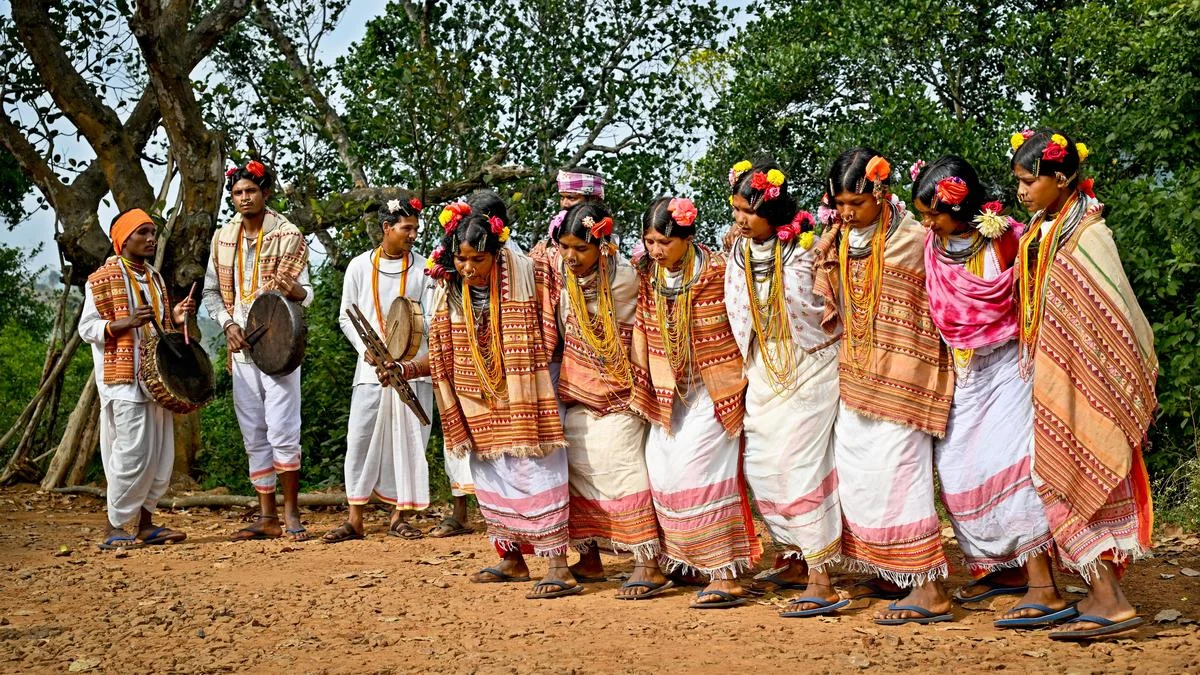
However, the market is also a visual testament to the tribe’s fierce adherence to their identity. The Dongria Kondh women are instantly recognizable. They adorn themselves with elaborate strands of colorful beads and multiple metal earrings that frame their faces. Most striking is the small traditional dagger, or kipna, tucked discreetly into their tightly coiled hair buns. This is not merely decorative; it is a tool for daily forest life and a symbol of their protective relationship with the hills. Their hand-embroidered stoles, featuring intricate geometric motifs, reflect a craftsmanship that mirrors the ridges and valleys of their homeland.

Chronology: From Ancestral Roots to the Landmark 2013 Verdict
To understand the present state of Niyamgiri, one must look at the timeline of the community’s struggle to preserve their habitat.
- Ancestral Era: For generations, the Dongria Kondh have lived in the Niyamgiri hills, practicing a form of shifting cultivation (podo) and gathering forest produce. They developed a sophisticated spiritual system centered on Niyam Raja, the "King of the Law," whom they believe resides on the mountain peaks.
- Early 2000s – The Mining Threat: The discovery of vast bauxite deposits (the raw material for aluminum) under the Niyamgiri soil brought the community into direct conflict with industrial interests. Vedanta Resources proposed a massive mining project that threatened to strip the mountaintops—the very areas the tribe considers the home of their deity.
- 2003–2012 – A Decade of Resistance: The tribe, supported by global human rights and environmental groups, engaged in a David-vs-Goliath battle. They argued that mining would destroy the perennial streams that originate in the hills, effectively ending their agricultural way of life.
- April 18, 2013 – The Supreme Court Milestone: In a historic judgment, the Supreme Court of India ruled that the religious and cultural rights of the Dongria Kondh must be respected. The court directed that the Gram Sabhas (village councils) would have the final say on whether mining should be permitted.
- August 2013 – The Unanimous Rejection: In a series of 12 village council meetings, the Dongria Kondh unanimously rejected the mining proposal. This was the first time in Indian history that a "referendum" was used to grant a tribal community the power to veto a major industrial project on environmental and religious grounds.
- 2014–Present – Post-Verdict Life: While the threat of large-scale mining has receded, the community remains vigilant. The focus has shifted toward sustainable development, education, and the formalization of their rights under the Forest Rights Act (FRA).
Supporting Data: The Economics of the Hill Bounty
The economy of the Dongria Kondh is a sophisticated blend of forest gathering and settled horticulture. Unlike many other tribal groups that rely on a single crop, the Dongria Kondh maintain a high level of biodiversity in their fields.

The Mango Economy
The wild mango season in June is the most critical period for cash flow. According to local wholesalers like J. Bhaskar, the market is highly sensitive to yield fluctuations. This year, a bumper harvest has seen prices stabilize at approximately ₹45 per kilogram for dried slices, compared to ₹85 per kilogram during the previous year’s leaner harvest. Despite the price drop, the sheer volume of produce ensures that families can purchase essential goods—salt, oil, dried fish, and clothing—that the hills do not provide.
Agricultural Diversity
The Dongria Kondh diet and trade are supported by a variety of native crops:

- Millet (Ragi): The staple grain, often consumed as a fermented porridge (mandia jau).
- Pulses: Native varieties of tur dal (pigeon pea) and black gram are grown on the slopes without chemical fertilizers.
- Wild Fruits: Beyond mangoes, the hills provide jackfruit, tamarind, pineapple, and various berries like kala jamun.
- Turmeric: Niyamgiri turmeric is renowned for its high curcumin content and is a significant trade item.
Modern Infrastructure
Change is arriving in the hills, albeit at a measured pace. Our observations in villages like Phakeri reveal a hybrid existence. While traditional thatched-roof houses remain, the government has introduced concrete "Indira Awas" homes. Solar panels are now common sights on rooftops, providing light for children to study and for charging the mobile phones that have become ubiquitous even among the elder generation.
Official Responses and Community Voice: The Spirit of Niyam Raja
The official stance of the community remains anchored in the 2013 verdict. For the Dongria Kondh, the "official" word comes from the Gram Sabha. Babula, a resident of Phakeri village, encapsulates the community’s sentiment: “The government and companies talk about development in terms of money and metal. But Niyamgiri is our father and mother. It gives us water that never runs dry, even in the hottest summer. Why would we trade a perennial source of life for a one-time payment?”

State officials from the Dongria Kondh Development Agency (DKDA) acknowledge the unique challenges of the region. Their efforts are currently focused on improving road connectivity to the hilltops and ensuring that tribal produce reaches markets without being exploited by middlemen. However, the balance remains delicate; every new road brings the Dongria Kondh closer to the mainstream economy but also threatens the isolation that has preserved their culture.
The legal community continues to view the Niyamgiri case as a benchmark. Legal experts often cite the 2013 ruling as the "Magna Carta" of tribal rights in India, reinforcing the idea that the "right to worship" includes the right to protect the physical landscape of that worship.

Implications: Tradition in the Age of Global Connectivity
The current state of the Dongria Kondh offers several profound implications for India’s development narrative:
1. Environmental Stewardship
The Dongria Kondh’s rejection of mining has effectively preserved a critical watershed. The Niyamgiri hills are the source of the Vansadhara and Nagavali rivers. By protecting the hills for their deity, the tribe has inadvertently secured the water supply for thousands of farmers in the plains of Odisha and Andhra Pradesh. This highlights the role of indigenous communities as the frontline guardians of biodiversity.

2. The Digital Divide and Integration
As mobile phones and solar power become standard, the tribe is no longer "isolated" in the traditional sense. Young Dongria Kondh are increasingly aware of their rights and the value of their produce. The implication is a shift from a "subsistence" mindset to a "sovereign" mindset, where they seek to engage with the modern world on their own terms.
3. Sustainable Tourism
The region is seeing a slow rise in "respectful tourism." Establishments like the Anija Golf Resort in Rayagada now offer guided excursions that emphasize cultural education over voyeurism. These tours, which include walks through hamlets and traditional meals, provide an alternative revenue stream for the community and foster a broader understanding of PVTG cultures.

4. Food Security and Climate Resilience
The Dongria Kondh’s reliance on millets and wild forest foods makes them remarkably resilient to climate change. As the world looks for "superfoods" and drought-resistant crops, the traditional knowledge held by this tribe—such as the cultivation of native dal and ragi—becomes a global asset.
Conclusion: An Unhurried Rhythm
As the sun begins to set over the Niyamgiri ridges, the bustle of the Kalyansingpur santha fades. The trucks loaded with dried mangoes begin their long journey to the ports and cities of India. Back in the villages, life returns to an unhurried rhythm. Children play cricket under the shade of ancient trees, while women stitch leaf plates for the evening meal.

The story of the Dongria Kondh is not a tragedy of a disappearing culture, but a saga of resilience. They have proven that it is possible to stand ground against the forces of industrialization and emerge with both their land and their dignity intact. In the shadow of Niyamgiri, the "King of the Law" still reigns, and the Monday market remains a testament to a people who know exactly what their heritage is worth.
