

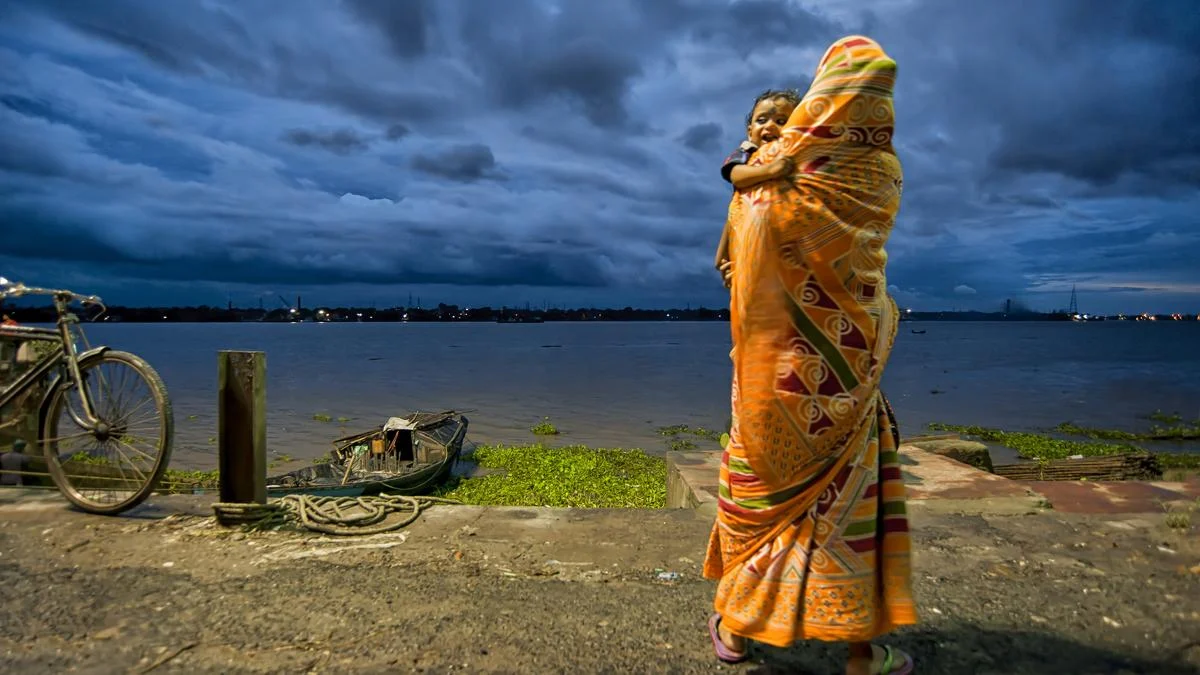
KOLKATA, INDIA — In the quiet corners of a room in Kolkata, a conversation unfolds that might sound, to an outsider, like a group of old friends reminiscing about mutual acquaintances.

“I think that was Remal, no?” one asks.
“No, no. That was Bulbul,” another corrects affectionately.
“But Fani… Fani was something else entirely.”
“And you’ve forgotten Mocha.”
The names are exchanged with a familiarity usually reserved for distant relatives or schoolmates. However, these are not people. They are the names of some of the most devastating cyclonic storms to hit the Bay of Bengal in recent memory. To the general populace of West Bengal, these names represent trauma, displacement, and the terrifying power of nature. But for the eight members of the Kolkata Cloud Chasers (KCC), these names represent "encounters"—fleeting, high-stakes moments where human curiosity meets atmospheric fury.

For over a decade, this eclectic group of professionals has spent their weekends and holidays pursuing the very phenomena that send millions of others scurrying for subterranean shelter. They are extreme weather photographers and amateur meteorologists, and their story is a testament to the intersection of citizen science, artistic obsession, and a profound respect for the natural world.
I. Main Facts: Measuring Life in Millibars
The Kolkata Cloud Chasers are a specialized unit of eight individuals who track, intercept, and document severe weather events across the plains of Bengal and the neighboring states. While most residents of Kolkata view the monsoon and the pre-monsoon "Kalbaisakhi" (Nor’westers) as seasonal inconveniences or hazards, the KCC views them as a canvas.

Their calendar is not dictated by the Gregorian year but by meteorological cycles. Their lives are punctuated by squall lines, supercells, and the darkening of the horizon. Over the last 12 years, they have evolved from a group of hobbyist photographers into a sophisticated tracking unit.
The Team Composition:
The strength of the KCC lies in its professional diversity, allowing the group to function like a well-oiled machine in high-pressure environments:

- Debarshi Duttagupta: A pharmaceutical professional who serves as the team’s primary navigator.
- Suman Kumar Ghosh: An engineer and the specialist in wind-data analysis.
- Chirasree Chakraborty: A publisher who acts as a primary storm tracker.
- Joyjeet Mukherjee: A debt recovery expert specializing in the high-speed capture of lightning.
- Krishnendu Chakraborty: A marketing professional.
- Diganta Gogoi: A professional photographer and expert storm spotter.
- Abhishek Saigal: A businessman with a focus on lightning photography.
- The Eighth Member: Provides logistical and spotting support during complex intercepts.
Armed with high-end DSLR cameras (Nikon full-frame, Sony mirrorless, and Fuji systems) and "Storm and Cloud-chasing Four-Wheelers" (SCIF) equipped with winches and recovery gear, they venture into the heart of the storm to capture images that are as scientifically valuable as they are aesthetically breathtaking.
II. Chronology: From Orkut Roots to WhatsApp Coordination
The genesis of the Kolkata Cloud Chasers can be traced back to the digital landscape of the late 2000s. In 2009, the members first crossed paths through the Kolkata Photographer’s Club, a community of roughly 2,500 enthusiasts on the now-defunct social media platform, Orkut.

While the larger group focused on street photography or portraits, this small faction found themselves drawn to the dramatic shifts in the sky. The arrival of the first Android smartphones in late 2009 and early 2010 was the catalyst for their evolution. For the first time, satellite imagery and real-time radar data from apps like AccuWeather were available in the palms of their hands.
Key Milestones:

- 2009–2013: The group operated informally, meeting during local storms in Kolkata to test the limits of their gear.
- March 24, 2014: The official formation of the "Kolkata Cloud Chasers" via a dedicated WhatsApp group. This allowed for instantaneous coordination, a necessity when chasing storms that move at 60 kilometers per hour.
- 2019–2021: The group faced their most significant challenges during the back-to-back hits of Cyclones Bulbul and Amphan. These events shifted their focus from mere photography to a deeper engagement with atmospheric science and disaster documentation.
- Present Day: The KCC is now recognized as one of India’s premier storm-chasing collectives, often cited for their unique blend of field observation and meteorological data collection.
III. Supporting Data: The Science of the Hunt
Storm chasing in the Indian subcontinent is significantly different from the "Tornado Alley" chases of the United States. The topography of Bengal, characterized by its vast river deltas and the proximity to the Chhotanagpur Plateau, creates unique atmospheric dynamics.
The Strategic Hub: Bardhaman
Through years of trial and error, the KCC has identified the town of Bardhaman as a critical strategic point. Located at a geographic crossroads, it allows the team to pivot toward Bankura, Purulia, Durgapur, or Asansol depending on the storm’s trajectory. Most Kalbaisakhis—the violent summer tempests—originate over the Jharkhand plateau and sweep eastward. By positioning themselves in Bardhaman, the team can intercept these "tempest lines" before they reach the urban density of Kolkata.

The "10-Minute Lag" Challenge
A significant portion of their work involves mitigating the limitations of technology. "The data we receive is already at least ten minutes old," explains Chirasree Chakraborty. In the world of meteorology, ten minutes is an eternity. A storm cell can intensify, dissipate, or "split" in that window.
To counter this, the group relies on a "probability-based" navigation system. While the navigator estimates where the storm will be, spotters inside the vehicle use visual cues—such as the formation of a "wall cloud" or the color of the sky (often turning a bruised green or deep violet)—to guide the driver.

Success Rates and Logistics
Despite their expertise, the atmosphere remains a fickle subject. The KCC reports a success rate of only 20 to 22 percent. For every iconic photograph of a jagged lightning bolt, there are four or five trips that end in "blue-skyed" disappointment or getting "cored" (trapped inside the heavy rain where visibility is zero and photography is impossible).
IV. Risk Management and Official Responses
The dangers inherent in storm chasing are not merely theoretical. The KCC operates in an environment where lightning strikes are a constant threat. In India, lightning kills more people annually than cyclones and floods combined, yet it remains an under-reported hazard.

The Human Cost:
The team has had several near-death experiences. Chirasree Chakraborty recalls receiving electric shocks through "upward streamers"—a phenomenon where an electrical charge builds up on the ground just before a lightning strike. Even more harrowing was the experience of Abhishek Saigal, who was struck by lightning during a chase and temporarily lost all sensation below his waist.
Safety Protocols:
To manage these risks, the KCC has developed a strict set of "Standard Operating Procedures" (SOPs):

- The Escape Route: Before any gear is unloaded, an evacuation path is identified.
- Vehicle Orientation: Cars are always parked facing the direction of the exit.
- Ignition Policy: Keys remain in the ignition at all times.
- The "Safety Spotter": While others are focused through their lenses, one member is designated to monitor the lightning trigger and the movement of the storm’s "gust front."
Community Outreach:
While the KCC is a private group, they have adopted a public-service mantle. During the off-season, they take their data to schools, colleges, and Rotary clubs. They provide presentations on lightning safety—teaching people what to do when caught in the open—and explain the mechanics of climate change. Their "official" stance is one of education; they refuse to monetise their passion, declining payments for these lectures to ensure their message remains untainted by commercial interests.
V. Implications: Citizen Science in a Changing Climate
The work of the Kolkata Cloud Chasers carries significant implications for the study of climate change in South Asia. As the Bay of Bengal warms, the intensity and frequency of cyclonic storms are predicted to increase. The "ground-truth" data—the visual and wind-speed observations—recorded by the KCC provides a granular look at how these storms behave when they make landfall.

The Philosophy of the Chase:
Beyond the science and the adrenaline, there is a philosophical core to the KCC. In an era where humanity often feels it has conquered nature through technology, the members of the KCC seek out moments that prove the opposite.
“You feel very small in front of nature,” says Chirasree. “The clouds are rumbling, the thunder is cracking, and you realize how tiny you are. It’s risky, but that feeling is priceless.”

Conclusion:
The Kolkata Cloud Chasers represent a unique brand of modern exploration. They do not seek to conquer the storm, but to witness it. By documenting the "encounters" with Remal, Amphan, and the tempests of the future, they provide a vital archive of a planet in flux. Their 12-year journey from an Orkut group to a sophisticated weather-tracking unit serves as a reminder that sometimes, to truly understand the world, one must drive directly toward the darkness.
As another monsoon season approaches the Bengal coast, the eight members of the KCC are already watching the models. They are fueling their vehicles, checking their winches, and waiting for the sky to turn that specific shade of grey that signals it is time to move. For them, the storm isn’t a disaster to be feared—it’s a story waiting to be told.
