

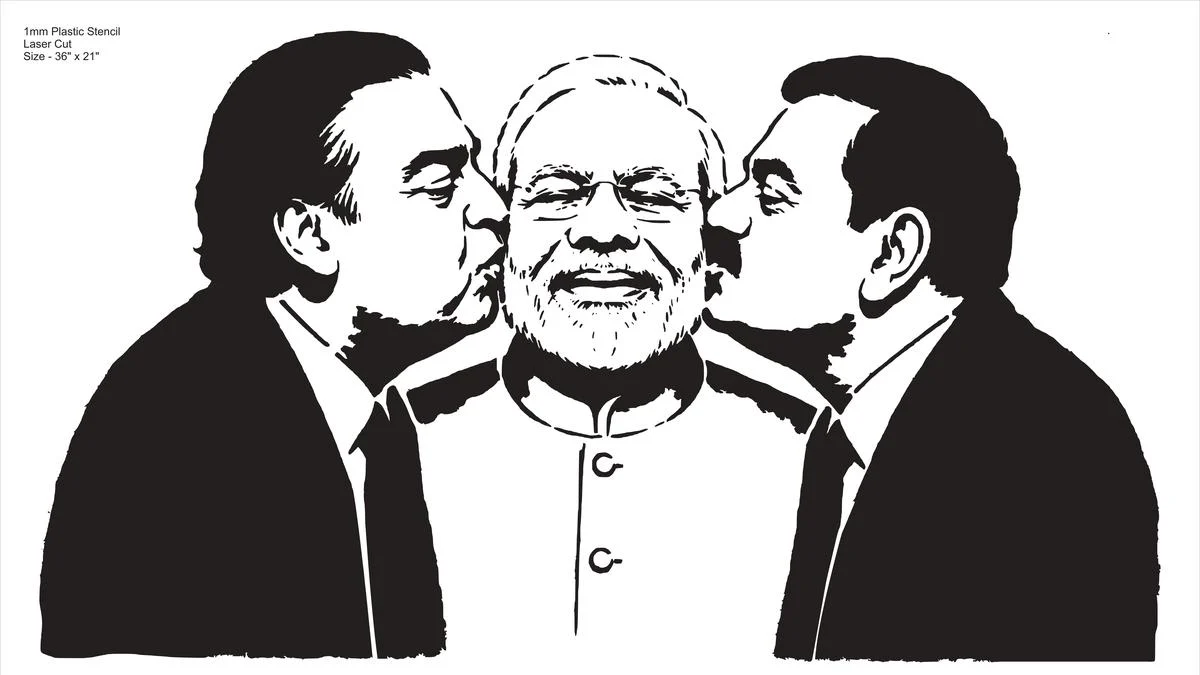
New Delhi, India – July 24, 2026 – In the cacophony of political discourse and the often-impenetrable machinery of governance, a potent new voice has emerged from the streets of India: that of its youth, channeling their frustration and demands through the visceral language of art. For weeks, the nation has been gripped by widespread protests, predominantly driven by Generation Z, against the alleged pervasive irregularities surrounding the National Eligibility-cum-Entrance Test (NEET) examination. While various political factions have attempted to leverage the discontent, it is the artistic expression, particularly a now-iconic poster by the enigmatic street artist Tyler, that has transcended partisan lines and become a unifying symbol of defiance.
The image in question, a stark stencil depicting Prime Minister Narendra Modi in an intimate embrace with industrial titans Gautam Adani and Mukesh Ambani, with the two businessmen appearing to kiss the Prime Minister, has become ubiquitous. It adorns social media feeds, is printed on protest banners, and scrawled on walls across the country. This powerful visual, originating from the creative wellspring of Tyler Street Art, a moniker often associated with Mumbai’s answer to the elusive Banksy, has transformed a complex issue into an easily digestible, emotionally resonant message that resonates deeply with a generation feeling unheard and disenfranchised.
The Genesis of a Protest Icon: Tyler’s Artistic Intervention
Tyler Street Art, an artist who prefers anonymity, has long utilized graffiti as a medium to engage with pressing public issues. His work, characterized by its bold lines and unflinching commentary, has previously addressed societal inequalities and political critiques within the bustling urban landscape of Mumbai. However, the recent NEET paper leak scandal has propelled his art into the national spotlight, transforming a single piece into a rallying cry.
The poster’s immediate appeal lies in its potent symbolism. The visual metaphor of Adani and Ambani, often perceived as beneficiaries of policies allegedly favoring large corporations, being depicted in such a manner directed at the Prime Minister, taps into a widespread public sentiment that questions the integrity of governance and its perceived alignment with corporate interests. For the protesting youth, it encapsulates a broader dissatisfaction, extending beyond the immediate NEET crisis to encompass concerns about job security, economic disparity, and the perceived erosion of meritocracy.
The "Cockroach Janata Party," as the article humorously, yet pointedly, refers to the group spearheading some of the protests, may have initiated the movement, but it is the visual language of dissent, spearheaded by Tyler, that has truly captured the imagination and solidified the protest’s identity. This artistic intervention has managed to cut through the noise of political rhetoric, offering a clear, unambiguous statement that resonates with the core anxieties of a generation facing an uncertain future.
A Chronology of Discontent: From Examination Frustration to Artistic Outcry
The NEET examination, a crucial gateway for aspiring medical professionals in India, has been embroiled in controversy for weeks. Allegations of widespread irregularities, including paper leaks, have led to widespread anxiety and anger among hundreds of thousands of students who dedicated years of their lives to preparing for this pivotal exam.
Early June 2026: Whispers of irregularities begin to surface in various states. Initial reports are often dismissed as isolated incidents or rumors.
Mid-June 2026: The scale of the alleged paper leak becomes more apparent. Multiple sources suggest a systemic issue, with question papers reportedly being leaked to favored individuals before the examination date.
Late June 2026: Student groups and parents begin organizing initial protests in affected regions. Demands range from a thorough investigation to the cancellation and re-examination of the NEET-UG 2026.
Early July 2026: The National Testing Agency (NTA), the body responsible for conducting NEET, faces intense scrutiny. The Ministry of Education initiates preliminary inquiries. Public frustration mounts as the pace of official action is perceived as slow.
Mid-July 2026: The scale of the alleged malpractice gains national attention. Various opposition parties begin to voice strong criticism of the government and the NTA. The Bharatiya Janata Party (BJP) government, led by Prime Minister Narendra Modi, finds itself under increasing pressure.
Late July 2026: Street artist Tyler’s iconic poster, depicting PM Modi with Adani and Ambani, begins to circulate widely on social media platforms. Its potent imagery quickly gains traction, adopted by Gen Z protesters as a powerful visual metaphor for their grievances. The poster is seen as a concise and impactful articulation of a belief that the examination system, and by extension the government, is compromised by crony capitalism. Protests intensify, with the poster becoming a ubiquitous symbol of this burgeoning dissent.

This chronological progression highlights how a localized issue of examination malpractice escalated into a national crisis, fueled by a perceived lack of transparency and accountability. The artistic response, particularly Tyler’s poster, arrived at a critical juncture, providing a unifying visual identity to a diffuse and widespread anger.
Supporting Data: The Ripple Effect of the NEET Scandal and Artistic Resonance
The impact of the NEET paper leak scandal extends far beyond the immediate disappointment of individual students. It has exposed deep-seated concerns about the fairness and integrity of India’s examination system, a system that holds the key to upward mobility and future careers for millions.
- Scale of Aspirants: The NEET-UG exam typically sees participation from over 2 million students annually, all vying for a limited number of medical seats. The sheer volume of individuals affected by any irregularity amplifies the public outcry.
- Economic Implications: The cost of coaching classes, often perceived as a necessity for cracking competitive exams like NEET, runs into lakhs of rupees. For many families, this represents a significant financial investment, making the prospect of a leaked paper or unfair advantage particularly devastating. The perceived influence of industrialists like Adani and Ambani in shaping economic policies further exacerbates anxieties about a system that may not be leveling the playing field.
- Social Media Amplification: The current generation of protesters is highly adept at leveraging social media. Tyler’s poster, with its easily shareable format, became a viral phenomenon, reaching millions of users across platforms like X (formerly Twitter), Instagram, and WhatsApp. This digital amplification has been crucial in mobilizing public opinion and maintaining the momentum of the protests.
- Artistic Reach: Unlike traditional media, street art and digital art bypass traditional gatekeepers, allowing messages to reach a broad audience directly. The anonymity of the artist further adds to the mystique and perceived authenticity of the message, positioning it as a voice of the people rather than a partisan attack.
The visual language of protest, as exemplified by Tyler’s work, has proven to be a powerful tool in articulating complex socio-political grievances. It has effectively translated the abstract concept of systemic corruption into a tangible, emotionally charged image that resonates with a broad spectrum of the Indian populace.
Official Responses: A Balancing Act Between Reassurance and Scrutiny
The escalating protests and the widespread adoption of artistic dissent have compelled the Indian government and its associated agencies to respond. However, the nature of these responses has often been characterized by a delicate balancing act, attempting to reassure the public while navigating the complexities of an ongoing investigation.
Initial Statements: In the early stages, the National Testing Agency (NTA) and the Ministry of Education issued statements acknowledging the concerns and promising a thorough investigation. These statements, however, were often met with skepticism from the public, who perceived them as perfunctory.
Judicial Intervention: The Supreme Court of India has played a crucial role, taking cognizance of the matter and initiating proceedings to address the allegations. The court’s involvement has lent a degree of legitimacy to the demands for accountability.
Governmental Actions: The government has undertaken several measures, including forming high-level committees to review the NTA’s functioning and the examination processes. There have been discussions about potential reforms to the examination system to prevent future irregularities. The Ministry of Education has also been actively engaged in damage control, issuing press releases and holding press conferences to address public concerns.
Focus on Investigation: The primary official response has been to emphasize the ongoing investigation into the alleged paper leak. This approach aims to demonstrate that the authorities are taking the matter seriously, while also avoiding premature pronouncements that could prejudice the investigation or lead to further public outcry.
Addressing the Art of Protest: While not directly commenting on the artistic expressions, the government’s heightened engagement with the media and public discourse can be seen as an indirect response to the powerful narratives being woven by artists like Tyler. The government’s efforts to control the narrative and present its actions as decisive are a direct counterpoint to the potent symbolism employed by the protesters.
However, the perception of official responses remains a critical factor. For many, the actions taken so far are seen as reactive rather than proactive, and the pace of justice is often questioned. The continued prominence of artistic symbols like Tyler’s poster suggests that the government has yet to fully address the underlying trust deficit that fuels such widespread dissent.
Implications: The Enduring Power of Art in Shaping Public Discourse
The unprecedented adoption of street art, and specifically Tyler’s poster, as a symbol of protest against the NEET paper leak has profound implications for how dissent is expressed and perceived in contemporary India.
- Democratization of Dissent: Art, particularly street art, offers a powerful avenue for individuals and groups to voice their opinions without relying on traditional political structures or media channels. This democratizes the process of dissent, empowering ordinary citizens to engage in public discourse.
- Amplifying Grievances: The visual impact of art can transcend linguistic and educational barriers, making complex issues more accessible and relatable to a wider audience. Tyler’s poster, in its stark simplicity, communicates a powerful message of perceived corruption and cronyism that resonates deeply with the aspirations and anxieties of the youth.
- Challenging Authority: Artistic interventions, by their very nature, often challenge established norms and authority. The visual critique offered by Tyler’s work is a direct confrontation with the perceived nexus between political power and corporate influence, forcing a public reckoning with these issues.
- Shaping Public Opinion: The widespread dissemination of such artistic symbols can significantly influence public opinion, framing the narrative and setting the agenda for public debate. The sustained visibility of Tyler’s poster suggests its success in capturing the public imagination and shaping the perception of the NEET scandal.
- The Future of Protest: This movement underscores the evolving nature of protest in the digital age. The seamless integration of art, social media, and public activism signifies a new era where visual narratives play an increasingly crucial role in mobilizing support and demanding accountability.
As the nation grapples with the fallout of the NEET scandal and the broader questions of governance and fairness it has raised, the enduring power of art, as exemplified by Tyler Street Art’s iconic poster, stands as a testament to its ability to articulate the unspoken, to galvanize the masses, and to hold power to account. The streets of India have once again become a canvas for change, and the art born from this discontent may well shape the nation’s future discourse.
