

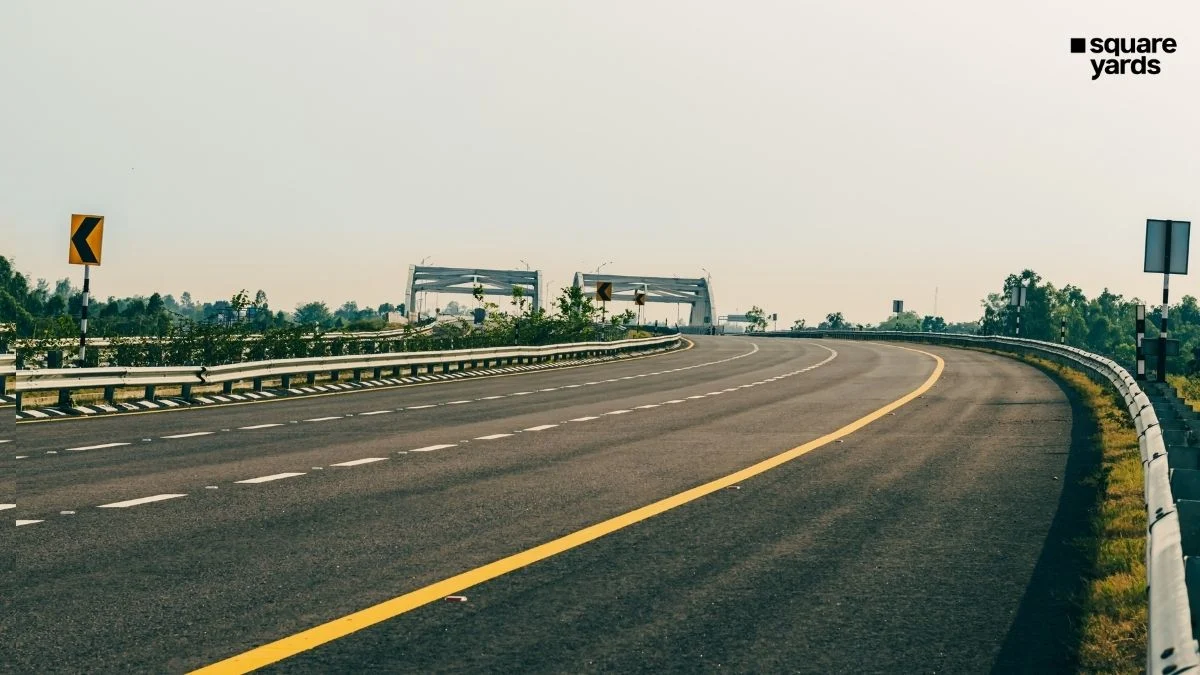
Following a high-powered review meeting held in Lucknow on July 22, 2026, Union Minister Nitin Gadkari and Uttar Pradesh Chief Minister Yogi Adityanath signaled a shift from planning to hyper-execution. The meeting served as a strategic audit of the state’s massive infrastructure pipeline, emphasizing the resolution of long-standing construction bottlenecks and the integration of 33 district headquarters into a high-speed four-lane network.
With a total investment portfolio now reaching a staggering ₹1.94 lakh crore, the infrastructure push is being positioned as the primary engine to propel Uttar Pradesh toward its ambitious goal of becoming a $1 trillion economy.
I. Main Facts: A Transformed Connectivity Map
The review meeting underscored a monumental scale of development. Since 2014, Uttar Pradesh has emerged as the epicenter of India’s highway expansion. The sheer volume of work completed and currently underway reflects a policy shift toward "Gati Shakti" (the power of speed), focusing on multimodal connectivity.
Key Statistics at a Glance:
- Total Awarded Length (since 2014): 10,204 km.
- Total Completed Length: 9,329 km.
- Recent Momentum (April 2025 – May 2026): 606 km of new projects approved and 1,010 km successfully paved.
- Financial Outlay: A cumulative ₹1.94 lakh crore, with ₹23,445 crore invested in the 2025-26 fiscal year alone.
The core objective of the latest directive is the democratization of high-speed travel. By ensuring that 33 district headquarters—many of which were previously bypassed by major corridors—are connected via four-lane highways, the government aims to reduce regional economic disparities. Furthermore, the development of new ring roads and bypasses in Tier-2 and Tier-3 cities is intended to de-congest urban centers, allowing for smoother freight movement and reduced carbon emissions from idling traffic.
II. Chronology: From Foundation to Acceleration (2014–2026)
The evolution of Uttar Pradesh’s road network can be divided into three distinct phases:
Phase 1: The Expansion (2014–2019)
This period focused on connecting major metropolitan hubs. Projects like the Eastern Peripheral Expressway and early segments of the Delhi-Meerut Expressway set the stage. During this time, the state saw a significant increase in the awarding of National Highway (NH) contracts, moving away from the sluggish pace of previous decades.
Phase 2: The Integration (2020–2024)
Despite the challenges posed by global disruptions, this phase saw the completion of critical arteries. The focus shifted toward "Expressway-led development." The Purvanchal Expressway and Bundelkhand Expressway, while state-led, were integrated into the broader National Highway framework to ensure seamless interstate travel. By the end of 2024, the state had already crossed the 8,000-km mark in completed NH projects.
Phase 3: The Hyper-Execution Era (2025–Present)
The current phase, highlighted by the July 2026 review, focuses on "filling the gaps." Between April 2025 and May 2026, the government pivoted toward micro-connectivity—ensuring that the "last mile" between industrial hubs, religious sites, and the main highway network is bridged. The recent approval of 606 km of new projects indicates that the government is not yet hitting a plateau but is instead seeking new corridors to link the state’s borders with neighboring Bihar, Madhya Pradesh, and Uttarakhand.
III. Supporting Data: Major Project Deep Dive
The Lucknow review provided specific updates on high-impact projects that are currently in various stages of construction. These projects are not merely roads; they are economic arteries designed to support specific industries.
1. The Mathura-Bareilly-Sitarganj Corridor
- Investment: Approximately ₹13,980 crore.
- Significance: This four-lane project is vital for the Western and Central UP regions. It connects the religious and tourism hub of Mathura with the industrial and agricultural belts of Bareilly and Pilibhit, eventually reaching the Uttarakhand border at Sitarganj.
- Timeline: The Bareilly-Pilibhit section is slated for completion by December 2026, with the full corridor operational by November 2027.
2. The Agra-Aligarh Four-Lane Project
- Investment: ₹5,904 crore.
- Significance: This route serves the "Brass City" of Aligarh and the leather/tourism hub of Agra. It is a critical link for the manufacturing sector, providing a faster route for exports to reach the National Capital Region (NCR).
- Timeline: Expected completion by November 2028.
3. The Ayodhya Infrastructure Overhaul
Perhaps the most high-profile project reviewed was the Ayodhya Ring Road. As Ayodhya transforms into a global spiritual destination, the Ring Road is designed to divert heavy traffic away from the city center while providing direct access from the Maharishi Valmiki International Airport to the Shri Ram Janmabhoomi Temple.
- Timeline: Late 2027 to early 2028.
- Additional Projects: Detailed Project Reports (DPRs) are currently being finalized for the Ayodhya-Gonda four-lane highway and several ropeway projects in Vrindavan and Prayagraj to facilitate "Green Mobility" in congested pilgrimage sites.
4. The Shamli-Gorakhpur Access-Controlled Corridor
This proposed 742-km corridor is perhaps the most ambitious project on the horizon. By providing an access-controlled route from the western edge (Shamli) to the eastern hub (Gorakhpur), it will effectively halve travel time across the breadth of the state.
IV. Official Responses: Tackling the "Bottleneck" Problem
During the review, Union Minister Nitin Gadkari was candid about the challenges that have historically plagued Indian infrastructure. He directed a "war-footing" approach to four specific areas:
- Land Acquisition: Gadkari urged state officials to expedite the legal and compensatory processes for land acquisition, which remains the primary cause of project litigation and delay.
- Utility Shifting: The Minister emphasized better coordination between the NHAI and state electricity/water boards to ensure that power lines and pipelines are moved before the heavy machinery arrives.
- Statutory Clearances: A streamlined process for forest and environmental clearances was discussed to prevent projects from stalling in the bureaucratic pipeline.
- Technological Innovation: In a notable directive, the Ministers urged the use of modern technology for the "transplantation" of trees rather than simple felling. This aligns with the Centre’s "Green Highways" policy.
Chief Minister Yogi Adityanath reiterated the state’s commitment by highlighting the "Task Forces" established at the district level. He also noted that the state is providing royalty-free soil for greenfield projects, a move that significantly lowers construction costs and speeds up the embankment process.
V. Implications: Real Estate, Logistics, and the Macroeconomy
The acceleration of these highway projects carries profound implications for the socio-economic fabric of Uttar Pradesh.
The Real Estate Transformation
Infrastructure is the single greatest driver of property value. The completion of these highways is expected to trigger a "de-urbanization" of sorts, where residential and commercial hubs move away from the saturated centers of Lucknow and Noida into emerging peripheral areas.
- Residential Growth: Areas around the Ayodhya Ring Road and the Agra-Aligarh corridor are already seeing a spike in land inquiries. Developers are pivoting toward "Integrated Townships" that cater to the middle class seeking better connectivity.
- Commercial Confidence: Timely execution is the key. As project delays decrease, developer confidence increases, leading to more aggressive project launches in Tier-2 cities.
Logistics and the Industrial "Gold Rush"
The logistics sector is perhaps the biggest beneficiary. With the UP Defence Industrial Corridor taking shape, the need for high-speed road connectivity to move heavy machinery and components is paramount.
- Warehousing: Improved roads make it feasible for e-commerce and manufacturing firms to set up large-scale warehousing hubs in central locations like Kanpur and Unnao, serving both the North and East Indian markets.
- Supply Chain Efficiency: Reduced travel times directly translate to lower fuel costs and faster turnaround times for freight, making UP-based industries more competitive on a national scale.
The $1 Trillion Vision
For Uttar Pradesh to reach a $1 trillion GSDP (Gross State Domestic Product), it must transition from an agrarian-heavy economy to a manufacturing and services powerhouse. The National Highway network acts as the skeletal structure for this transition. By linking religious tourism (Ayodhya, Mathura, Varanasi) with industrial corridors and international airports, the state is creating a self-sustaining economic ecosystem.
Conclusion: The Road Ahead
The July 2026 review meeting in Lucknow has set a clear tone: the era of "announcement-only" infrastructure is over. With over 9,000 km already on the ground and nearly ₹2 lakh crore in the pipeline, Uttar Pradesh is no longer just a "state with potential"—it is a state in motion.
While the timelines for projects like the Mathura-Bareilly corridor and the Ayodhya Ring Road are ambitious, the collaborative "Task Force" model adopted by the Centre and the State provides a robust framework for success. For the residents, investors, and industries of Uttar Pradesh, these highways represent more than just asphalt and concrete; they represent the fast lane to a new era of prosperity.
