

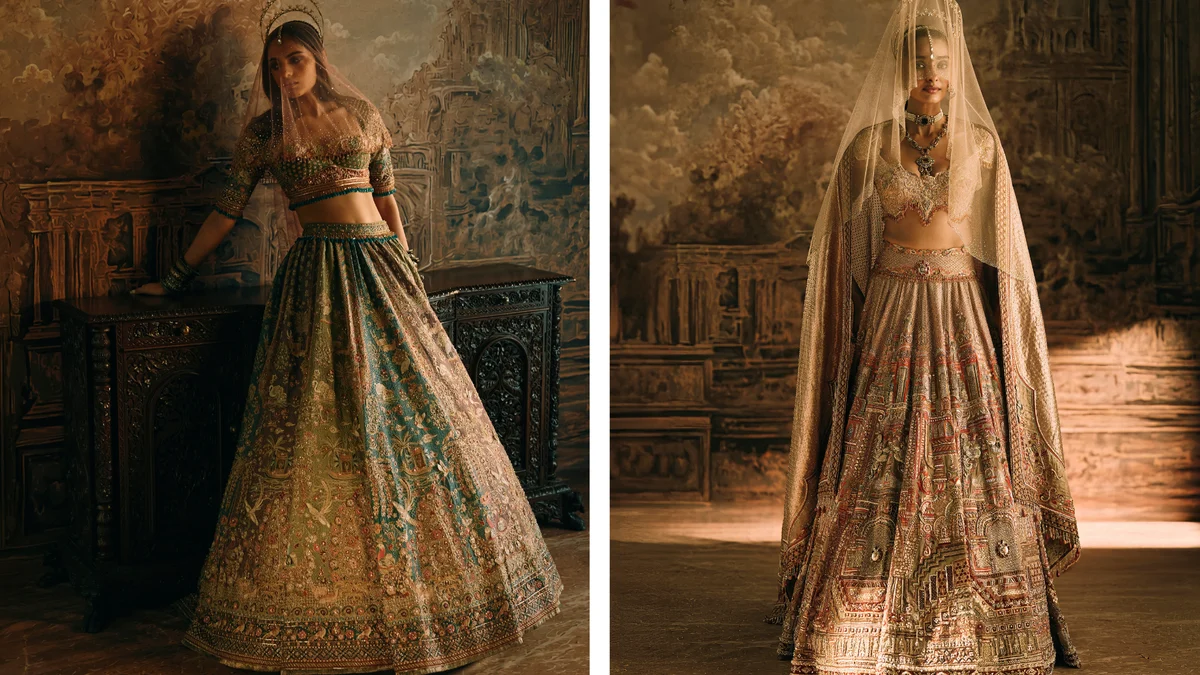
New Delhi, India – In the discerning world of Indian fashion, where fleeting trends often dictate narratives, Tarun Tahiliani has long been an architect of experiences, meticulously crafting contexts that extend far beyond the ephemeral glamour of a runway. At 64, Tahiliani, a name synonymous with sophisticated Indian couture, continues to redefine the very essence of fashion presentation, eschewing the conventional for the profound. His upcoming presentation, "Navaratna," at Bikaner House for India Couture Week, is a testament to this enduring philosophy, inviting audiences not just to observe, but to immerse themselves in the intricate tapestry of Indian artistry and heritage.
Tahiliani’s career, spanning over three decades, is punctuated by a consistent commitment to storytelling and a deep-seated belief in celebrating India’s multifaceted cultural inheritance. Long before "immersive experiences" became the industry’s buzzword, he was pioneering a more holistic approach, drawing guests into the heart of his creative process. This deliberate engagement with context has become his hallmark, transforming fashion shows into dialogues, celebrations, and meditations on India’s evolving identity.
A Legacy of Immersive Storytelling
Tahiliani’s approach to showcasing his collections has consistently aimed to provide a richer, more contextual understanding of his design philosophy. This commitment to creating an "experience" rather than a mere display has been evident throughout his illustrious career.
Early forays into experiential fashion: Even in the nascent stages of his career, Tahiliani recognized the power of context. He would invite editors and critics not just to witness the finished garments, but to spend time in his studio, observing the intricate craftsmanship, the meticulous detailing, and the creative journey that culminated in each collection. This allowed for a deeper appreciation of the artistry involved, fostering a more meaningful connection between the designer and his audience.
Milestone anniversaries as grand narratives: His 25th and 30th anniversaries stand as prime examples of his commitment to creating unforgettable, context-rich events. For his silver jubilee, he transported guests to the majestic Qutub Minar, seamlessly blending his creations with the grandeur of historical architecture. This choice was not merely aesthetic; it was a deliberate act of situating his modern designs within the enduring legacy of Indian architectural marvels.
The celebration of his 30th year in fashion was an even more ambitious undertaking. Transforming Hyderabad into an extended canvas for "India Modern," Tahiliani orchestrated a multi-day event that began with a lecture in the opulent Jade Room of the Taj Falaknuma Palace. This was followed by a journey to the historically significant restored British Residency. Here, a remarkable fusion of architecture, cutting-edge AI projections, historical narratives, and haute couture unfolded, culminating in a powerful recitation of Rabindranath Tagore’s "Where the Mind is Without Fear." This closing segment perfectly encapsulated Tahiliani’s unifying vision, demonstrating how contemporary fashion can be a conduit for profound cultural and philosophical exploration.
Navaratna: A Deliberate Departure from Convention
This year, as India Couture Week returns, Tarun Tahiliani is once again challenging the traditional format of the fashion show. His presentation, "Navaratna," at the historically significant Bikaner House, is an intentional invitation for guests to decelerate and engage with his work on a more intimate and contemplative level.

The Art of Slowing Down
"There are just 12 outfits on the ramp," Tahiliani reveals during a candid conversation, underscoring his departure from the typical seven-minute spectacle. "People can come in between 5 p.m. and 8 p.m. There won’t be that crush that is often the case at couture week." This staggered entry and extended viewing window are designed to eliminate the frenzy often associated with fashion events, allowing for a more personal and unhurried interaction with the collection.
The "Navaratna" presentation will feature a curated selection of twelve key looks that will move continuously through a central hall. However, the true essence of the exhibition lies beyond the fleeting passage of models. Visitors will be guided through nine distinct galleries, each meticulously designed to house over 50 mannequins, interspersed with evocative multimedia installations and projections. The sensory experience is further enhanced by ambient soundscapes – the gentle drift of rain in some rooms, the resonant pulse of percussion in others. One gallery is transformed into a breathtaking installation, draped entirely in beige flowers, creating an atmosphere of serene contemplation.
This multi-sensory approach is a deliberate strategy to encourage a deeper appreciation of the craftsmanship. Instead of catching a fleeting glimpse of intricate embroidery as a model disappears backstage, viewers are actively encouraged to pause, observe, and absorb the details. "The models go by at the usual fashion show and how much do you see?" Tahiliani questions, articulating the inherent limitation of traditional runways. "This way you can take your own time and stand and stare at the detailing." This emphasis on allowing the audience to "stop and stare" directly translates into an elevated appreciation for the painstaking work that goes into each garment.
The "Navaratna" presentation is not merely a showcase of clothing; it is a deeply personal narrative, an extension of Tahiliani’s lifelong fascination with storytelling. Each of his collections has been a sophisticated reinterpretation of India’s rich cultural heritage, drawing inspiration from diverse sources such as Mughal attire, intricate miniature paintings, architectural marvels, devotional temple details, the fluid elegance of draped textiles, and the vibrant traditions of Banaras, Kutch, and the Kumbh Mela. These elements are not replicated nostalgically, nor are they transformed into costumes. Instead, they are refracted through Tahiliani’s unique lens of "India Modern," creating pieces that are simultaneously rooted in history and vibrantly contemporary. "I always have references from the miniatures or Mughal clothing," he asserts, highlighting the continuous dialogue between past and present that defines his aesthetic.
Evolution Over Revolution: A Philosophy of Enduring Design
Tahiliani’s design philosophy has been a consistent beacon of evolution rather than revolution, a principle that has guided his work for over three decades.
The Continuum of Indian Fashion
During his Hyderabad anniversary showcase in January, Tahiliani eloquently traced the lineage of Indian fashion, presenting it as a continuous stream of influences. He highlighted the foundational role of draped textiles, the introduction of Central Asian embroidery through the Mughals, and the integration of British tailoring techniques, all of which have coalesced to form a distinctly contemporary Indian fashion vocabulary. This understanding of fashion as an organic progression, rather than a radical break from the past, underpins his entire oeuvre. "Evolution, rather than revolution, has become his refrain," as the original article notes, a sentiment that continues to define his creative direction.
Embracing Indigenous Sensibilities
Tahiliani’s philosophy extends to a steadfast belief in the inherent strengths of Indian design and craftsmanship. He advocates for building upon existing traditions rather than adopting foreign paradigms wholesale. "We don’t have to be something we are not," he states, referring to the influx of foreign fabrics and construction techniques that may not align with India’s sartorial heritage. "We still want drape. We still want fabrics. A lot of women still want to wear a beautiful lehenga. We keep evolving that." This commitment to preserving and enhancing indigenous aesthetics while embracing innovation is a cornerstone of his enduring appeal.

Celebrating the Indian Form
This philosophy of inclusivity and evolution also extends to the celebration of the human form. Long before size inclusivity became a prominent conversation in luxury fashion, Tahiliani was a vocal advocate for celebrating diverse body types. His playful " tashreef bustle," introduced during his "30 years of TT" celebration, ingeniously exaggerated the hips rather than attempting to conceal them, a design that was surprisingly popular even among his more slender clientele. "You can borrow it anytime you want to be super voluptuous," he chuckles, adding with a wink, "Just zip it up and drape over it and you have the hottest rump." This lighthearted approach to body positivity reflects his broader vision of fashion as a tool for empowerment and self-expression, celebrating the unique beauty of every individual.
Innovation with Wit and Whimsy
Tahiliani’s designs are characterized by a remarkable blend of technical innovation and an unmistakable sense of wit and playfulness. This season, his focus has shifted to the intricate construction of the bodice.
Sculptural Corsetry and Fluid Draping
"We’ve been working on these corsets that come down to the hip," he shares, offering a glimpse into his current creative explorations. These sculptural bodices, rendered in luxurious cream and black, create an almost stone-like torso, a striking counterpoint to the fluid drapes that fall below. "You can drape beautifully on them. Almost like a stone statue," he explains, his laughter punctuating the description. This juxtaposition of rigid structure and effortless drape exemplifies his mastery of form and his ability to imbue even the most structured garments with a sense of lightness and movement.
The "Tashreef Bustle" and Kumbh-Inspired Hair
The playful spirit that defines Tahiliani’s work remains a constant. The " tashreef bustle" garnered amusement and admiration in Hyderabad, and for "Navaratna," he is set to surprise audiences once again. This time, the focus is on the models’ hair, which will draw inspiration from the iconic ascetics of the Kumbh Mela. Collaborating with a French hairstylist, Tahiliani envisions these styles as something "insane" – a bold and artistic interpretation that promises to be a visual spectacle. "If someone walked into a wedding dressed like this," he muses, his eyes twinkling with anticipation, "I would pass out from the sheer joy."
This embrace of the unconventional and the artistic, while seemingly lighthearted, masks a deeper commentary on beauty and authenticity. Tahiliani recalls his encounters in Tiruvannamalai, Tamil Nadu, where he was struck by the unadorned beauty of everyday life – women tending tea stalls, the serene presence of sadhus, their naturally radiant skin, the simple elegance of flowers tucked into hair, the understated luxury of silk and gold, and the dramatic allure of kohl. This personal observation fuels his critique of a prevailing notion that Western ideals of beauty are inherently superior. His frustration is reserved not for cultural exchange, but for "excess masquerading as luxury," citing the ostentatious display of enormous emeralds at weddings, which he wryly notes could cause brides to "fall out" if they leaned too far out of a window. This sharp, irreverent, and pointed observation is classic Tahiliani – insightful and delivered with a signature flair.
The Pursuit of Wearable Art
Tahiliani’s perspective on couture is refreshingly grounded in practicality and wearability. He recently attended Paris couture week, where he observed collections that left him with mixed impressions. "I saw some beautiful things and some scary things too," he admits. His concern lies with garments that are presented as fantastical spectacles with no discernible purpose beyond the runway. "I don’t see why people do that in a show. What is the purpose? Showing fantastical clothes that no one can wear? Send it straight to a museum."
He expresses greater admiration for conceptual presentations like Viktor & Rolf’s theatrical experiments and the sensual allure of Dolce & Gabbana Alta Moda, whose couture is deeply rooted in Italian culture. "We must keep pushing the boundaries," he advocates, "so that eventually translates into a fantastic experience for the wearer." This unwavering focus on the wearer’s experience has been a quiet but consistent force throughout his career. He has consistently argued against the notion that brides should endure discomfort under heavy embroidery. For Tahiliani, technical innovation is only valuable if it contributes to making garments lighter and more comfortable to inhabit.

This philosophy has taken on a personal dimension for Tahiliani himself. Last year, he underwent hip replacement surgery shortly before fashion week, followed by another operation on his heel that necessitated weeks in a wheelchair. "I call myself the Bionic Man," he laughs, humorously noting that he sets off airport alarms. Despite these physical challenges, he returned to work within two days of both surgeries, stating, "The only way I can forget the pain is to work." This dedication highlights his passion and resilience, demonstrating that his commitment to his craft transcends personal hardship.
Where Iyengar Yoga Meets AI: A Forward-Looking Vision
Tahiliani’s disciplined approach to life, which begins with early morning fitness routines and extends to his engagement with emerging technologies, underscores his enduring relevance and forward-thinking vision.
The Discipline of the Body and Mind
Tahiliani’s mornings are a testament to his commitment to well-being and productivity. They commence before dawn, with a rigorous gym session followed by Iyengar yoga. By 7:15 a.m., he is out of the house, embodying the discipline of a "good boarding school boy." "I take all this [attention to health and self] super seriously," he emphasizes. "If you want to work, if you want to travel and you like what you do, then this has to take priority over everything else." This unwavering discipline is arguably a key factor in his sustained success and his ability to continually innovate and reinvent himself after three decades in the industry.
Embracing AI for Efficiency, Not Design
In an era where artificial intelligence is rapidly transforming various sectors, Tahiliani has embraced it as a tool for enhancing efficiency. He has completed AI courses, subscribes to ChatGPT, and distributes printouts to different departments within his organization. "It’s for efficiency," he clarifies, "Not for design." While acknowledging that clients are beginning to present AI-generated sketches, and that his teams utilize the technology for visualizing colorways and reducing wastage, he firmly maintains that "creativity, he insists, remains resolutely human." This nuanced approach to AI reflects a balanced perspective, leveraging technology without compromising the core of human artistry.
Expanding Horizons Authentically
Tahiliani’s interest in expansion is driven by a commitment to authenticity and a desire to create products that resonate with his brand ethos. A forthcoming watch collection with Nebula by Titan is in the pipeline, and a fragrance line, developed over a decade, is set to launch later this year. Inspired by the scent of ginger lily blooming during Mumbai’s monsoon and the evocative aroma of petrichor, this venture into perfumery highlights his understanding of the profound emotional connection that scent can evoke. "Smell has the deepest emotional connect," he observes, underscoring the sensory richness that defines his brand.
Bikaner House: A Stage for Contemporary Indian Luxury
The choice of Bikaner House as the venue for "Navaratna" is a deliberate one, aligning with Tahiliani’s lifelong appreciation for spaces that embody heritage, proportion, and narrative.
The Resonance of Heritage
"The thread, whether perfume, couture or architecture, remains a search for contemporary Indian luxury that neither imitates the West nor freezes India inside nostalgia." This statement encapsulates the overarching goal of his endeavors. He continues to speak with admiration about understated Indian elegance, whether observed in historic buildings, the impeccable hospitality of Oberoi hotels, or the simple yet profound styling of women adorning themselves with flowers and kohl.

Bikaner House, with its inherent grandeur and historical significance, provides an ideal backdrop for "Navaratna." Tahiliani has always gravitated towards locations with rich histories and compelling stories. He finds inspiration in buildings where "proportion, craftsmanship and history already exist." He elaborates, "I just like the proportions of these historical buildings. When I was building my farmhouse I said this is like the Lutyens house I grew up in and I want to be connected to my past. I don’t want something that looks like an airport terminal with Italian marbles or ceilings." This preference for heritage spaces underscores his desire to create a dialogue between his modern creations and the enduring legacy of Indian architectural and cultural achievements.
The "India Modern" Dialogue
The term "India Modern," which Tahiliani coined and has championed, is now widely adopted by other designers and fashion campaigns. When asked about this phenomenon, he responds with a characteristic blend of magnanimity and insight: "I don’t care. We are all Indians and we are going to be inspired by the same thing over different times." However, he also points to a potential pitfall: the practice of designers hiring talent from his studio, leading to derivative work and a loss of individual point of view. This observation highlights his concern for the preservation of originality and authentic creative expression within the industry.
Artistry as a Guiding Principle
Art has always served as a profound influence on Tahiliani’s fashion. His European holidays are often spent sketching in front of renowned sculptures in Copenhagen and Milan. The artistic legacy within his own family, with artist Anjolie Ela Menon having painted in his parents’ garage, further deepens this connection. This artistic sensibility is evident in the Anjolie Ela Menon printed T-shirts in his latest collection and the campaign for this collection, shot against the iconic backdrop of the Khajuraho temples. It is this delightful fusion of gentle irony, exceptional craftsmanship, and a profound appreciation for art and heritage that audiences can anticipate experiencing with "Navaratna." Tarun Tahiliani’s presentations are more than just fashion shows; they are meticulously curated journeys into the soul of India, offering a vision of contemporary luxury that is both timeless and undeniably modern.
