

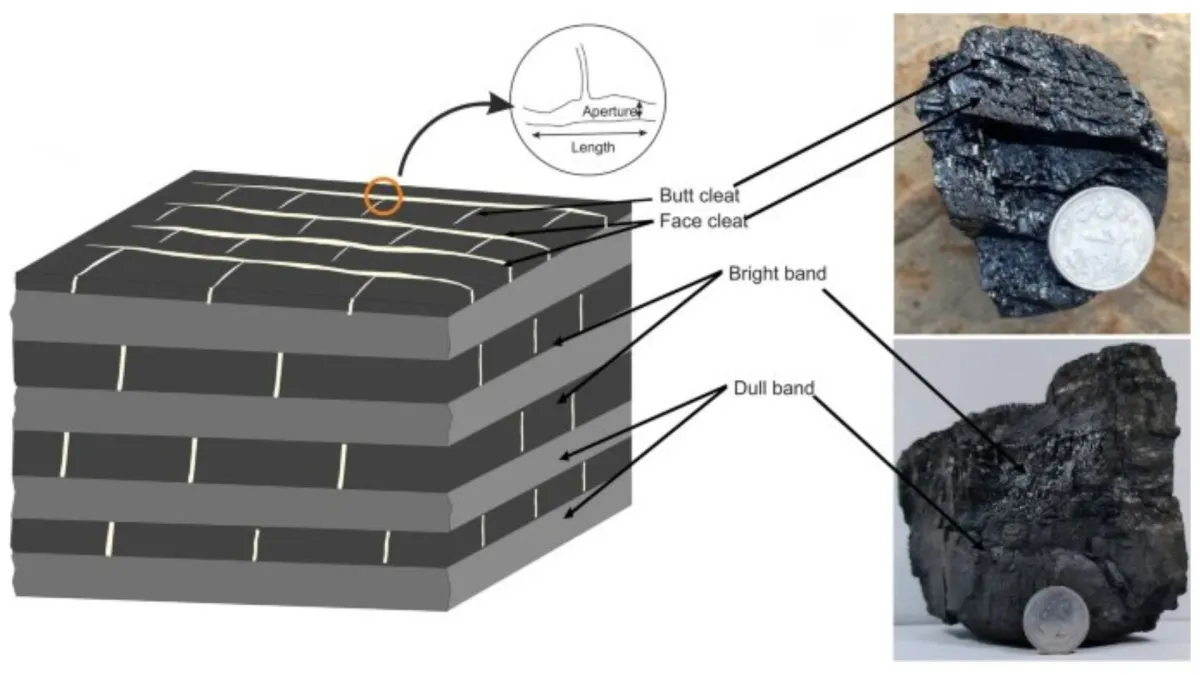
BHOPAL — In the soot-stained heart of Jharkhand’s Jharia coalfields, a region synonymous with India’s industrial past and its subterranean fire-stricken present, a team of researchers from the Indian Institute of Science Education and Research (IISER) Bhopal has uncovered a microscopic secret. This discovery, centered on the way gases traverse infinitesimal cracks in coal seams, promises to revolutionize how the nation extracts clean energy and—more critically—how it might permanently bury its carbon footprint.
As India balances the tightrope of rapid economic development and its "Net Zero" 2070 climate commitments, the research provides a vital mathematical roadmap. By debunking long-held geological formulas and replacing them with a framework tailored to the unique tectonic history of the Indian subcontinent, the study offers a dual-purpose toolkit for energy security and environmental preservation.
Main Facts: A Shift in the Mathematical Paradigm
For decades, the global mining and petroleum industries have relied on a standard equation known as the "Cubic Law" to predict fluid flow through fractured rock. This law posits that the volume of fluid moving through a crack is proportional to the cube of its width (aperture). However, the IISER Bhopal team, led by specialists in geological sciences, found that this "one-size-fits-all" approach fails spectacularly when applied to the stressed, high-quality coking coal of the Jharia basin.
The researchers discovered that in Jharia, gas flow does not scale to the power of three, but rather to the power of five. Specifically, they identified a power exponent ranging from 4.38 to 5.08. This means that even a microscopic increase in the width of a coal fracture allows for a significantly higher volume of gas movement than previously estimated.

This revelation has two immediate applications:
- Enhanced Coal-Bed Methane (CBM) Extraction: It allows for more precise harvesting of methane, a potent but clean-burning "bridge fuel" trapped within coal layers.
- Carbon Capture and Storage (CCS): It provides a reliable method for calculating how much carbon dioxide (CO2) can be safely injected into "unmineable" coal seams, effectively turning old mines into permanent, leak-proof vaults for greenhouse gases.
Chronology: From Tectonic Evolution to Modern Discovery
The story of this breakthrough begins hundreds of millions of years ago during the Gondwana era. The Jharia basin was formed through intense tectonic activity, characterized by the folding and faulting of the Earth’s crust. This geological "squeezing" created a complex network of fractures known as "cleats."
- The Traditional Era (Pre-2000s): Engineers relied on the Cubic Law, developed largely from studies on more uniform geological formations in North America and Europe. While effective for simple pipes or homogenous rock, it struggled to account for the "dual porosity" of coal—where gas is stored in the solid matrix but moves through the cleats.
- The Sampling Phase: To challenge these old models, the IISER Bhopal team conducted extensive field research in Jharia. They bypassed the limitations of laboratory-only studies by collecting samples from a diverse array of environments, including deep underground mines where pressures are extreme and vast open-cast pits that reveal the coal’s upper layers.
- The Analysis Phase: Using advanced microscopy and the "1D scanline method," researchers mapped thousands of fractures. They realized that the length of these cracks was intrinsically tied to their width in a scaling relationship unique to the Indian Shield’s tectonic history.
- The Breakthrough (2024-2026): The team successfully synthesized their findings into a new mathematical framework. By mid-2026, the implications of the "Power of 5" relationship began to ripple through the geological community, offering a more accurate way to model the Jharia basin’s permeability.
Supporting Data: The Physics of the "Power of Five"
To understand why this discovery is a game-changer, one must look at the "Dual Porosity System" of coal. Coal acts like a rigid sponge; the "holes" (matrix) hold the gas, but the "cracks" (cleats) act as the highways.
The Failure of Length-Based Models
In traditional geology, measuring the length of a fracture is the standard way to predict flow. However, the IISER study highlights a major practical hurdle: Sampling Bias. When engineers drill for "core samples"—long cylinders of rock extracted from the earth—the cores are often only a few inches wide.

- If a fracture is several feet long, a core sample only captures a tiny segment of it.
- This leads to "under-sampling," where the true length of the fracture network is underestimated, causing fluid flow models to crash or provide dangerously inaccurate data.
The Width Solution
The IISER Bhopal team’s new model eliminates the need to measure fracture length—a notoriously difficult metric to obtain accurately deep underground. Instead, their formula relies on fracture width (aperture), which is easily visible and measurable even in small core samples.
By identifying that the flow scales to the power of 5 based on width, the researchers have simplified the workload for field engineers. This relationship is a direct result of how tectonic forces have shaped Jharia’s coal; the millions of years of stretching and squeezing have ensured that the width of a crack is a perfect proxy for its overall connectivity.
Official Responses and Industry Impact
While the Ministry of Coal and various national energy agencies have yet to fully integrate the IISER framework into all mining protocols, the response from the scientific and industrial sectors has been one of cautious optimism.
Energy Analysts suggest that this research could be the key to unlocking India’s "unconventional" gas reserves. "For years, CBM extraction in Jharia has been a hit-or-miss endeavor due to unpredictable flow rates," says Dr. Aradhana Singh, a senior energy consultant. "This research provides the ‘missing link’ that could make domestic gas extraction commercially viable and predictable."

Environmental Scientists are looking at the Carbon Capture (CCS) potential. With India’s heavy reliance on coal, the ability to "sequester" carbon—injecting it back into the ground where it reacts with the coal and stays trapped—is a primary strategy for meeting the Paris Agreement goals. The IISER model ensures that when CO2 is injected, scientists can predict exactly where the "plume" of gas will go, preventing accidental leaks into the atmosphere or groundwater.
Implications: A Sustainable Path Forward
The IISER Bhopal study does more than just solve a math problem; it addresses the existential challenge of the 21st century: how to use fossil fuel resources without destroying the planet.
1. Energy Security
By making CBM extraction more efficient, India can reduce its reliance on expensive liquefied natural gas (LNG) imports. CBM is a cleaner alternative to coal and oil, serving as a "bridge fuel" while the nation builds up its solar and wind infrastructure.
2. Safeguarding the "Sponge"
The research confirms that Jharia’s coal seams are excellent "sponges" for CO2. However, it also warns that without this specific mathematical understanding, injection projects could fail. Knowing that flow is hyper-sensitive to crack width (the Power of 5) allows engineers to manage pressure more carefully, ensuring the coal seam doesn’t fracture further and release trapped gases.

3. A Broader Warning for Infrastructure
The study’s emphasis on site-specific research echoes other environmental concerns in India. Just as the IISER team found that "global" coal laws don’t apply to Jharia, other researchers have warned that massive infrastructure projects, such as the National River Linking Project (NRLP), require similar local scrutiny.
Critics of the NRLP argue that connecting previously isolated river basins via canals could cause an "explosion" of invasive species, threatening native ecosystems. Both the Jharia study and the river-linking debate highlight a singular truth: in a country as geologically and biologically diverse as India, large-scale engineering must be guided by localized, high-precision science rather than broad assumptions.
Conclusion
As the global community pushes toward net-zero emissions, the "tiny cracks" of Jharia have become a focal point for a greener future. The work of IISER Bhopal demonstrates that the path to a sustainable economy is paved with fundamental science. By understanding the microscopic highways beneath our feet, India is better positioned to harvest the energy it needs today while building the carbon vaults it needs for tomorrow.
In the high-stakes theater of climate change, these mathematical equations are the essential gears that will make the machinery of a green economy actually turn, ensuring that the legacy of the Jharia coalfields shifts from one of fire and smoke to one of carbon storage and clean energy.
