

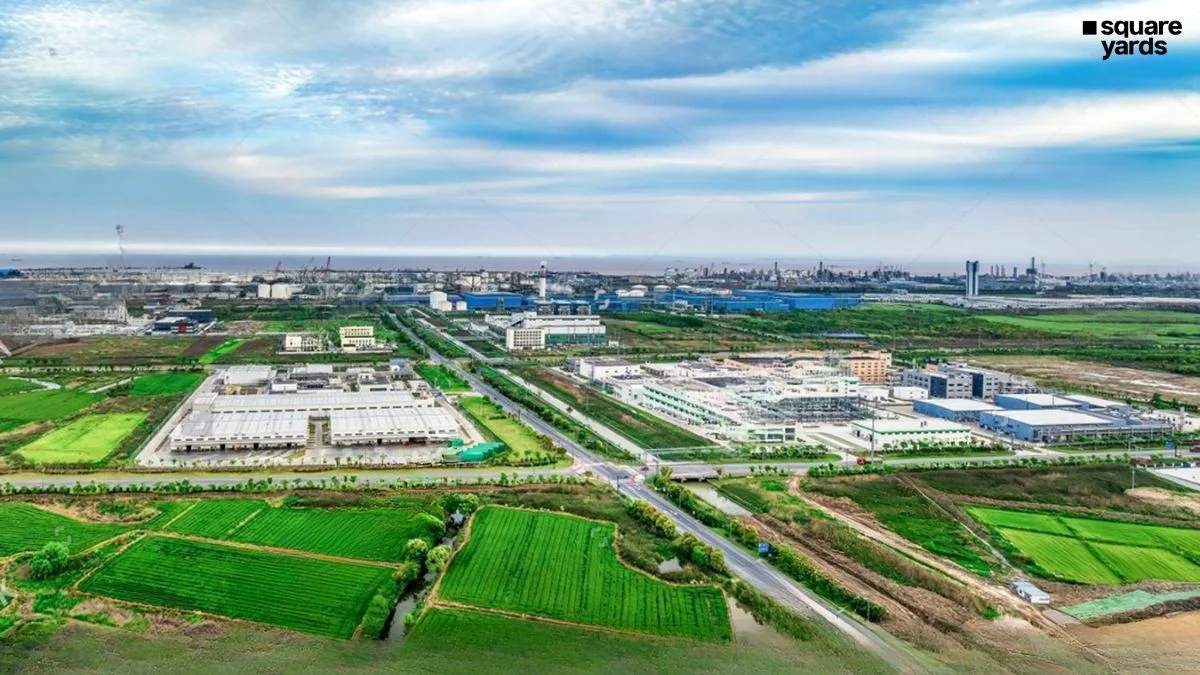
LUCKNOW – In a move that signals a paradigm shift in Northern India’s economic landscape, the Uttar Pradesh State Industrial Development Authority (UPSIDA) has formally approved a monumental budget of ₹9,000 crore for the 2026-27 fiscal year. This strategic financial commitment, ratified during the authority’s 51st Board Meeting, marks a 100% increase over the previous year’s allocation, underscoring the state’s aggressive pursuit of a "manufacturing-first" growth model.
The expansive roadmap is designed to catalyze industrial infrastructure, expedite land acquisition, and establish new industrial hubs in historically underserved regions like Fatehpur and emerging economic centers like Ayodhya. By doubling its capital outlay, UPSIDA is positioning Uttar Pradesh not merely as a transit corridor, but as a global destination for manufacturing excellence, leveraging its burgeoning network of expressways and logistics parks.
I. Main Facts: The ₹9,000 Crore Industrial Mandate
The 51st Board Meeting of UPSIDA, chaired by senior state officials, has set a new benchmark for state-led industrial planning. The core of the announcement lies in the sheer scale of the fiscal expansion. The approved ₹9,000 crore budget for FY27 is a significant leap from the ₹4,500 crore earmarked for FY26.
Key Highlights of the Approval:
- Budgetary Doubling: The 100% increase in the annual budget is intended to facilitate "plug-and-play" infrastructure for global and domestic investors.
- New Industrial Estates: Approval of layout plans for Katayi Mill (Fatehpur) and the Sandhinawa and Trishundi areas (Ayodhya).
- Land Acquisition Fund: A dedicated allocation of ₹2,250 crore specifically for the identification and procurement of new land banks.
- Operational Scale: UPSIDA currently manages a massive portfolio of 165 industrial areas spanning 17 districts, a footprint that is set to expand further under this new mandate.
- Focus on Speed: The authority has prioritized "investor readiness," aiming to reduce the lead time between land allotment and the commencement of factory operations.
II. Chronology: The Evolution of UPSIDA’s Strategy
To understand the magnitude of the FY27 budget, one must look at the chronological progression of Uttar Pradesh’s industrial policy over the last few years.
2022-2024: The Connectivity Phase
During this period, the state focused heavily on the completion of the "Expressway Quadrilateral," including the Purvanchal and Bundelkhand Expressways. UPSIDA began aligning its land banks with these high-speed corridors to ensure that industrial goods could reach major ports and markets with minimal friction.
2025: The Consolidation Phase
The FY26 budget of ₹4,500 crore was a foundational step. It focused on upgrading existing industrial areas that had suffered from decades of neglect. This included modernizing drainage, improving power reliability, and digitizing the land allotment process through the "Nivesh Mitra" portal.
2026-2027: The Expansion Phase
The current approval for FY27 represents the "Scaling" phase. With the connectivity infrastructure largely in place, the state is now shifting focus toward massive land aggregation and the creation of specialized clusters. The inclusion of Ayodhya in the industrial map reflects a shift from purely religious tourism to a diversified economic model.
III. Supporting Data: Financial Breakdown and Infrastructure Metrics
The ₹9,000 crore investment is not a monolithic figure but a multifaceted financial strategy.
1. Land Acquisition and Feasibility (₹2,250 Crore)
Nearly a quarter of the budget is reserved for expanding the state’s land bank. UPSIDA’s strategy involves:
- Demand-Based Identification: Using GIS mapping and market demand surveys to identify land near the Dedicated Freight Corridor (DFC).
- Price Benchmarking: Ensuring land acquisition remains competitive yet fair to local stakeholders to avoid legal delays.
2. Core Infrastructure Development
A significant portion of the remaining ₹6,750 crore will be funneled into "Internal and External Infrastructure," which includes:
- Power Sub-stations: Upgrading to 24/7 industrial-grade power supply.
- Common Effluent Treatment Plants (CETPs): Ensuring that the expansion adheres to modern environmental standards.
- Last-Mile Connectivity: Building wide-lane approach roads from the main expressways directly into the industrial estates.
3. Regional Focus: Ayodhya and Fatehpur
- Ayodhya (Sandhinawa & Trishundi): These layouts are designed to tap into the massive influx of capital following the city’s spiritual and infrastructural redevelopment. The focus here will likely be on light manufacturing, agro-processing, and consumer goods.
- Fatehpur (Katayi Mill): Located strategically between Kanpur and Prayagraj, this site is being revived to serve as a hub for MSMEs (Micro, Small, and Medium Enterprises) and textile manufacturing.
IV. Official Responses: A Vision for a Trillion-Dollar Economy
The leadership at UPSIDA and the Uttar Pradesh government have framed this budget as a cornerstone of the state’s ambition to become a $1 trillion economy.
The UPSIDA Chairman’s Statement:
In a briefing following the board meeting, the Chairman emphasized that the authority is no longer just a "land-owning agency" but a "facilitator of industrial ecosystems."
"Our goal is to provide an environment where a manufacturer can move from allotment to production in record time. This ₹9,000 crore budget is a testament to our commitment to making Uttar Pradesh the industrial backbone of India. We are focusing on high-tech layouts and sustainable infrastructure that can compete with global standards."
Department of Infrastructure and Industrial Development:
Senior officials noted that the integration of the "Gati Shakti" framework has allowed UPSIDA to coordinate better with other departments, ensuring that when an industrial estate is cleared, the water, power, and road departments are already in sync.
V. Implications: Real Estate, Logistics, and Socio-Economic Impact
The ripple effects of a ₹9,000 crore industrial injection extend far beyond the factory gates. The implications for real estate and the broader economy are profound.
1. The Real Estate "Multiplier Effect"
The development of industrial corridors invariably leads to a surge in demand for three distinct real estate segments:
- Industrial Real Estate: Increased demand for Grade-A warehouses and cold storage facilities, especially near the Ayodhya-Lucknow-Gorakhpur circuit.
- Commercial Real Estate: As multinational corporations and large domestic players set up shop, there will be a burgeoning need for office spaces, banks, and service centers in nearby towns.
- Residential Real Estate: The "employment-led housing" phenomenon will take center stage. New industrial estates in Fatehpur and Ayodhya will require housing for thousands of workers, managers, and engineers. This will likely trigger a boom in affordable housing projects and organized townships.
2. Strengthening the Logistics Backbone
With the Ganga Expressway nearing completion and the Dedicated Freight Corridor operational, UPSIDA’s new estates are perfectly positioned to lower logistics costs. Currently, logistics costs in India hover around 13-14% of GDP; projects like these aim to bring that figure down to 8-9% by creating efficient clusters that minimize empty backhauls and optimize freight movement.
3. Socio-Economic Transformation and Employment
The expansion is expected to generate hundreds of thousands of direct and indirect jobs. By taking industrialization to districts like Fatehpur, the state is addressing regional imbalances. This localized employment helps curb distress migration to tier-1 metros, allowing for a more balanced demographic distribution and improving the standard of living in rural and semi-urban Uttar Pradesh.
4. Ayodhya’s Economic Diversification
Perhaps the most intriguing implication is the industrialization of Ayodhya. While the city has seen a tourism explosion, tourism is often seasonal or sensitive to external factors. By introducing a manufacturing base in Sandhinawa and Trishundi, the state is providing Ayodhya with a "second engine" of growth, ensuring economic stability through year-round industrial production.
Conclusion: A New Industrial Epoch
The approval of the ₹9,000 crore FY27 budget by UPSIDA is more than a fiscal exercise; it is a declaration of intent. By doubling its investment and focusing on systematic, layout-driven development in Fatehpur and Ayodhya, Uttar Pradesh is signaling that it has moved past the era of sporadic growth.
As the state aligns its industrial estates with its world-class expressways and freight corridors, it creates a self-sustaining cycle of investment, employment, and infrastructure development. For investors, developers, and the citizens of Uttar Pradesh, this blueprint represents a transition toward a more prosperous, industrialized future where the "Made in UP" tag carries global weight.
