

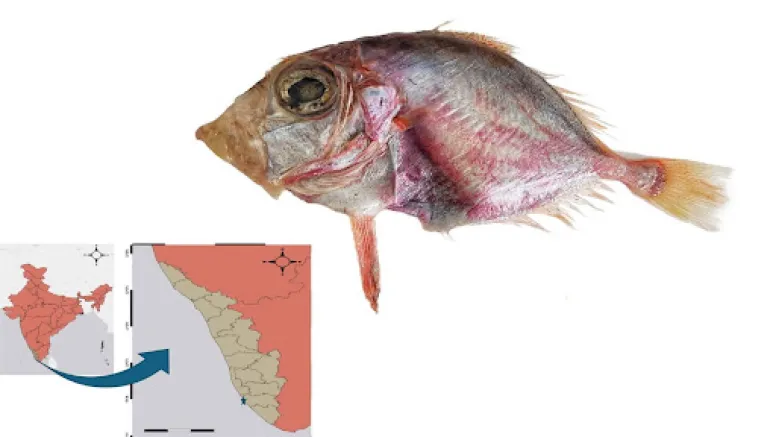
KERALA — In a landmark discovery for marine biology and Indian ichthyology, scientists from the ICAR-Central Marine Fisheries Research Institute (CMFRI) have officially identified a new species of deep-sea fish. Found inhabiting the enigmatic "twilight zone" of the eastern Lakshadweep Sea, the species has been named Cyttopsis indica, commonly referred to as the Indian dory.
This discovery, emerging from the depths of the southwest coast of India, underscores the vast, untapped biodiversity of the Indian Ocean’s continental slopes. As global interest in the "Blue Economy" and deep-sea conservation intensifies, the identification of Cyttopsis indica serves as a poignant reminder of how much remains unknown within the world’s third-largest ocean.
Main Facts: The Emergence of Cyttopsis indica
The Indian dory (Cyttopsis indica) belongs to the family Zeidae, a group of deep-sea fishes often characterized by their disc-shaped, laterally compressed bodies. While dories are found in various oceans across the globe, the identification of a unique species specific to the Indian coastline is a significant scientific milestone.
The specimens were first intercepted at the Sakthikulangara Fisheries Harbour in Kerala. They were brought to the surface by commercial trawlers that had been operating at substantial depths—ranging from 350 to 500 meters—along the continental slope of the eastern Lakshadweep Sea. This region, often referred to as the mesopelagic or "twilight zone," is a layer of the ocean where sunlight is extremely faint, necessitating specialized biological adaptations for survival.
Key Characteristics of the New Species:
- Scientific Name: Cyttopsis indica
- Common Name: Indian dory
- Coloration: A uniform rosy to silvery pink hue, lacking the distinctive dark spots found in some of its Pacific counterparts.
- Morphology: Distinguished by a specific count of 68 to 78 scales along the lateral line and the presence of two hard spines in the anal fin.
- Habitat: Deep-sea continental slopes at depths of 350–500 meters.
- Genetic Divergence: Displays a 4.6% to 11% genetic variance from its closest taxonomic relatives.
Chronology: From the Abyss to the Laboratory
The journey of Cyttopsis indica from an unknown inhabitant of the abyss to a recognized species involved a multi-stage process of "opportunistic discovery" and rigorous laboratory validation.

1. The Collection Phase
The discovery did not begin in a high-tech submersible, but rather at the bustling Sakthikulangara Fisheries Harbour. Marine scientists from ICAR-CMFRI often conduct routine biodiversity surveys at major fishing hubs to monitor the "bycatch"—species caught incidentally by deep-sea trawlers. In this instance, commercial vessels targeting deep-sea shrimp and other high-value crustaceans inadvertently brought up several specimens of an unusual-looking dory.
2. Initial Observation
Upon initial inspection, the fish bore a striking resemblance to the Rosy dory (Cyttopsis rosea) and the Little dory (Cyttopsis cypho). However, seasoned taxonomists at CMFRI noted subtle morphological discrepancies, particularly in the head shape and the spacing of the eyes. These anomalies prompted a more formal investigation to determine if the fish was a known species extending its range or an entirely new branch of the Cyttopsis genus.
3. Integrated Taxonomic Analysis
Over several months, the research team employed an "integrated taxonomy" approach. This involved two parallel tracks of investigation:
- Morphometric Analysis: Detailed physical measurements and counts of anatomical features (meristics) were compared against historical records of the Zeidae family.
- Molecular Sequencing: Back at the CMFRI laboratories, DNA was extracted from the specimens. Scientists focused on DNA barcoding, specifically targeting the mitochondrial cytochrome c oxidase subunit I (COI) gene, which serves as a standard "genetic fingerprint" for animal species.
4. Validation and Naming
By July 2026, the results were conclusive. The genetic data confirmed that the specimens were distinct from Atlantic and Pacific populations. With the evidence published and peer-reviewed, the species was officially named Cyttopsis indica, paying homage to the Indian Ocean (Indica) where it was discovered.
Supporting Data: Comparative Biology and Genetics
The distinction of Cyttopsis indica is not merely a matter of geography; it is rooted in significant biological differences that separate it from its global cousins.

Morphological Distinctions
Taxonomists use "meristic counts"—the number of countable structures like scales or fin rays—to differentiate species. Cyttopsis indica possesses 68 to 78 scales along its lateral line. When compared to the Atlantic Rosy dory, the Indian dory exhibits a broader interorbital space (the area between the eyes) and a shorter post-orbital length (the area behind the eyes).
Furthermore, while the Pacific Cyttopsis cypho often displays a prominent black spot on its flank, C. indica maintains a consistent rosy-pink or silvery-pink coloration across its body. This lack of a "target spot" is a key visual identifier for researchers in the field.
Genetic Divergence
The most compelling evidence for the new species came from the molecular data. In the world of marine biology, a genetic difference of 1% to 2% can often indicate a separate species. The Indian dory, however, showed a staggering 4.6% to 11% difference from other known species in the Cyttopsis genus. This high level of divergence suggests that the Indian dory has been evolutionarily isolated in the Indian Ocean for a significant period, allowing it to develop into a genetically distinct lineage.
Official Responses: The Scientific Community Reacts
The identification of Cyttopsis indica has been hailed by the Indian Council of Agricultural Research (ICAR) and the wider scientific community as a victory for domestic marine research.
Dr. Karthick Balasubramanian, a lead researcher involved in the study, emphasized the importance of the find: "The discovery of Cyttopsis indica is a significant reminder of the cryptic diversity in our oceans. We often assume that because a fish looks similar to one found in the Atlantic, it must be the same species. Our study proves that the deep waters of the Indian Ocean harbor unique life forms that require their own specific conservation and management strategies."

Officials from ICAR-CMFRI noted that this discovery is part of a broader effort to document India’s marine wealth. They highlighted that while shallow-water species are relatively well-documented, the deep-sea "twilight zone" remains a frontier of mystery. The institute plans to increase its focus on deep-water surveys, moving beyond commercial landing sites to dedicated research vessel expeditions.
Implications: Conservation and the Future of the Deep Sea
The discovery of the Indian dory carries weight far beyond the walls of a laboratory. It has profound implications for how India manages its marine resources and protects its biodiversity.
1. Understanding Cryptic Diversity
The existence of Cyttopsis indica highlights the concept of "cryptic species"—organisms that appear identical to the naked eye but are biologically and genetically distinct. If scientists do not recognize these differences, they may inadvertently over-exploit a rare species, thinking it is part of a larger, more common population. Accurate identification is the first step in effective fisheries management.
2. Monitoring the Twilight Zone
The mesopelagic zone (200m to 1,000m) is one of the most under-researched areas on Earth. Yet, it plays a vital role in the global carbon cycle and serves as a massive reservoir of biomass. Discovering new species like the Indian dory suggests that the Lakshadweep Sea’s continental slopes are more biodiverse than previously thought. As climate change alters ocean temperatures and acidity, understanding the baseline inhabitants of these depths is crucial for monitoring ecological shifts.
3. The Impact of Trawling
The fact that this species was discovered via commercial trawling is a double-edged sword. While it demonstrates the utility of "fisheries-dependent sampling," it also raises concerns about the impact of deep-sea bottom trawling. If new species are being pulled up in nets as bycatch, there is a risk that delicate deep-sea habitats are being disturbed before they can even be studied.

4. Strengthening the Blue Economy
India’s "Deep Ocean Mission" aims to explore the deep sea for resources and minerals. However, the discovery of Cyttopsis indica reinforces the argument that biological wealth is just as valuable as mineral wealth. Maintaining a healthy, biodiverse ocean is essential for the long-term sustainability of India’s Blue Economy, particularly for the livelihoods of thousands of fishers in Kerala and Lakshadweep.
Conclusion
The discovery of Cyttopsis indica is more than just the addition of a name to a taxonomic list. It is a testament to the persistence of Indian marine scientists and a call to action for the preservation of the Indian Ocean’s hidden depths. As the sun sets over the Lakshadweep Sea, far beneath the waves, the Indian dory continues its silent existence in the dark—a rosy-pink reminder that the age of discovery is far from over.
