

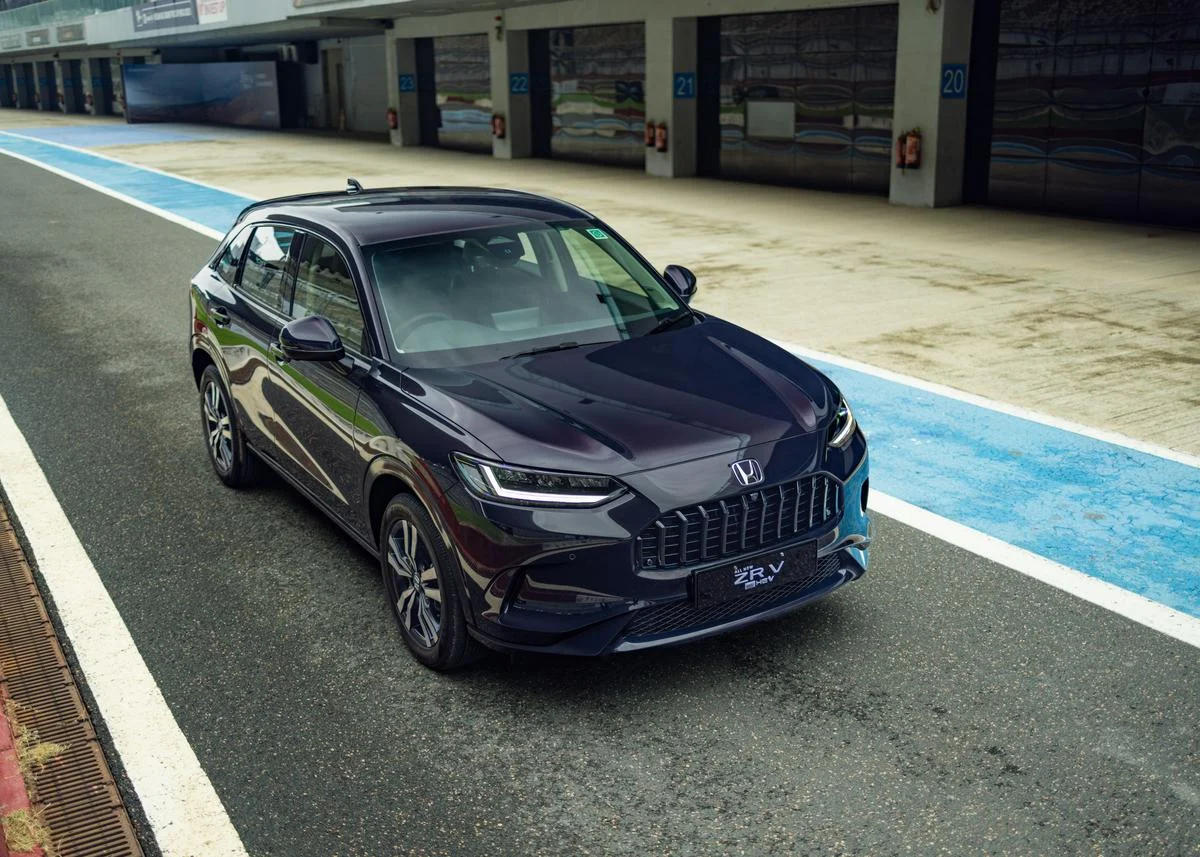
The Indian automotive landscape, particularly the premium SUV segment, has recently devolved into what industry analysts call a "feature arms race." Manufacturers are increasingly prioritizing aesthetic aggression, oversized infotainment screens, and exhaustive brochures to capture the attention of a tech-savvy consumer base. However, Honda’s latest offering, the ZR-V, suggests a deliberate pivot away from this trend.
Launched at an ex-showroom price of ₹47.99 lakh, the ZR-V enters the market not as a mass-market volume seeker, but as a testament to mechanical integrity and "quiet luxury." Imported as a Completely Built Unit (CBU), it challenges the status quo by betting on engineering depth over marketing gimmicks.
Main Facts: Positioning the ZR-V in a Crowded Field
The Honda ZR-V arrives in India at a time when the mid-to-premium SUV space is bifurcated between rugged off-roaders and feature-heavy urban crossovers. At nearly ₹48 lakh, the ZR-V finds itself in a precarious yet unique position. It is a five-seater crossover that costs as much as some seven-seater rivals, yet it lacks certain "standard" luxuries like a panoramic sunroof or ventilated seats.
Key Specifications at a Glance:
- Price: ₹47.99 Lakh (Ex-showroom).
- Powertrain: 2.0-litre i-VTEC Atkinson-cycle engine paired with Honda’s e:HEV strong hybrid system.
- Output: 181 bhp and 315 Nm of peak torque.
- Transmission: e-CVT (Electronic Continuously Variable Transmission).
- Performance: 0-100 km/h in 7.9 seconds.
- Efficiency: ARAI-claimed 22 kmpl; real-world estimates at 17-19 kmpl.
- Safety: 8 Airbags, Honda Sensing (ADAS), and a 4-star Euro NCAP rating.
The ZR-V is positioned for the "discerning minimalist"—a buyer who values how a car is put together more than how many pixels are on the dashboard. By bringing it in as a CBU, Honda is targeting a niche audience that appreciates global build standards and is willing to pay the associated tax-driven premium.

Chronology: The Evolution of Honda’s Hybrid Philosophy
To understand the ZR-V, one must look at Honda’s journey with the e:HEV technology. While the Honda City Hybrid introduced the Indian masses to this sophisticated dual-motor setup, the ZR-V represents the system’s most refined iteration to date.
- The Hybrid Foundation: Honda’s development of the e:HEV system focused on solving the "rubber-band effect" common in traditional CVTs. By using a generator motor and a propulsion motor, Honda created a system that mimics the linear feel of a traditional gearbox while maintaining EV-like efficiency.
- Global Debut and Adaptation: The ZR-V was originally designed to bridge the gap between the compact HR-V and the larger CR-V in global markets like Europe and Japan. Its arrival in India marks a strategic attempt to reclaim the premium "Civic-like" aura in an SUV body style.
- The Indian Testing Phase: Before its commercial rollout, the ZR-V underwent rigorous evaluation at the Buddh International Circuit (BIC). This choice of venue was symbolic; Honda wanted to prove that a hybrid family SUV could handle the stresses of a Formula 1-grade track, emphasizing chassis balance over mere straight-line speed.
Supporting Data: Engineering and Performance Metrics
The heart of the ZR-V is its 2.0-litre e:HEV powertrain. Unlike "mild hybrids" that merely assist the engine, Honda’s "strong hybrid" system allows the vehicle to operate in three distinct modes without driver intervention:
- EV Drive Mode: The propulsion motor draws power exclusively from the lithium-ion battery, providing silent, zero-emission travel at low speeds.
- Hybrid Drive Mode: The petrol engine powers the generator motor, which in turn provides electricity to the propulsion motor. This is used during brisk acceleration.
- Engine Drive Mode: At sustained highway speeds, a lock-up clutch connects the petrol engine directly to the front wheels, as internal combustion is most efficient in this specific rev range.
Performance on the Track
During testing at the Buddh International Circuit, the ZR-V demonstrated remarkable high-speed composure. It reached 150 km/h on the back straight with a level of stability usually reserved for European luxury marques. The 0-100 km/h sprint of 7.9 seconds puts it ahead of many diesel-powered competitors in the segment.
In the slalom tests, the ZR-V’s low center of gravity—aided by the floor-mounted battery pack—allowed for crisp direction changes at 80 km/h. The steering rack, though light for city use, weights up progressively, providing the driver with enough feedback to place the car accurately through corners.

Efficiency vs. Utility
The ZR-V’s efficiency is its strongest empirical argument. In a segment where petrol SUVs often struggle to cross the 10 kmpl mark in city traffic, the ZR-V’s ability to deliver upwards of 17 kmpl in real-world conditions significantly reduces the total cost of ownership over a 5-to-7-year period.
Official Responses and Manufacturer Perspective
Honda’s official stance on the ZR-V emphasizes "Substance over Spectacle." While the company acknowledges the absence of certain "trending" features, spokespeople highlight the vehicle’s long-term reliability and build quality.
According to Honda’s engineering philosophy for the ZR-V, every touchpoint was designed for tactile satisfaction. The "click" of the climate control knobs, the dampened movement of the air vents, and the use of premium soft-touch plastics are intended to create an environment of "perceived quality."
Thoughtful Innovation
Honda representatives point to two specific "invisible" features as evidence of their engineering-first approach:

- Integrated Wiper Jets: By moving the washer fluid nozzles from the bonnet to the wiper arms, Honda ensures that the driver’s vision is never obscured by a spray of water, and fluid consumption is reduced by 20%.
- The "Considerate" Tailgate: Most powered tailgates begin closing immediately. The ZR-V’s system pauses for a second, allowing the user to step back safely, a small but significant nod to daily usability.
Critical Analysis: The Price of Refinement
Despite its engineering prowess, the ZR-V faces significant headwinds in the Indian market. The price tag of ₹47.99 lakh places it in direct competition with vehicles that offer more "perceived value" for the money.
The Feature Deficit
In the Indian context, "premium" is often synonymous with "abundance." The ZR-V lacks:
- Ventilated Seats: A near-essential feature in India’s tropical climate.
- Panoramic Sunroof: While it has a standard sunroof, many Indian buyers prefer the airy feel of a full glass roof.
- Modern Infotainment: The 9-inch screen, while functional and lag-free, looks dated compared to the 12-inch or 14-inch curved displays found in newer rivals.
Ergonomic Considerations
The high-voltage battery located under the floor results in a slightly "knees-up" seating position for rear-seat passengers. While the seats themselves are well-bolstered and covered in high-quality leather, the lack of a reclining rear backrest may be a deal-breaker for those who intend to be chauffeur-driven.
Implications: A New Benchmark for the "Long-Term" Buyer?
The introduction of the ZR-V has broader implications for the Indian automotive market and Honda’s future in the subcontinent.

1. The Viability of CBUs
The ZR-V serves as a litmus test for whether Indian buyers are willing to pay a premium for "Import Quality." If the ZR-V finds a steady niche, it may encourage other manufacturers to bring in global models without the immediate need for heavy localization, focusing instead on high-end, low-volume segments.
2. The Hybrid vs. EV Debate
As India moves toward electrification, the ZR-V makes a compelling case for the hybrid as a "bridge" technology. It offers the smoothness and torque of an EV without the range anxiety or the need for a robust charging infrastructure, which is still lacking in many parts of the country.
3. Brand Rejuvenation
For years, Honda has been perceived as a manufacturer of reliable but "safe" cars like the City and Amaze. The ZR-V, with its sophisticated drivetrain and BIC-proven handling, injects a much-needed dose of "The Power of Dreams" back into the brand’s Indian portfolio.
Conclusion: A Masterclass in Understated Excellence
The Honda ZR-V is a polarizing vehicle, not because of its design, but because of its value proposition. It asks the buyer to ignore the lack of a large screen or a panoramic roof and instead focus on the precision of its welds, the efficiency of its motor, and the balance of its chassis.

It is a car designed for the driver who understands that the best engineering is often that which you don’t see, but rather that which you feel over years of ownership. While it may not top the sales charts against more "flashy" competitors, it sets a new benchmark for refinement and mechanical integrity in the premium SUV segment. For those who prioritize substance, the ZR-V isn’t just a car; it’s a long-term investment in quality.
This report was compiled by Motorscribes in association with The Hindu. For further automotive insights, follow @motorscribes on Instagram.
