

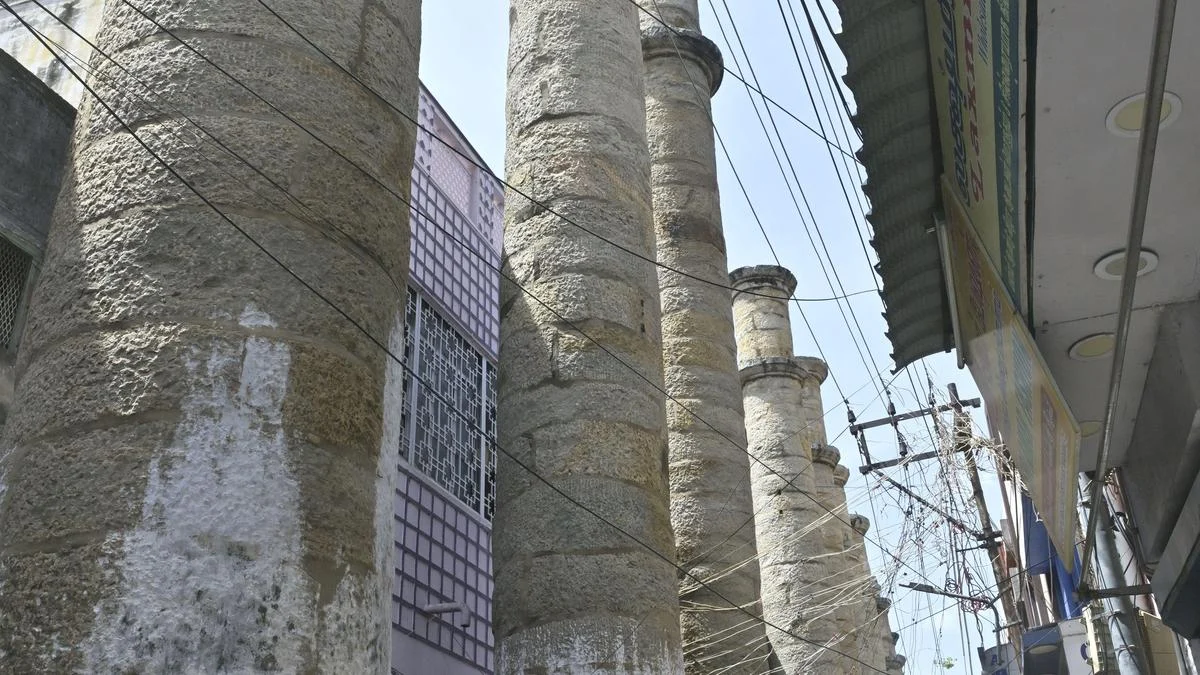
Madurai, India – Amidst the vibrant chaos of Madurai’s bustling marketplaces, a significant historical artery often goes unnoticed by the hurried stride of its shoppers. Pathu Thoon, translating to "ten pillars," is a testament to Madurai’s rich past, a street whose very name echoes with centuries of history. Tucked away in the heart of the city, this lesser-known heritage site derives its identity from a row of colossal pillars, silent sentinels that have graced the lane for over 300 years. While these ancient structures narrate tales of royal lineage and architectural prowess, the neighborhood has evolved into a dynamic hub of textile commerce, where the echoes of trade and the whispers of history intermingle, creating a unique tapestry of past and present.
For many residents and visitors, these imposing pillars are merely familiar landmarks, navigational aids in the labyrinthine lanes. However, for archaeologists and historians, they are invaluable fragments of a grand narrative, pieces of a historical puzzle still being meticulously assembled. The enduring presence of these pillars, juxtaposed against the lively commercial activity, creates a poignant visual representation of a city that honors its heritage while embracing its future.
Unearthing the Past: The Nayak Legacy and the Pillars’ Origin
The origins of the Pathu Thoon pillars are shrouded in the mists of time, with scant direct documentation from the period of their presumed creation. An official from the Department of Archaeology, speaking on condition of anonymity, highlighted the scarcity of surviving records from the Nayak era concerning this specific structure. "What we know today comes largely from British-era records and the meticulous work of historians," the official stated, underscoring the reliance on secondary sources to piece together the historical context.
Based on these fragmented records, historians and archaeologists widely believe that the pillars were once an integral part of an extensive palace complex dating back to the Nayak period, a significant era in the history of South India. The prevailing theory suggests that these pillars were part of a separate palace constructed for Muthiyalu Nayak, the brother of the renowned Thirumalai Nayak. This hypothesis offers a compelling glimpse into the dynastic ambitions and architectural undertakings of the Nayak rulers.

The Nayak dynasty, which held sway over the region, initially established its seat of power in Tiruchi. However, Thirumalai Nayak, a visionary ruler, recognized the strategic and cultural importance of Madurai and shifted the capital to this ancient city. This relocation spurred a period of significant architectural and developmental growth in Madurai, leaving behind a legacy of grand structures that continue to awe visitors. Centuries later, Thirumalai Nayak’s grandson, Chokkanatha Nayak, would once again shift the capital back to Tiruchi, marking a cyclical pattern in the region’s political landscape.
It is during this subsequent period of transition that the narrative of the Pathu Thoon pillars gains a crucial dimension. Historians theorize that as construction of a formidable fort commenced in Tiruchi, stones and materials from portions of the Madurai palace were repurposed. This practice, common in ancient construction, would have allowed for the efficient utilization of resources. However, the monumental pillars, perhaps too grand or too integral to be easily dismantled, were left standing in their original location. This act of preservation, albeit unintentional, ensured their survival, leading to the formation of the street we recognize today as Pathu Thoon.
The British Imprint and the Street’s Transformation
The historical trajectory of the Pathu Thoon pillars continued to evolve during the British colonial era. The period witnessed various efforts to restore and preserve historical sites across India, and Madurai was no exception. Lord Napier, a prominent figure during this time, is credited with overseeing the restoration of the Madurai palace complex. While the palace itself underwent repairs and renovations, the ancient pillars were left untouched, their historical significance acknowledged.
"The palace was repaired, but these pillars remained where they were," explained the archaeology official. "Over time, as the area around them developed, and perhaps due to their prominent presence, this street came to be known as Pathu Thoon." The name, derived from the very pillars that defined its landscape, became a permanent fixture, solidifying its identity as a place of historical importance, even as its character began to shift.

A Living Heritage: Generations in the Shadow of Pillars
For residents like JK Subramanian, who has called Pathu Thoon home for over seven decades, the street is far more than just a bustling textile market; it is a repository of personal memories and a living testament to enduring community. "Many people know Pathu Thoon for its shops, but there are houses too. Families have been living here for generations," he shared, emphasizing the residential character that often gets overshadowed by the commercial vibrancy.
Subramanian’s daily commute along Pathu Thoon is a constant communion with history. "Every time I walk down this street, I think about its history," he confessed. "These pillars remind me that they were once part of something very important." The sheer scale and antiquity of the structures continue to evoke a sense of awe and wonder in him, a sentiment echoed by many who pause to look up.
"Even today, I wonder how people built something like this without the machines we have now," he mused, marveling at the craftsmanship and engineering of a bygone era. "They have been standing here for centuries and have seen the city change around them." This profound sense of continuity, of witnessing the ebb and flow of urban development from an unchanging vantage point, imbues the pillars with a unique significance for the long-term residents.
The Enduring Allure of the Textile Trade
While the historical narrative of Pathu Thoon is deeply rooted in its ancient pillars, its present-day identity is inextricably linked to its vibrant textile market. R Murugan, who has been operating a textile shop on the street for the past 15 years, attests to the enduring appeal of this commercial hub, even in the face of modern retail evolution. "New showrooms and branded stores have come up across Madurai, but people still come here to shop," he stated with a sense of pride.

The primary draw, according to Murugan, is the unparalleled variety and competitive pricing that Pathu Thoon offers. "If they don’t find what they are looking for in one shop, they simply walk into the next. They can compare prices, designs, and quality before deciding," he explained, highlighting the traditional marketplace model that empowers consumers with choice and negotiation. This freedom to explore, compare, and haggle is a stark contrast to the often curated and fixed-price environments of modern malls.
The street experiences its peak of activity during festive seasons and the wedding season, transforming into a kaleidoscope of colors and a symphony of bargaining. "On some days, the street is so crowded that there is hardly any space to walk," Murugan observed, painting a vivid picture of its bustling nature. The street’s resilience is further underscored by the generational loyalty it commands. "We have seen families who shopped here years ago come back with their children. That’s what keeps this place alive," he added, emphasizing the intergenerational connection that the market has fostered.
A Customer’s Perspective: History in the Fabric
The loyalty of customers like M Vijayalakshmi further validates the unique appeal of Pathu Thoon. "I have been shopping here for many years," she shared. "Even though there are malls now, I still prefer coming here because I can visit several shops at one stretch." Her shopping routine exemplifies the practical advantages of the street’s concentrated retail offering.
While her primary focus is on saris and dress materials, Vijayalakshmi’s approach is one of exploration rather than pre-determined choices. "I don’t have a favorite shop; I usually walk through the street first and then decide where to buy." This serendipitous shopping experience, where discovery plays a significant role, is a hallmark of traditional markets.

Interestingly, it was only through conversations with others that Vijayalakshmi began to truly appreciate the historical significance of the pillars. "I never paid much attention to the pillars until someone told me about their history," she admitted. "Now, whenever I come here, I make it a point to look at them." This realization adds a new layer of appreciation to her shopping excursions, transforming a routine activity into an opportunity to connect with the city’s past.
The Unfolding Future: Continuity and Enduring Significance
As the sun sets over Madurai, casting long shadows across Pathu Thoon, the street continues its age-old rhythm. The shop shutters will eventually close, but the inherent spirit of the place will endure. The tall pillars, standing stoically against the backdrop of a rapidly modernizing city, will continue their silent vigil. They are not merely architectural remnants; they are storytellers, waiting patiently for the next passerby to pause, look up, and contemplate the layers of history they have carried for centuries.
Pathu Thoon, therefore, represents more than just a historical site or a commercial district. It is a microcosm of Madurai itself – a city that skillfully weaves its rich historical tapestry into the vibrant fabric of contemporary life. The enduring presence of the ten pillars, juxtaposed with the lively exchange of textiles, serves as a powerful reminder that the past is not a separate entity, but an intrinsic part of the present, shaping and enriching the lives of those who walk its storied lanes. The street’s future, much like its past, seems destined to be a continuation of this harmonious coexistence, where the echoes of royalty resonate within the clamor of commerce, and the silent stones bear witness to the ceaseless flow of human endeavor.
