

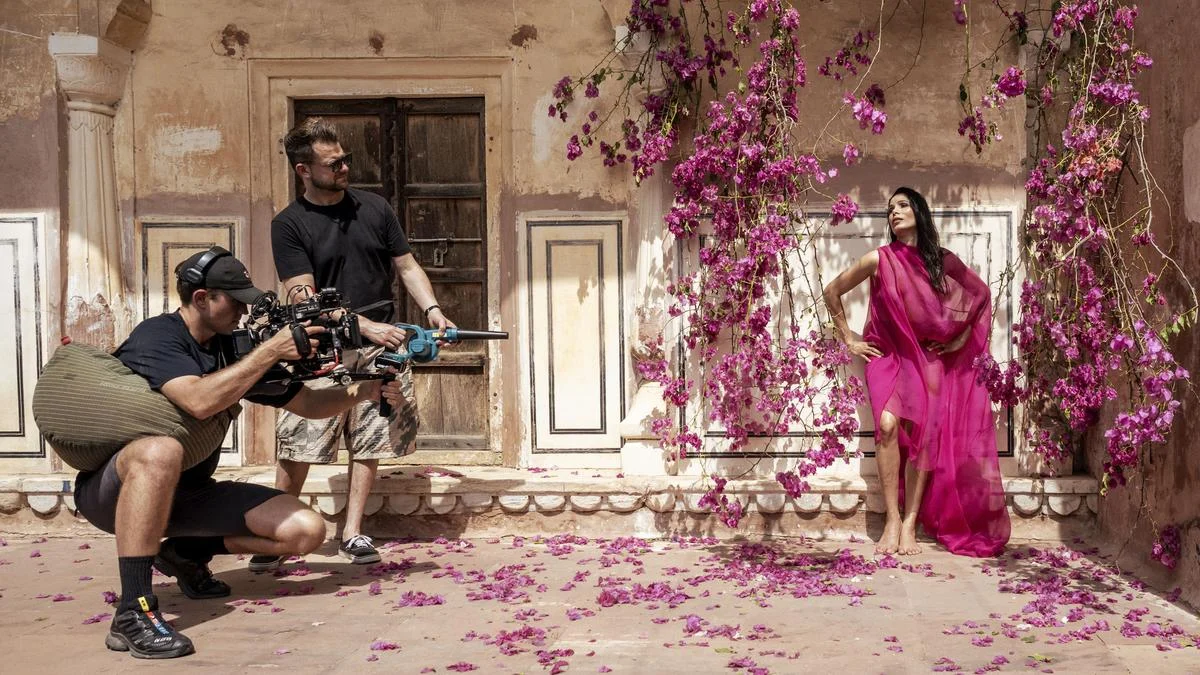
The iconic Pirelli Calendar embarks on its most ambitious project yet, turning its gaze towards India for its 2027 edition. Titled "India, Beyond a Single Gaze," the project, for the first time in its storied 62-year history, embraces a collaborative approach, enlisting three distinct photographic voices to capture the multifaceted soul of a nation that defies easy definition. This endeavor, steeped in the rich tapestry of Indian landscapes and cultures, promises to be a captivating, albeit complex, exploration of a country that consistently challenges external perceptions.
The air crackled with an unusual blend of artistic intensity and logistical precision on the banks of Somsagar Lake in Alwar, Rajasthan. Here, against the serene backdrop of the historic water body, photographer-turned-muse Avani Rai, daughter of legendary Indian photographer Raghu Rai, posed regally in a vibrant canary yellow Roberto Cavalli gown. The ethereal atmosphere was further enhanced by a fogging machine, its misty tendrils diffusing the world and creating a dreamlike tableau.

Meanwhile, a short distance away, Norwegian photographer Sölve Sundsbø, fresh from capturing model and Chanel house ambassador Bhavitha Mandava against the weathered ramparts of Jaigarh Fort, meticulously adjusted his formidable camera setup. Behind him, the imposing Ajabgarh Fort stood as a silent witness to this unique convergence of global talent. The assembled crew, a curious mix of Indian urbanites and an international contingent, sporting matching Pirelli sun hats, undoubtedly presented a striking sight for the local villagers. This was the genesis of the 2027 Pirelli Calendar, a project that dared to venture beyond a singular perspective.
A Legacy of Visual Storytelling: The Pirelli Calendar’s Evolution
For over six decades, the Pirelli Calendar has been a benchmark in artistic photography, a curated collection that transcends mere imagery to become a cultural artifact. Its inception in 1964, with British photographer Robert Freeman – renowned for his iconic portraits of The Beatles – setting the tone, marked the beginning of an era. The calendar’s journey has seen it traverse continents and explore diverse themes, with its first foray into an Asian country occurring in 2009 when French photographer Patrick Demarchelier shot in Shanghai.

The 2027 edition, however, represents a significant departure. For the first time, The Cal has opened its doors to a collaborative spirit, inviting multiple photographers to contribute, each bringing their unique vision to the fore. This decision, unprecedented in the calendar’s history, underscores a deliberate effort to move beyond a monolithic portrayal of its chosen subject.
Three Perspectives, One Nation: The Photographers’ Mandates
The decision to feature India in its entirety for the 2027 edition is not merely a geographical choice; it is a statement about the country’s burgeoning global significance and its intricate cultural landscape. The three photographers tasked with this monumental undertaking – Avani Rai, Sölve Sundsbø, and a third, yet to be fully detailed voice – each bring a distinct rationale to the project, reflecting the calendar’s new collaborative ethos.

Sölve Sundsbø, an established figure in the world of fashion and portrait photography, approaches his involvement with a profound sense of humility. "It is like being asked to exhibit at a museum or gallery that has a history that you really want to be a part of," he admits, reflecting on the prestige associated with The Cal. This marks his second consecutive year contributing to the calendar, a testament to his enduring connection with the project.
For Avani Rai, the opportunity carries an even deeper, more personal significance. She inherits this monumental task following the passing of her father, the celebrated Indian photographer and photojournalist Raghu Rai, in April. "It is as if my father is like, ‘Here you go; you better do this well’," she shares, her voice tinged with both responsibility and reverence. A poignant element of Avani’s contribution lies in her deliberate use of her father’s powerful existing works as backdrops for her own photographs. This creates a visual dialogue between generations, a spectral presence of Raghu Rai’s legacy interwoven with Avani’s contemporary interpretation.

Raghu Rai himself, had he been alive, would have approached this project with a characteristic fervor. While not traditionally aligned with the glossy aesthetic of the Pirelli Calendar, his lifelong passion was to "grab" every opportunity to interpret India. His daughter explains his perspective: "every time someone interpreted India, he wanted to grab it." The idea of a tribute to his beloved country resonated deeply with him, akin to "watching a person write a romantic letter to your lover – and then being asked if you wanted to join in." His enthusiastic assent, had it been possible, would have been a resounding yes.
It is this very essence – a beloved land being chronicled by both those who hold it dear and those who are encountering it anew – that forms the bedrock of the 2027 Pirelli Calendar. This dual perspective, while potentially leading to moments of both authentic vibrancy and unintentional cliché, promises a compelling narrative.

Embracing the Iconic and the Everyday: A Tale of Two Visions
Sölve Sundsbø, with a disarming candor, acknowledges the inherent limitations of an outsider photographing a nation as complex as India. "I can’t try to capture India in any way, shape, or form. I’m not qualified," he states plainly. "I’m a tourist; I’m a guest. But what I can do is portraits of people from India."
This self-imposed boundary has led Sundsbø to focus on capturing the individuals who embody the spirit of India. His lens has found subjects in the ethereal Padma Lakshmi, floating amidst lotus flowers in an artificial pond at Amanbagh; the vibrant Anoushka Shankar, joyously embracing the Rajasthani sky on a lawn dotted with peacocks; and the striking Lakshmi Menon, playfully splashed with the vivid hues of Holi. Bollywood actor Aditi Rao Hydari is depicted reclining on a bed of sun-kissed chrysanthemums, while "Mean Girls" (2024) star Avantika Vandanapu is adorned with a bejeweled ferronnière, evoking the image of a lost Indian princess. Freida Pinto, too, finds herself immersed in the lush beauty of pink bougainvillea against ornate palatial frescoes.

These images, rich with flowers, opulent clothing, and a vibrant palette, consciously lean into the visually iconic elements associated with India. While undeniably beautiful, they tread a fine line, aiming for an "emphatically exotic" portrayal that risks falling into well-trodden territory. Sundsbø, a long-time admirer of India and Raghu Rai’s work, expresses no desire to outdo or compete with the intricate complexities of the nation. "I’m doing my thing," he asserts, with Avani Rai’s right to her perspective, regardless of her perceived qualifications, acknowledged. The resulting photographs, in Sundsbø’s vision, seek to reinterpret the sensual allure of India and its women.
Photographing the Unscripted: Avani Rai’s Grounded Reality
In stark contrast to Sundsbø’s curated aesthetic, Avani Rai’s photographic approach is deeply rooted in the raw, unscripted reality of Indian street life. Her work, juxtaposed with her father’s own powerful images of similar, often unconventional environments and people, offers a compelling counterpoint. "The imagery that he [Raghu Rai] has captured over the last six decades can only be photographed in the streets. That’s where he belonged," she explains. Her father’s focus, she emphasizes, was always on the common people engaged in the "magically mundane things that make the world go round," a stark departure from the elaborate crews and curated wardrobes often associated with such large-scale productions.

Avani’s lens captures the vibrant chaos of India’s bustling thoroughfares. In the heart of Old Delhi’s Kinari Bazaar, Indian bandsmen play a medley of Bollywood hits alongside "Bella Ciao," a protest folk song resonating with a different kind of cultural heritage. Even the usually composed Italian executives from Pirelli find themselves swept up in the infectious rhythm, dancing along. Within the hallowed, albeit fading, walls of the archaic single-screen Delite Cinema, a troupe of regulars transforms the viewing experience into a spectacle of popcorn-throwing, gasps, and shrieks. Avani, ever the observer, captures this unscripted drama, even inviting journalists and crew members to participate in the ensuing pandemonium.
Near Jama Masjid, with the majestic mosque as a backdrop, a group of local natak (street theatre) performers animate a terrace. A boy’s kite soars against a mint-green rooftop, his fleeting moment captured by Avani’s discerning eye. Women clad in matching yellow saris, their hair adorned with gajras, share giggles, as do members of the transgender and intersex communities from the hijra community. Throughout these vignettes, the monumental black-and-white photographs of Raghu Rai loom large, a constant reminder of his enduring influence. Even as Avani carves her own path as a photographer, her father’s creative voice remains a guiding presence, a "corner in her head," as she later confides.

The Unframable: Can India Ever Be Fully Captured?
Within the diverse narratives that the Pirelli Calendar attempts to weave, the "real" India – whatever that may be to each individual – often remains elusive. This is an India that is unapologetically complex, a land of myriad experiences and contradictions. As Padma Lakshmi eloquently states, "Is my experience of being an Indian person in the world any more valid than that woman selling flowers outside my old temple? No, it’s not. Both are true; both are valid. Both exist."
The 2027 Pirelli Calendar, with its ambitious scope and collaborative spirit, enters a discourse that The Cal has, for decades, masterfully engaged in. The institution boasts an impressive roster of subjects, from Naomi Campbell and Christy Turlington immortalized by Richard Avedon, to Adriana Lima by Steve McCurry, and Serena Williams, Yoko Ono, and Patti Smith by Annie Leibovitz.

However, this captivating endeavor, with India at its very center, faces an inherent challenge: the impossibility of definitively capturing the country’s vast plurality within a single edition. It is a testament to India’s dynamic nature that any attempt at a singular, definitive portrayal will inevitably fall short. Perhaps only with subsequent editions, as The Cal continues to explore and engage with the subcontinent, will a more comprehensive vision begin to take shape.
Until then, India, in its inimitable fashion, will continue to challenge those who seek to frame it entirely. It will, as it always has, slip the frame ever so slightly, daring its observers to keep pace. The 2027 Pirelli Calendar is not an endpoint, but a fascinating, imperfect, and utterly compelling beginning in the ongoing visual dialogue with a nation that continues to surprise and inspire.
