

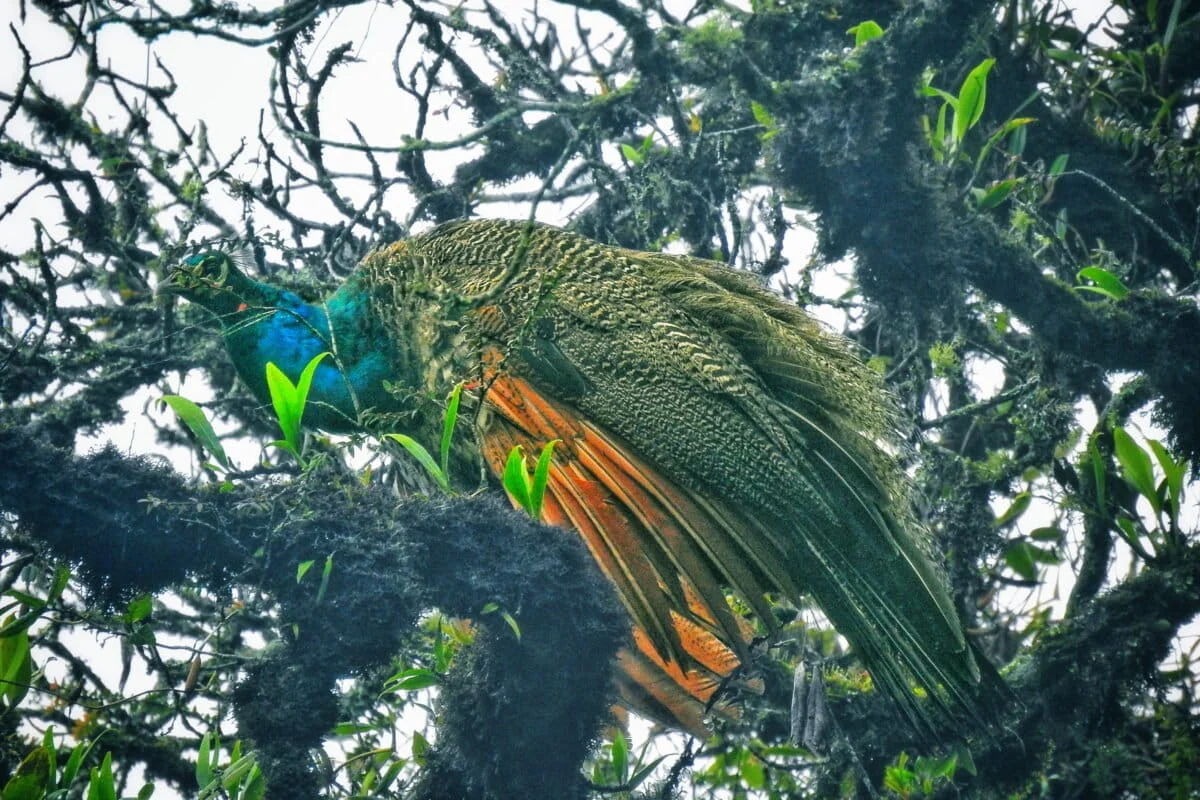
KALIMPONG, WEST BENGAL — For centuries, the Indian peafowl (Pavo cristatus) has been the ultimate symbol of the Indian subcontinent’s aesthetic and spiritual identity. Adorned with iridescent plumage and immortalized in Hindu mythology as the vahana (mount) of Lord Kartikeya, the bird was rightfully designated as India’s national bird in 1963. However, in the steep, terraced farms of the Eastern Himalayas, this symbol of grace is increasingly viewed through a lens of resentment.
What was once a rare and celebrated sight in the foothills is now being described by locals as an "intolerable nuisance." As populations explode and the birds migrate to unprecedented altitudes, a burgeoning conflict is exposing a massive rift between national conservation policy and the lived reality of mountain communities.
Main Facts: A Conservation Success Turned Management Crisis
The crisis surrounding the Indian peafowl is a unique byproduct of conservation success and environmental change. Unlike many species struggling for survival, the peafowl is thriving, yet it remains tethered to the highest level of legal protection in India.
The Legal Fortress
Under the Wildlife (Protection) Act, 1972, the Indian peafowl is listed in Schedule I. This classification grants it the same legal status as the Bengal tiger and the Asian elephant. While this protection was instrumental in saving the bird from poaching and habitat loss in the mid-20th century, it has now become a bureaucratic barrier. Because the bird is "untouchable," local forest departments cannot easily implement population control measures, relocation programs, or even invasive research without arduous federal clearances.
The Population Surge
Recent data from the State of India’s Birds report confirms that peafowl populations are on a steady upward trajectory across the country. In the Eastern Himalayas, specifically in districts like Kalimpong and Darjeeling, this surge is particularly noticeable. Farmers who once rarely saw a peacock now report flocks of 15 to 20 birds descending on their fields daily.
The Agricultural Toll
The impact on subsistence farming is devastating. In villages such as Ambiok Busty and Chota Suruk, the peafowl has transitioned from a forest dweller to a crop raider. They target high-value and staple crops alike, including:
![Increasing numbers of the Indian peafowl worry farmers [Commentary]](https://imgs.mongabay.com/wp-content/uploads/sites/30/2026/08/17101028/Photo-2_%40Mingma-Tamang-1200x800.jpg)
- Paddy: Devouring grains before harvest.
- Maize: Uprooting seedlings and pecking at ripening ears.
- Dalle Khursani: The iconic round chillies of the region, which the birds consume with impunity.
- Pulses: Foraging through beans and legumes drying in courtyards.
Chronology: The Great Ascent
To understand why the peafowl has become a "pest," one must look at its historical distribution versus its current range. Historically, Pavo cristatus was a bird of the plains and dry deciduous forests. Its presence in the humid, high-altitude Eastern Himalayas is a relatively recent phenomenon.
The Historical Baseline
Historical records and local oral histories suggest that the peafowl was almost non-existent in the higher reaches of the Himalayas until the late 19th century. In neighboring Nepal, for instance, there were no documented sightings of the bird before 1877. In the Darjeeling and Kalimpong hills, elders recall a time when a peacock call was a distant, melodic rarity heard only from the deep valleys.
2010–2017: The Tipping Point
By the early 2010s, anecdotal reports of crop damage began to surface in the lower foothills. A pivotal 2017 study conducted on the outskirts of the Kitam Bird Sanctuary in Sikkim officially categorized the Indian peafowl as an "intolerable species." The study noted that farmers perceived the bird as a maximum threat—one that could force them to alter their livelihoods or abandon cultivation entirely.
2020–Present: Reaching the Summits
The most alarming development has been the bird’s move into high-altitude alpine zones. In a shocking departure from its natural habitat, forest guards have recently spotted peafowl in Singalila National Park and even at Sandakphu, the highest point in West Bengal at 3,636 meters. This shift places the peafowl in direct competition with rare, native Himalayan pheasants like the Satyr Tragopan and the Blood Pheasant.
Supporting Data: Drivers of Expansion
Ecologists point to a combination of climate change and anthropogenic factors as the primary drivers of this northern migration.
1. The Climate Signal
The Himalayas are warming at a rate higher than the global average. Between 1881 and 1997, temperatures in the region rose by approximately 0.57°C. This warming trend, coupled with erratic monsoon patterns, has transformed previously cold, inhospitable mountain slopes into viable habitats for the peafowl. The bird is essentially "tracking" the warmth as it moves up the valleys.
![Increasing numbers of the Indian peafowl worry farmers [Commentary]](https://imgs.mongabay.com/wp-content/uploads/sites/30/2026/08/17105705/Photo-3_%40Mingma-Tamang-768x512.jpg)
2. Habitat Modification
Local agricultural practices have inadvertently aided the bird. The seasonal burning of broom-grass (Amriso) fields in lower altitudes during March and April—a common practice to stimulate new growth—destroys the birds’ nesting and foraging grounds in the valleys. This "push factor" forces the peafowl to seek refuge and food in higher-altitude agricultural clusters.
3. Behavioral Adaptation
The peafowl has demonstrated remarkable "synanthropic" behavior—the ability to thrive in human-modified landscapes. Farmers in Sittong report that the birds are no longer deterred by traditional scaring methods. Scarecrows are ignored, and the birds have learned that humans, bound by the fear of the Forest Department, rarely take physical action against them.
Official Responses: A Policy in Silos
Despite the growing crisis, the institutional response has been characterized by fragmentation and a lack of urgency.
The "Peacock Park" Irony
While farmers in the hills plead for population control, several state governments continue to fund "Peacock Parks" and eco-tourism projects centered on the bird. In Sikkim and Karnataka, these projects are promoted as biodiversity wins. This highlights a "glaring policy gap": the national narrative treats the peacock as a conservation priority, while the local reality demands a management strategy.
Institutional Deadlock
Responsibility for managing the peafowl is currently split across four distinct bodies:
- The Forest Department: Focused on protection and legal enforcement.
- The Agriculture Department: Concerned with crop yield but lacking the authority to manage wildlife.
- Panchayati Raj Institutions: Facing the brunt of local anger but possessing no budget for mitigation.
- State Biodiversity Boards: Primarily focused on documentation rather than conflict resolution.
Because no single agency is held accountable for the economic losses caused by the bird, farmers are left in a state of "legal paralysis." They cannot harm the bird due to its Schedule I status, yet they receive little to no compensation for ruined harvests, as peafowl damage is often not categorized under the same compensation schemes as elephant or leopard attacks.
![Increasing numbers of the Indian peafowl worry farmers [Commentary]](https://imgs.mongabay.com/wp-content/uploads/sites/30/2026/08/17110932/Photo-4_%40Mingma-Tamang-768x512.jpg)
Mitigation Efforts
There have been rare attempts at innovative solutions. In Sikkim, the government experimented with acquiring fields destroyed by peafowl to convert them into bird-watching zones for tourists. While successful on a micro-scale, experts argue this is not a scalable solution for the thousands of acres currently under threat across the Eastern Himalayas.
Implications: The Human and Ecological Cost
The "Peacock Paradox" carries profound implications for the future of Himalayan conservation and rural stability.
The Threat to Native Biodiversity
The presence of peafowl at 3,600 meters is not just a curiosity; it is an ecological red flag. The Indian peafowl is a generalist feeder and a dominant bird. There are growing fears that they will outcompete native Himalayan species for nesting sites and food. If the peafowl establishes permanent populations in parks like Singalila, the survival of the already endangered Tragopans could be jeopardized.
Socio-Economic Migration
For the farmers of Kalimpong and Darjeeling, the peafowl is often the "final straw." Already struggling with fluctuating market prices and water scarcity, the added burden of 24-hour field guarding is unsustainable. "It doesn’t let the paddy get harvested; it doesn’t let the chillies ripen," says one farmer from Chota Suruk. The economic shock of losing a season’s crop to a protected bird is driving a quiet exodus of youth from farming to urban labor.
The Erosion of Conservation Ethics
Perhaps the most dangerous implication is the erosion of the "conservation ethic." When a national icon becomes a source of poverty, the local population’s willingness to protect other wildlife—such as leopards or red pandas—diminishes. The resentment toward the peacock is easily transferred to the Forest Department and the state at large.
Conclusion: Toward an Adaptive Management Strategy
The story of the Indian peafowl in the Himalayas serves as a cautionary tale about the rigidity of wildlife laws. Conservation cannot exist in a vacuum; it must be adaptive.
![Increasing numbers of the Indian peafowl worry farmers [Commentary]](https://imgs.mongabay.com/wp-content/uploads/sites/30/2026/08/17110554/Singalila_national_park-768x512.jpg)
To resolve the crisis, experts suggest several steps:
- Regional Reclassification: Exploring whether the peafowl’s Schedule I status can be modified regionally (e.g., to Schedule II or III) in areas where they are overabundant, allowing for more flexible management.
- Integrated Compensation: Including avian crop damage in state-sponsored insurance and compensation schemes.
- Scientific Monitoring: Initiating a trans-Himalayan study to map the exact economic and ecological footprint of the peafowl’s expansion.
As the author and conservation biologist Vikram Pradhan notes, "Conservation cannot succeed by celebrating wildlife while overlooking the burdens borne by those who live alongside it." The vibrant feathers of the peacock, once a source of national pride, must not become the shroud under which Himalayan agriculture is buried. The path forward requires listening to the farmers in the foothills, whose quiet struggle is the true frontline of modern conservation.
