

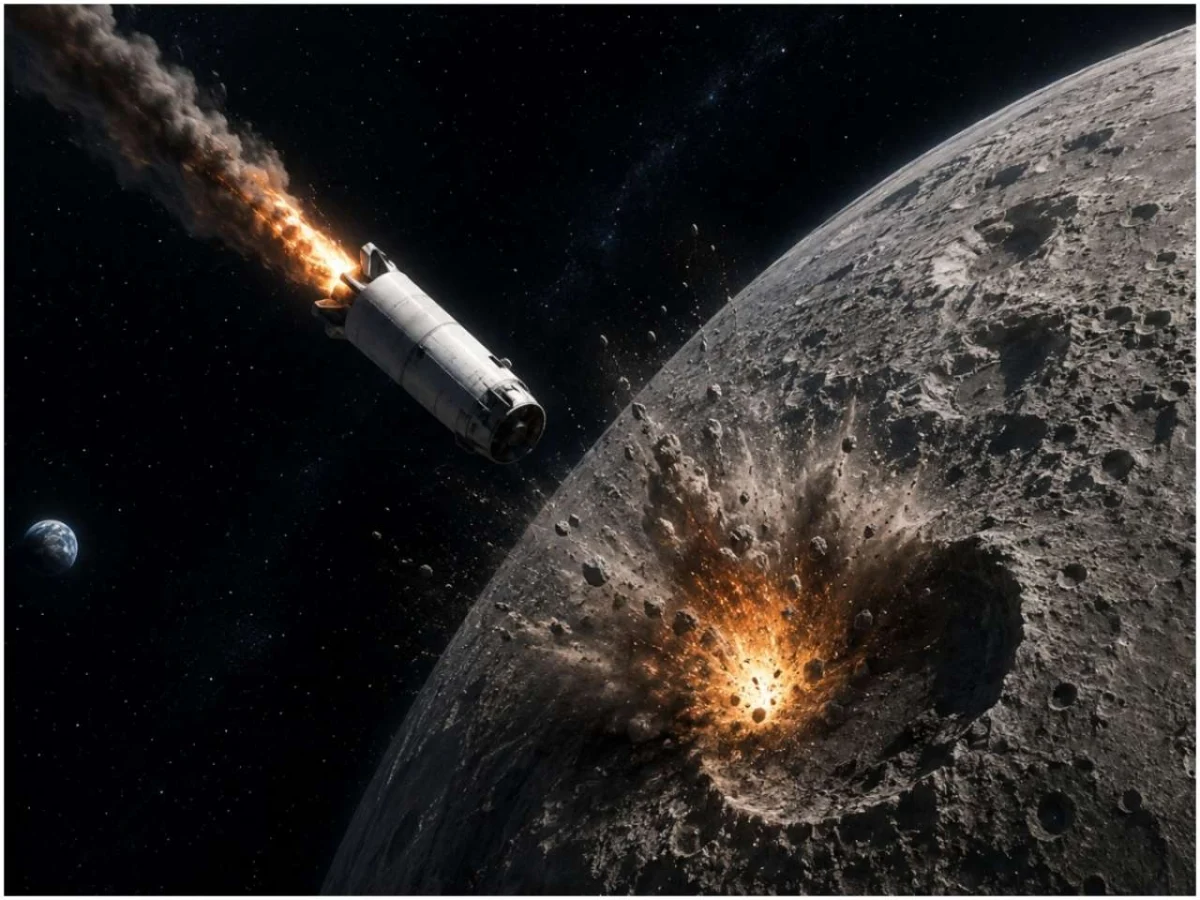
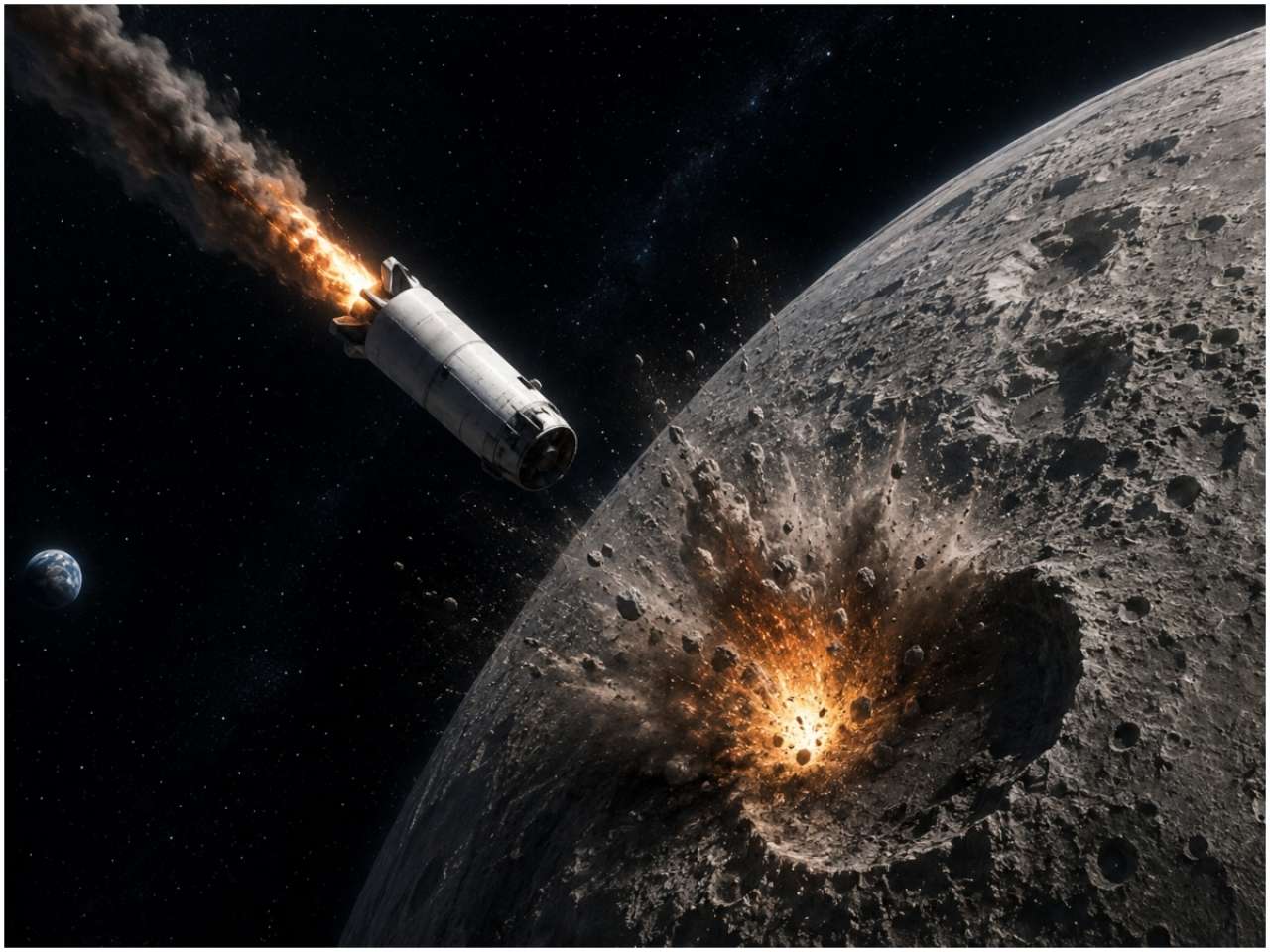
A discarded upper stage of a SpaceX Falcon 9 rocket, which has been an uncontrolled object in deep space for nearly a year, has made an unprecedented and accidental collision with the Moon. The incident, occurring on Wednesday at an estimated speed of 8,700 km/h (5,400 mph), marks the first known unintentional lunar impact of space junk, sparking both scientific interest and renewed discussions about the growing problem of orbital debris.
The school bus-sized rocket segment, weighing approximately 4,000 kilograms, struck the lunar surface in an area known as the Einstein Crater, located along the Moon’s western edge. While direct observation of the impact from Earth was challenging due to the location and the swift nature of the event, astronomers and space agencies are now mobilizing resources, including lunar orbiters, to confirm the collision and study its aftermath. This extraordinary event transforms what was once a mere piece of space junk into a unique scientific opportunity, while simultaneously serving as a stark reminder of humanity’s ever-expanding footprint in the cosmos.
A Celestial Collision: The Story Unfolds
The dramatic lunar impact on Wednesday was the culmination of an almost year-long journey for a spent rocket stage that was never intended to reach the Moon. The incident has drawn significant attention from both the scientific community and the public, highlighting the complex dynamics of objects in deep space and the challenges of tracking them.
The Unintended Trajectory
The Falcon 9 upper stage was initially deployed for a mission that required it to escape Earth’s immediate gravitational influence, setting it on a path that would eventually lead to its lunar demise. Unlike most rocket stages designed for missions in Low Earth Orbit (LEO) or Geosynchronous Earth Orbit (GEO), which are typically de-orbited to burn up in Earth’s atmosphere or splash down in designated ocean areas, this particular stage received an extra thrust. This additional propulsion was necessary to deliver its payload—Firefly Aerospace’s lunar lander—onto a trajectory towards the Moon in January 2022.
After deploying its primary payload, the upper stage found itself on a highly elliptical orbit around the Earth. Over the subsequent months, its trajectory was subtly but persistently altered by a complex interplay of gravitational forces from both the Earth and the Moon, as well as the more subtle influence of solar radiation pressure. These forces, acting over an extended period, gradually nudged the object onto a collision course with Earth’s natural satellite. Julianna Scheiman, SpaceX’s director of NASA science and Dragon programs, acknowledged this intricate dance of cosmic mechanics, stating that "What has happened is essentially a mixture of solar activity and gravity forces have put it on a path toward the moon." This "gravitational ballet" ultimately sealed the fate of the booster, setting it on an unavoidable path to impact the lunar surface.
The Object in Question
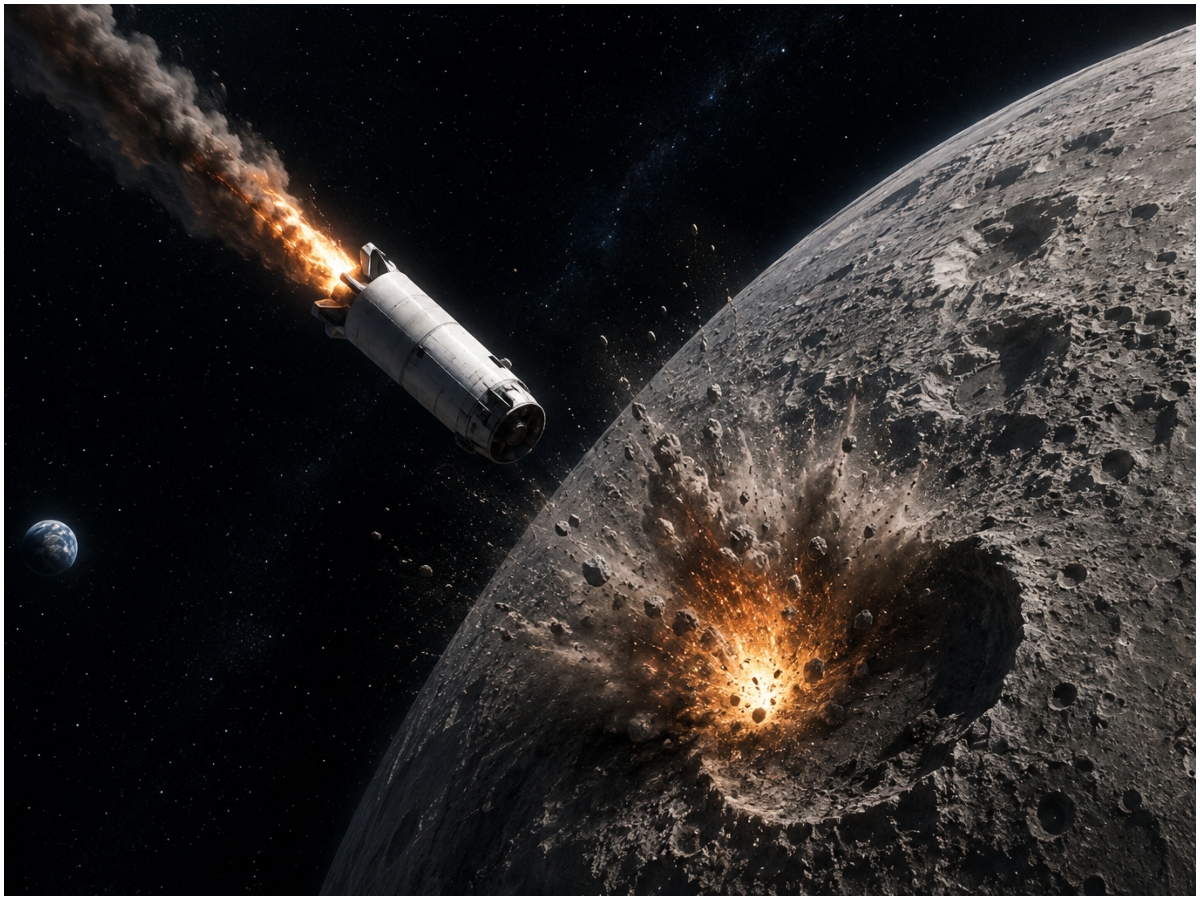
The impacting object was the second stage of a SpaceX Falcon 9 rocket. These stages are workhorses of modern spaceflight, responsible for delivering a wide array of payloads into various orbits and trajectories. This specific stage, measuring roughly 15 meters (49 feet) in length and 3.7 meters (12 feet) in diameter, is comparable in size to a school bus. Its substantial mass of 4,000 kilograms (approximately 8,800 pounds), even when depleted of fuel, meant it carried considerable kinetic energy at its high impact velocity.
)
While designed to be robust for the rigors of launch, these stages are not built to withstand such high-speed impacts. The collision was not a gentle descent but a high-velocity destructive event. The stage was part of the Falcon 9 launch that deployed Firefly Aerospace’s Nova-C lunar lander as part of a mission in January 2022, which aimed to deliver commercial payloads to the lunar surface. Following payload deployment, the booster was left in a "highly energetic" orbit, meaning it had enough speed to largely escape Earth’s gravity but not enough to fully escape the Earth-Moon system, leading to its eventual lunar rendezvous.
The Predicted Impact Site and Observational Challenges
Astronomers had predicted the impact would occur on Wednesday, around 12:30 PM IST (Indian Standard Time), within the Einstein Crater. This ancient and prominent impact crater, named after the renowned physicist Albert Einstein, is situated on the far side of the Moon, near its western limb as viewed from Earth. Its location presented significant challenges for direct observation of the impact event.
The far side of the Moon is notoriously difficult to observe from Earth, as it never faces our planet. While instruments like NASA’s Lunar Reconnaissance Orbiter (LRO) or India’s Chandrayaan-2 orbiter could potentially capture images of the impact or the resulting crater, real-time observation from Earth-based telescopes was virtually impossible. Scientists will need to rely on post-impact analyses, searching for new craters or changes in the lunar landscape, to confirm the event and study its geological consequences. The impact was expected to generate a flash of light and potentially eject a plume of dust and debris, which could be detected by orbiting spacecraft.

Chronology of the Orbital Wanderer
The journey of the Falcon 9 upper stage from a critical component of a space mission to an uncontrolled lunar impactor is a fascinating, if somewhat concerning, chronicle of orbital mechanics and the challenges of managing objects in deep space.
Launch and Initial Mission (January 2022)
The story of the soon-to-be lunar impactor began in January 2022. On this date, a SpaceX Falcon 9 rocket successfully launched from Earth, carrying a critical payload: Firefly Aerospace’s lunar lander. The mission’s primary objective was to deliver this lander onto a trajectory that would eventually take it to the Moon. This required the Falcon 9’s second stage to perform a particularly energetic burn, imparting sufficient velocity to the lander and, by extension, to itself, to escape the immediate gravitational pull of Earth and embark on a translunar injection course. Once the lander was successfully deployed on its intended path, the second stage, having fulfilled its purpose, became a discarded piece of hardware.
The Discarded Stage: Why it Didn’t Return to Earth
Typically, rocket stages used for missions closer to Earth are designed with de-orbiting capabilities. After deploying their payloads, they either perform a controlled burn to re-enter Earth’s atmosphere, where they safely burn up due to friction, or are guided to splash down in remote ocean areas. This ensures they don’t contribute to the growing problem of space debris in heavily trafficked orbits.
)
However, the January 2022 mission was different. The requirement to send Firefly Aerospace’s lander to the Moon meant the Falcon 9 second stage had to achieve a much higher velocity and altitude than a typical Earth-orbiting mission. This "extra thrust" prevented it from performing a controlled re-entry into Earth’s atmosphere. With insufficient fuel remaining for a dedicated de-orbit maneuver and already on an escape trajectory from Earth’s LEO and GEO, the stage was effectively left to drift in the vastness of space. It became a piece of "space junk," albeit one that was, for a time, on an unpredictable path.
The Year-Long Drift and Discovery
For nearly a year following its mission, the Falcon 9 upper stage continued its uncontrolled journey through the Earth-Moon system. Its trajectory was complex, influenced by the gravitational tug-of-war between Earth and Moon, as well as the subtle but cumulative effects of solar radiation pressure. It was during this extended drift that its eventual fate began to solidify.
The collision course was first identified and tracked by independent astronomers and space debris enthusiasts, most notably Bill Gray, a developer of the Project Pluto software used for tracking near-Earth objects. Gray, who has a long track record of accurately predicting the trajectories of space objects, initially identified the object as part of a Chinese Chang’e 5-T1 mission, but later corrected his assessment. After consulting with others and analyzing spectral data, he confirmed it to be the upper stage of the SpaceX Falcon 9 rocket. His meticulous tracking and calculations, shared widely among the astronomical community, allowed for precise predictions of the impact time and location, transforming what might have been an unnoticed event into a widely anticipated celestial collision. This diligent work by amateur and professional trackers underscores the importance of a global network dedicated to monitoring objects in space.
)
The Final Approach
As Wednesday approached, the certainty of the impact grew. Astronomical models, refined over weeks of observation, narrowed down the window of collision and pinpointed the Einstein Crater as the likely impact site. The object, traveling at an incredible speed of nearly 8,700 km/h (5,400 mph), represented a significant amount of kinetic energy—equivalent to roughly 1.2 tons of TNT. At this velocity, even a spent rocket stage could create a substantial new crater on the lunar surface. The final approach was a testament to the inexorable laws of physics, as the gravitational pull of the Moon eventually dominated its trajectory, drawing it in for the final, violent rendezvous.
Supporting Data and Context
The Falcon 9 lunar impact is not an isolated incident but rather a symptom of a larger, evolving challenge in space exploration. Understanding this event requires placing it within the broader context of space debris, lunar impacts, and orbital mechanics.
Tracking Space Debris: A Growing Challenge
The ability to track objects like the Falcon 9 upper stage is a monumental task. Thousands of pieces of space junk, ranging from defunct satellites and spent rocket stages to tiny fragments from collisions, currently orbit Earth. Organizations like the U.S. Space Force’s 18th Space Defense Squadron maintain a catalog of over 30,000 tracked objects larger than 10 centimeters, but countless smaller pieces remain untracked. The increasing density of debris, particularly in Low Earth Orbit, poses a significant threat to active satellites, human spaceflight missions, and future launches. The Falcon 9 incident highlights the challenges of tracking objects in deep space, where gravitational influences are more complex and tracking assets are less concentrated than in Earth’s immediate vicinity. The dedication of independent astronomers like Bill Gray in identifying and predicting such events is invaluable, supplementing official tracking efforts.
)
Lunar Impacts: A Historical Perspective
While the Falcon 9 crash is notable for being the first unintentional impact of this kind, the Moon has been a recipient of both natural and artificial impacts throughout its history.
- Natural Impacts: The Moon’s pockmarked surface is a stark testament to billions of years of bombardment by asteroids and meteoroids. These natural impacts continue to occur daily, constantly reshaping its surface, though most are too small to be observed from Earth.
- Intentional Impacts: Humanity has intentionally crashed objects into the Moon for scientific purposes. The most famous examples include:
- Apollo Missions: The spent third stages of the Saturn V rockets and the ascent stages of lunar modules were deliberately crashed into the Moon after their missions to create seismic waves that were detected by seismometers left on the surface by astronauts. This provided invaluable data about the Moon’s interior structure.
- LCROSS (Lunar Crater Observation and Sensing Satellite) in 2009: NASA intentionally crashed the Centaur upper stage of its Atlas V rocket into the Cabeus crater near the Moon’s south pole. The goal was to detect water ice in the resulting plume, a mission that proved highly successful.
- GRAIL (Gravity Recovery and Interior Laboratory) in 2012: Two NASA probes were deliberately de-orbited and crashed into a lunar mountain after completing their mission to map the Moon’s gravitational field.
- Unintentional (or Failed) Impacts: The Falcon 9 is not the first human-made object to crash on the Moon unexpectedly. Several spacecraft attempting soft landings in recent years have instead crashed due to technical failures.
- China’s Chang’e 5-T1 Service Module (March 2022): While initially misidentified as the Falcon 9, a piece of China’s Chang’e 5-T1 mission’s service module did indeed crash into the Moon in March 2022. This module was part of an experimental mission launched in 2014, designed to test technologies for future lunar sample return missions.
- India’s Chandrayaan-2 Lander (2019): India’s Vikram lander, part of the Chandrayaan-2 mission, suffered a hard landing and crashed on the lunar surface during its attempt at a soft landing near the Moon’s south pole.
- Israel’s Beresheet Lander (2019): The first privately funded lunar lander, Beresheet, also crashed during its landing attempt in April 2019 due to a main engine failure.
The Falcon 9 incident, however, stands apart as the first instance of a discarded, uncontrolled rocket stage from a non-lunar mission accidentally impacting the Moon after a prolonged drift in deep space.
The Physics of the Collision
The impact of a 4,000 kg object traveling at 8,700 km/h is a high-energy event. The kinetic energy involved can be calculated using the formula KE = 0.5 * mv^2 (where m is mass and v is velocity). This translates to approximately 11.5 gigajoules of energy, roughly equivalent to the detonation of about 2.7 metric tons of TNT.
)
Such an impact would not merely dent the Moon’s surface; it would create a new crater. Based on studies of similar high-velocity impacts on rocky bodies, scientists expect the Falcon 9 crash to have formed a crater perhaps 10 to 20 meters (33 to 66 feet) in diameter, and several meters deep. The impact would have generated a significant shockwave and ejected a substantial plume of lunar regolith (dust and rock) into space, which might be detectable by lunar orbiters. The data from such an event, if successfully observed, could provide valuable insights into the Moon’s surface composition, crater formation processes, and even potentially its subsurface structure, similar to the intentional impacts of the Apollo missions.
Official Responses and Scientific Scrutiny
The accidental lunar impact has elicited responses from various stakeholders, from the company whose hardware was involved to the scientific community eager to capitalize on this unexpected event.
SpaceX’s Stance
SpaceX, the manufacturer and operator of the Falcon 9 rocket, has maintained that the collision was accidental. The company emphasized that the upper stage had long ceased to be under its control after completing its primary mission. As Julianna Scheiman’s statement indicated, the trajectory toward the Moon was a result of natural gravitational forces and solar activity, not a deliberate maneuver or a failure of the initial mission design for an Earth-return. While SpaceX has robust programs for de-orbiting its first stages and fairings for reusability, and for controlled disposal of second stages in Earth-bound missions, the unique trajectory requirements for the lunar lander mission meant this particular upper stage was left in a different, less controlled orbital regime. The company has not expressed concern about any direct impact on its operations or reputation, given the accidental nature and the object’s status as uncontrolled deep-space debris.
)
Astronomical Community’s Reaction
For the astronomical community, the Falcon 9 impact presents a fascinating, albeit unintended, scientific opportunity. While there is a broader concern about space debris, this specific event is being viewed as a chance to study a fresh lunar impact with unprecedented detail. Scientists are particularly interested in:
- Crater Morphology: Analyzing the shape, size, and depth of the new crater could provide new data on the properties of lunar regolith and subsurface layers in the Einstein Crater region.
- Ejecta Plume Analysis: If the ejecta plume was observed, its composition could offer clues about the materials beneath the lunar surface.
- Seismic Activity: Although no active seismometers are currently near the impact site, future missions might use similar events to study lunar seismology.
- Planetary Protection: While not a biological risk, the incident contributes to the discussion about the long-term presence of human-made objects on celestial bodies.
Experts like Bill Gray, who meticulously tracked the object, have expressed a mix of scientific excitement and concern. "It’s a good opportunity to learn something," Gray commented, while also acknowledging the broader issue of managing space junk.
Monitoring and Confirmation
Confirmation of the impact is likely to take some time. The primary instruments for verification will be lunar orbiters, particularly NASA’s Lunar Reconnaissance Orbiter (LRO). LRO has a powerful camera suite (LROC) capable of imaging the lunar surface at high resolution. Scientists will task LRO to image the predicted impact site and search for a new crater. This process involves comparing "before" and "after" images of the area. Given LRO’s orbital parameters, it may take days or even weeks for the orbiter to pass over the exact impact site and acquire suitable imagery.
)
Beyond LRO, other international lunar orbiters, such as India’s Chandrayaan-2 orbiter, could potentially contribute to the search. Ground-based telescopes, while unable to image the impact directly due to the far-side location, might have attempted to detect any faint flashes or debris plumes if they were significantly large and caught by instruments on the lunar limb. The data collected from these observations will be crucial for confirming the event, precisely locating the impact site, and initiating detailed scientific analysis.
Implications and Future Considerations
The accidental lunar impact of the SpaceX Falcon 9 upper stage transcends a mere astronomical curiosity; it carries significant implications for our understanding of space debris, regulatory frameworks, and the future of lunar exploration.
Impact on the Moon: Minimal but Scientific
From a purely macroscopic perspective, the impact of a 4,000 kg object is minuscule compared to the Moon’s vast mass and the countless natural impacts it has endured over billions of years. The Moon itself will not be "affected" in any meaningful geological or environmental sense. There is no atmosphere to disperse pollutants, and the formation of a single new crater, even one several meters across, is a routine event on a cosmic timescale.
)
However, the scientific value is undeniable. A freshly formed crater, with its exposed subsurface material, offers a pristine laboratory for studying lunar geology. Future missions could potentially investigate this new crater to understand the impact process, the properties of the regolith, and the composition of the lunar crust in that specific region. It serves as a natural experiment that scientists would otherwise have to undertake deliberately, at significant cost and effort.
The Growing Problem of Space Debris
The Falcon 9 incident powerfully underscores the escalating problem of space debris. Thousands of tons of human-made objects, from tiny paint flecks to massive defunct satellites, clutter various orbits around Earth. While most attention is focused on Low Earth Orbit (LEO) due to the risk to active satellites and the potential for a "Kessler Syndrome" (a cascading chain reaction of collisions), this event demonstrates that debris can also escape into deep space and pose risks or create unpredictable events far from Earth.
The incident raises questions about the long-term consequences of leaving spent rocket stages in uncontrolled, Earth-escaping trajectories. As more nations and private companies launch missions to the Moon, Mars, and beyond, the number of discarded upper stages and interplanetary probes will inevitably increase. Without clear international guidelines for the disposal of such objects, the likelihood of future uncontrolled impacts on other celestial bodies, or even collisions with active deep-space missions, will grow.
)
Regulatory Landscape and Planetary Protection
Current international guidelines for space debris mitigation, largely governed by the Inter-Agency Space Debris Coordination Committee (IADC) and national regulations, primarily focus on objects in Earth orbit. These guidelines typically recommend de-orbiting spacecraft within 25 years after their mission ends or placing them in "graveyard orbits" for geosynchronous satellites. However, there are fewer, if any, specific, binding regulations for the disposal of objects that achieve Earth-escape trajectories and subsequently drift into the Earth-Moon system or beyond.
The Falcon 9 crash highlights this regulatory gap. It prompts a critical discussion within the United Nations Committee on the Peaceful Uses of Outer Space (COPUOS) and other international forums about expanding debris mitigation guidelines to include deep space and planetary protection protocols. While the Moon is considered largely geologically inactive, future impacts on bodies with potential for life, such as Mars or Europa, could have profound biological contamination risks, necessitating stricter adherence to planetary protection protocols. This event may catalyze the development of more comprehensive and internationally binding rules for end-of-life management for all types of space missions.
Lessons Learned and Future of Lunar Exploration
This accidental lunar impact offers several crucial lessons:
)
- Enhanced Tracking: The incident highlights the invaluable role of independent astronomers and the need for more robust global tracking systems for deep-space objects, not just those in Earth orbit.
- Mission Planning: It may prompt space agencies and private companies to re-evaluate their end-of-life disposal strategies for upper stages on high-energy trajectories, considering controlled impacts or alternative disposal orbits where feasible.
- Scientific Opportunity: While accidental, such events provide unique data points for planetary science, demonstrating the potential for "found science" from unintended consequences.
As humanity embarks on a new era of lunar exploration, with ambitious missions like NASA’s Artemis program, China’s lunar exploration program, and numerous private ventures aiming for sustained human presence and resource utilization on the Moon, the management of space debris and the responsible conduct of space activities become paramount. The Falcon 9 impact, while a relatively minor event in the grand scheme of the cosmos, serves as a poignant reminder that even our smallest endeavors in space have lasting, and sometimes unpredictable, consequences. It underscores the responsibility that comes with exploring and utilizing the final frontier, urging a more sustainable and conscientious approach to our celestial backyard.
