

By Regional Correspondent
Last Updated: August 20th, 2026
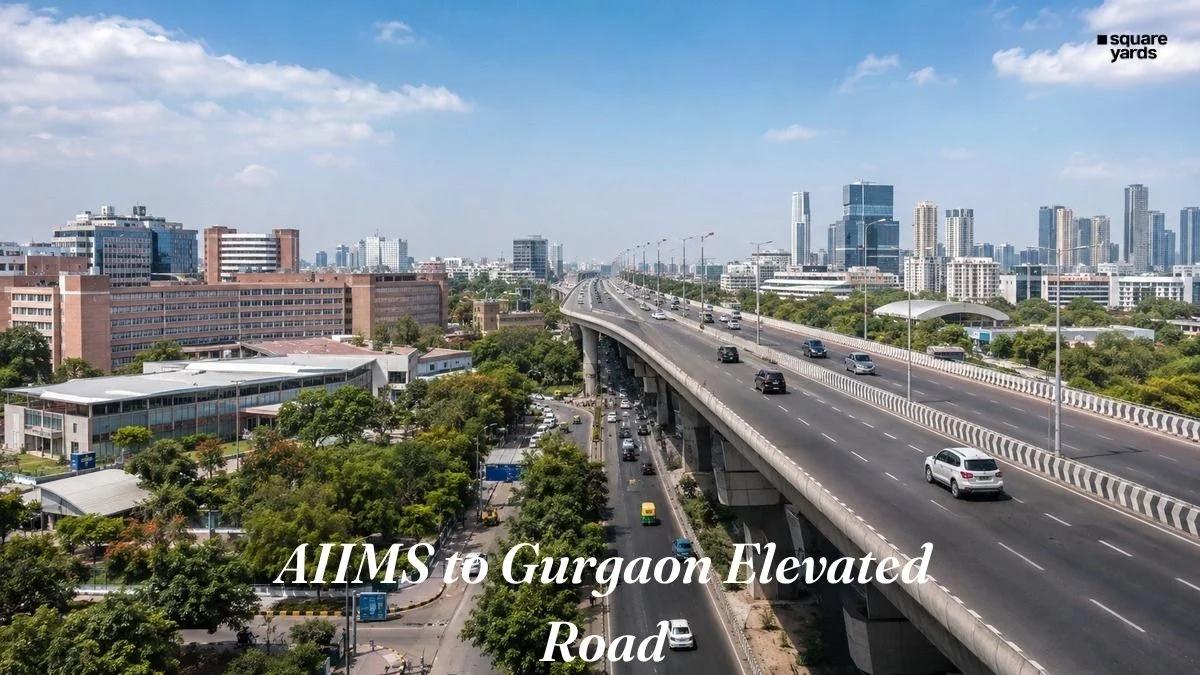
NEW DELHI – In a move set to redefine the logistical and real estate landscape of the National Capital Region (NCR), the National Highways Authority of India (NHAI) has officially resumed the administrative and technical groundwork for a landmark 20-kilometer, signal-free elevated corridor. This ambitious infrastructure project aims to bridge the gap between AIIMS in South Delhi and the Gurgaon-Faridabad Road via Mahipalpur, effectively bypassing some of the most congested transit points in Northern India.
Estimated at a staggering Rs 5,000 crore, the project has transitioned from a conceptual "bottleneck fix" to a priority Detailed Project Report (DPR) stage under the Ministry of Road Transport and Highways (MoRTH). The corridor is being hailed not just as a traffic solution, but as a secondary "lifeline" for the NCR, mirroring the transformative impact seen with the recently completed Dwarka Expressway.
I. Main Facts: A Strategic Bypass for a Choked Metropolis
The proposed corridor is designed to provide a seamless, high-speed link that avoids the traditional "crawls" associated with National Highway 48 (NH-48) and the inner Ring Road.
Key Project Specifications:
- Total Length: Approximately 20 kilometers.
- Design: Fully elevated, signal-free corridor.
- Estimated Cost: Rs 5,000 crore.
- Primary Route: Starting near AIIMS (South Delhi), threading through the dense Mahipalpur area, and terminating at the Gurgaon-Faridabad Road junction.
- Current Status: Detailed Project Report (DPR) phase.
- Immediate Action: Transfer of Mehrauli-Gurugram (MG) road stretches to NHAI for interim safety and lighting upgrades.
For decades, the commute between South Delhi’s medical and administrative hubs and the corporate skyscrapers of Gurugram has been a source of economic attrition. Officials suggest that once operational, the corridor could reduce travel time from AIIMS to the Gurugram border to "mere minutes," effectively halving the current commute time during peak hours.
II. Chronology: From 2006 Vision to 2026 Reality
The history of this corridor is a testament to the complexities of urban planning in India’s capital. The idea of a signal-free link through Mahipalpur dates back nearly two decades, originally conceived as a solution to the 2006-era bottlenecks that plagued the airport approach roads.
- 2006–2015: The project remained largely on the drawing board as the Delhi Government and NHAI grappled with land acquisition hurdles and jurisdictional overlaps.
- 2016–2021: Focus shifted toward the completion of the Dwarka Expressway. The AIIMS-Mahipalpur link was deprioritized as authorities focused on the "New Gurgaon" connectivity.
- 2022–2024: With the Dwarka Expressway nearing completion and NH-48 reaching saturation points despite upgrades, the Ministry of Road Transport and Highways (MoRTH) directed NHAI to revisit the South Delhi-Gurugram bypass.
- Early 2025: Formal agreement reached between the Delhi Government and the Center to transfer relevant road stretches to NHAI.
- August 20th, 2026: NHAI confirms the resumption of the DPR process and initiates interim upgrades (LED lighting and crash barriers) on the MG Road stretch, signaling the start of active field preparation.
III. Supporting Data: The "Dwarka Expressway" Precedent
To understand the economic weight of this announcement, market analysts point toward the historical data of the Dwarka Expressway. The 29-km, eight-lane elevated highway—India’s first single-pillar urban expressway—serves as the blueprint for what the AIIMS-Gurugram corridor hopes to achieve.
Real Estate Appreciation Patterns:
According to data from Square Yards Research, the impact of high-speed elevated connectivity on property value is quantifiable:
- Short-term Appreciation: Flat rates along the Dwarka Expressway corridor appreciated by 75% over a three-year period following the acceleration of construction.
- Long-term Growth: Values increased by 1.5 times over a five-year horizon.
- Current Market Rates: Sectors along the expressway now trade between Rs 9,000 and Rs 24,000 per square foot, depending on the luxury tier of the project.
Commuter Catchment Expansion:
The AIIMS-Gurugram corridor is not an isolated project; it is a strategic extension. By integrating with the existing Dwarka Expressway network, the new corridor effectively extends the "addressable catchment" of South Delhi residents into the Gurugram real estate market. This creates a "commute-time arbitrage" where professionals can live in more affordable, modern sectors of Gurugram while maintaining a 20-30 minute commute to central South Delhi.
IV. Official Responses and Institutional Cooperation
The revival of this project is marked by a rare level of synergy between central and state authorities.
NHAI Official Statement:
"The resumption of the DPR for the AIIMS-Mahipalpur-Gurgaon corridor reflects our commitment to de-congesting the Ring Road. This is not merely a paper exercise; the transfer of the Mehrauli-Gurugram road stretches for interim upgrades proves that we are already preparing the ground for a larger structural overhaul."
Delhi Government Perspective:
The Delhi Government has signaled its cooperation by facilitating the transfer of land stretches. While the city-state has historically been protective of its internal roads, the realization that NH-48 cannot handle the projected 2030 traffic volumes has led to a more collaborative approach.
Ministry of Road Transport and Highways (MoRTH):
MoRTH sources indicate that the Rs 5,000-crore budget has been earmarked as part of the broader "Bharatmala Pariyojana" or similar urban congestion-relief schemes, ensuring that funding is unlikely to be the primary bottleneck.
V. Implications: Economic, Social, and Real Estate
The ripple effects of a signal-free corridor through the heart of the NCR are multi-faceted, affecting everyone from institutional investors to daily wage earners.
1. Real Estate: From Speculation to Stability
For the real estate sector, the announcement marks the beginning of a "second chapter." While the "explosive growth" phase of the Dwarka Expressway (where 50-60% jumps were common) may have stabilized into a steadier 8-12% annual appreciation, the AIIMS link provides a new catalyst.
- Investors: The DPR stage is the "sweet spot" for capital positioning—after the project is confirmed but before the "execution risk" is fully priced out.
- Renters: Sectors in New Gurgaon that previously suffered from "commute friction" will likely see a surge in rental demand as South Delhi professionals look for modern amenities without the South Delhi price tag.
2. Commercial Development and "Plug-and-Play" Hubs
The corridor reinforces the viability of Gurugram as a commercial powerhouse. Developments like M3M IFC and DLF Downtown are already operational. A faster link to AIIMS and the airport makes these business parks even more attractive to multinational corporations who require quick access to Delhi’s diplomatic and administrative zones.
3. The "Mahipalpur Factor"
Mahipalpur has long been a transit nightmare, acting as a narrow funnel for traffic moving toward Indira Gandhi International (IGI) Airport. An elevated corridor would effectively "lift" the transit traffic above the local congestion, providing a double benefit: faster transit for long-distance commuters and reduced local traffic for the residents and hotel hubs of Mahipalpur.
VI. Where the Project Faces Headwinds: Risks and Challenges
Despite the optimism, seasoned infrastructure watchers remain cautious. The path from a DPR to a functional highway in India is fraught with specific risks:
Land Acquisition in High-Value Zones
Unlike the Dwarka Expressway, which was largely built on "greenfield" land (previously undeveloped sectors), the AIIMS-Mahipalpur stretch runs through some of the most expensive and densely built-up real estate in the world.
- Cost: The compensation for land acquisition in South Delhi could potentially rival the construction cost itself.
- Legal Hurdles: Built-up areas often lead to protracted legal battles over demolition and right-of-way.
Speculative Pricing Risks
Real estate brokers in the NCR are notoriously quick to price in "future infrastructure." There is a risk that property prices in the vicinity may see an artificial spike based on the DPR news, leading to a bubble before a single pillar is even cast. Analysts warn buyers to focus on "commute-time arbitrage" rather than banking on a repeat of the 2010s-era price booms.
Execution Timelines
The Dwarka Expressway took 18 years from conception to completion. While modern NHAI processes are significantly faster, a project of this magnitude in a high-density urban environment could easily face a 7-to-10-year delivery window, depending on the speed of environmental clearances and utility shifting (water, power, and fiber-optic lines).
VII. Conclusion: A New Arc for the NCR
The revival of the AIIMS-Gurugram elevated corridor is more than just a road project; it is a recognition that the National Capital Region’s growth is limited by its transit friction. By attempting to replicate the success of the Dwarka Expressway, the NHAI is looking to create a seamless urban grid that ignores the traditional boundaries between "Delhi" and "Gurugram."
For the resident of South Delhi, it promises an end to the hour-long crawl to the airport. For the investor in Gurugram, it promises a direct umbilical cord to the heart of the capital. Whether the project moves from "paperwork" to "paving" in two years or twelve will ultimately determine who captures the immense value this connectivity promises. However, with interim upgrades already underway and the DPR in motion, the message to the market is clear: the second chapter of the NCR’s infrastructure revolution has officially begun.
