

In the bustling vegetable markets of modern India, a visual monotony has taken hold. Bins are filled with perfectly spherical red tomatoes, uniform dark-purple brinjals, and standardized onions. Yet, missing from these stalls are the "nose-pin" beans, the ivory-white eggplants, and the gnarled, nutrient-dense tubers that once defined the regional cuisines of the subcontinent. As market homogenization and industrial agricultural practices prioritize shelf-life and appearance over biodiversity, India is facing a silent crisis: the rapid disappearance of its heirloom vegetable species.
Main Facts: The Erosion of the Kitchen Garden
The clove bean, affectionately known in Tamil as mookuthi avarai for its resemblance to a traditional nose-pin, serves as a poignant symbol of this decline. A fast-growing vine related to the morning glory, it was once a staple of South Indian households, immortalized in S. Meenakshi Ammal’s 1951 culinary bible, Samaithu Paar (Cook and See). Today, the clove bean has nearly vanished from the commercial landscape, surviving only in the private collections of conservationists.
This loss is not merely a matter of culinary nostalgia; it represents a significant threat to global food security. A recent perspective article published in the Proceedings of the National Academy of Sciences (PNAS) warns that vegetable biodiversity is under unprecedented pressure. Researchers found that nearly 24% of the wild relatives of 79 major vegetable species are currently at risk of extinction. While the Global Vegetable Species Dataset now lists 1,482 varieties, experts argue the true number of local and wild species is far higher—and many are disappearing before they can even be documented.

In Bengaluru, landscape architect and natural farmer Prabhakar Rao, founder of Hariyalee Seeds, is one of the few individuals standing between these vegetables and total extinction. On his farm, he nurtures "forgotten" varieties like the Yerengere white long eggplant—the original and essential ingredient for the classic Karnataka dish vangi bath. According to Rao, the public remains largely unaware of this loss because the supermarket shelves remain full, albeit with a limited, genetically narrow selection of hybrid crops.
Chronology: From Diversity to Disappearance (1951–2025)
The transition from a biodiverse food system to a homogenized one has occurred over seven decades, driven by the Green Revolution and the subsequent rise of industrial seed technology.
- 1951: Publication of Samaithu Paar. At this time, regional diets in India relied on a vast array of local landraces. Vegetables were grown in home gardens and small-scale farms, prioritizing flavor and seasonal availability.
- 1960s–1980s: The Green Revolution focuses heavily on staple grains (wheat and rice). Vegetable cultivation begins to shift toward high-yielding varieties (HYVs) that respond well to chemical fertilizers but require standardized conditions.
- 2011: Prabhakar Rao establishes Hariyalee Seeds, recognizing that heirloom seeds—open-pollinated varieties passed down through generations—are being replaced by hybrids that do not "breed true," meaning farmers cannot save seeds for the next season.
- 2020: The Indian Ministry of Food Processing Industries (MoFPI) expands "Operation Greens" from its initial focus on Tomato, Onion, and Potato (TOP) to include all fruits and vegetables ("TOP to Total"). While intended to stabilize prices, the focus remains on commercially viable, high-volume crops.
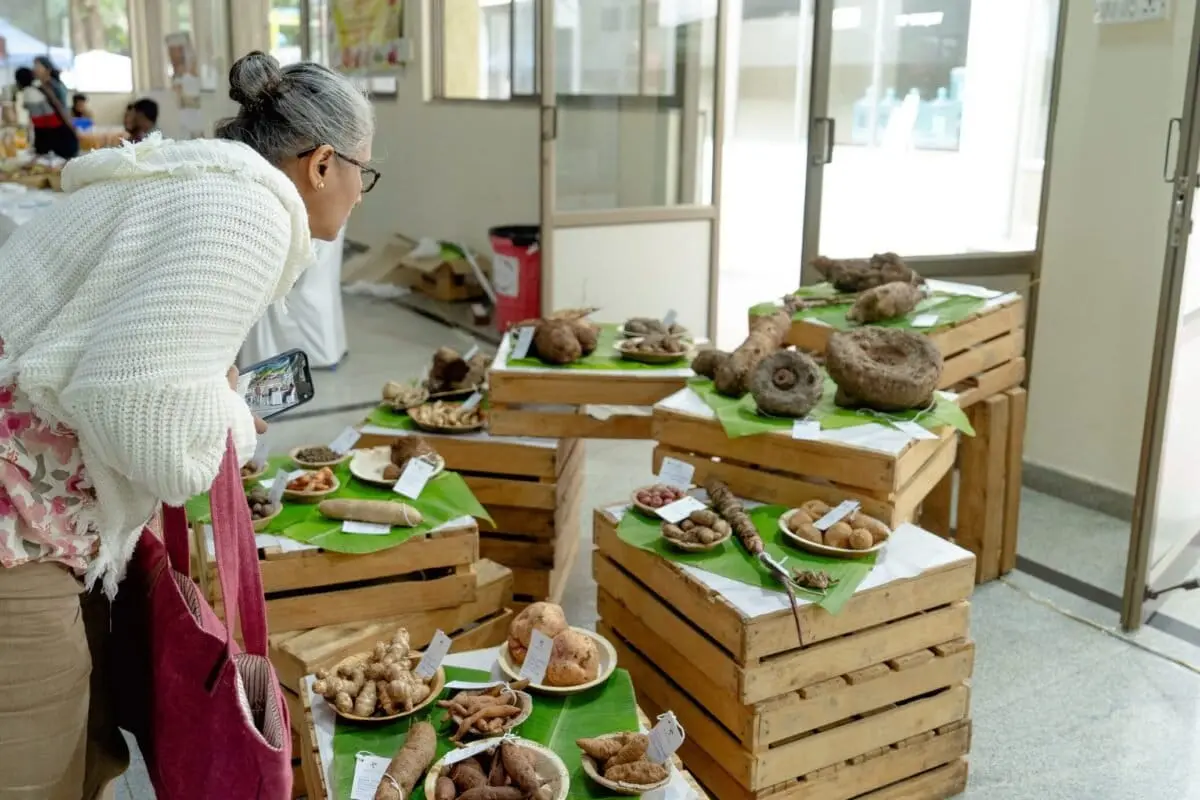
- 2022–2024: Collaborative initiatives like "Rooting for Tubers" emerge in Bengaluru, led by groups like Edible Issues and Spudnik Farms, attempting to reintroduce consumers to forgotten tubers through workshops and community events.
- 2025: Contemporary analysis reveals a paradox: while India is the world’s second-largest producer of vegetables, its productivity per hectare remains the lowest among the top five producing nations. The reliance on a few hybrid varieties has left the system vulnerable to climate shocks and pests.
Supporting Data: The Nutritional and Ecological Toll
The decline in biodiversity is mirrored by a decline in consumption and nutritional health. Data from a 2020 study by UK researchers highlights a stark reality: despite being a major producer, the average Indian consumes only 230g of fruits and vegetables per day. This is significantly lower than the 400g daily intake recommended by the FAO and the World Bank.

The Genetic Gap
The scale of missing genetic data is substantial. While India’s National Bureau of Plant Genetic Resources (NBPGR) houses over 30,700 accessions of vegetable crops like okra and brinjal, and the WorldVeg Genebank holds 65,000 samples globally, thousands of local landraces remain "under the radar." These landraces often possess traits—such as drought tolerance or resistance to specific local pests—that are absent in commercial hybrids.
The Market Paradox
Market homogenization is driven by aesthetic standards. Elizabeth Yorke, a chef and researcher at Edible Issues, notes that consumers have been conditioned to associate quality with visual perfection. "The idea that tomatoes come in different colors and shapes… those references have been eliminated," she explains. This visual bias creates a feedback loop: supermarkets only buy what looks "perfect," so farmers only grow those varieties, leading to the extinction of "ugly" but nutrient-dense traditional crops.
Economic Struggles
For the Indian farmer, vegetable cultivation is often a "hit or miss" endeavor. High-return crops like colored capsicums grown in polyhouses offer profits, but traditional vegetables often lack the supply chain support needed to reach urban markets. Post-harvest losses and price volatility mean that many small-scale farmers cannot afford the risk of planting unproven or lesser-known heirloom varieties.

Official Responses and Expert Perspectives
International conservation bodies are beginning to sound the alarm, shifting focus toward "Opportunity Crops"—overlooked species that could bolster climate resilience.
Maarten van Zonneveld, Head of the Genebank at the International Potato Center in Lima, emphasizes that conservation is only the first step. "The end goal is not just conservation, but also ensuring that this diversity is utilized," he says. Van Zonneveld points out that many vegetables are "dual-purpose," such as sweet potatoes and taro, where both roots and leaves are edible, providing a multi-layered safety net for food security.
Colin Khoury, Global Conservation Lead at Crop Trust, argues that the agricultural industry has historically ignored vegetables because they do not fit the "large-field" model of staple grains. "They are grown in small terraces, gardens, rooftops… often by women, the elderly, and children," Khoury notes. He suggests that the "push" of supply must be met with a "pull" of demand, facilitated by chefs, influencers, and government-backed education.

In India, the North East Society for Agroecology Support (NESFAS) has provided a successful blueprint for this "pull" strategy. Since 2022, they have integrated indigenous foods into school meal programs across 26 schools in Meghalaya. By serving underutilized local vegetables like Indian pennywort and taro stems, they are cultivating a new generation’s palate for biodiversity.
Implications: A Climate-Resilient Future
The loss of vegetable biodiversity is not just a cultural tragedy; it is a biological one. As climate change brings erratic rainfall and rising temperatures, the "standardized" seeds of industrial agriculture may fail. Heirloom varieties, which have evolved over centuries to thrive in specific micro-climates, hold the genetic keys to adaptation.
Reclaiming Culinary Confidence
To reverse the trend, experts argue that "culinary confidence" must be restored. Many consumers avoid traditional tubers or wild greens simply because they no longer know how to clean, store, or cook them. Initiatives that provide recipes and processing tips are essential to bringing these vegetables back into the domestic sphere.

Policy Shifts
There is an urgent need for government initiatives to move beyond the "TOP" (Tomato, Onion, Potato) mindset. Supporting market linkages for minor crops and providing incentives for farmers who maintain "in-situ" (on-farm) conservation of heirloom seeds could stabilize the supply.
The Path Forward
The survival of the clove bean and the Yerengere eggplant depends on a fundamental shift in how society values food. If vegetables continue to be treated as uniform commodities, the genetic heritage of the last several centuries will be lost within a single generation. However, through the combined efforts of seed savers like Prabhakar Rao, researchers like van Zonneveld, and community programs like NESFAS, there remains a window of opportunity to bring color, flavor, and resilience back to the Indian plate.
As Rao observes while walking through his rows of heirloom tomatoes, the stakes are high: "The loss of vegetables is not palpable or widely discussed… it is happening under the radar." Breaking that silence may be the only way to ensure that the "nose-pin" bean remains more than just a footnote in a vintage cookbook.
