SHILLONG, MEGHALAYA — On a crisp autumn morning near Cherrapunji, the air is thick with the scent of damp earth and limestone. Milton Marak, 27, stands at the yawning mouth of Mawmluh Cave, his headlamp cutting a sharp beam through the mist. As he leads a small group into the subterranean silence, he isn’t just showing them a tourist attraction; he is walking them through a 7.2-kilometer-long archive of Earth’s history.
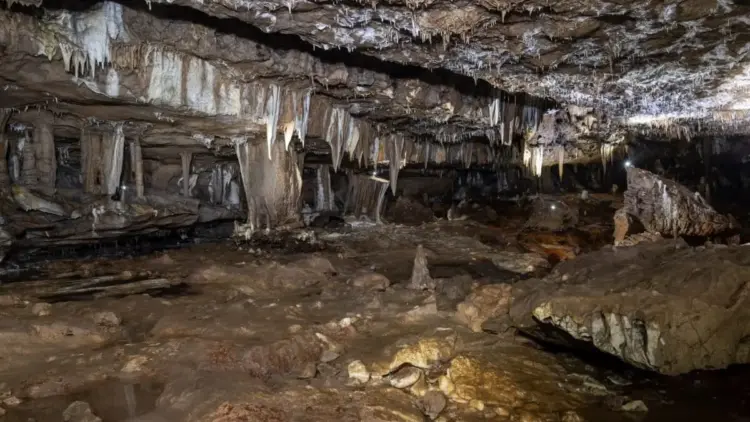
Inside, the world changes. There are no neon lights or paved walkways. Instead, the beams of hand-held torches dance across towering stalagmites, delicate "soda straw" formations, and shimmering curtains of calcite. "We’ve deliberately kept the cave natural," Marak explains, his voice echoing against the ancient walls. "If we install lights, it becomes a showroom. The real experience is entering a naturally dark cave with only your own light."
Marak’s intimate knowledge of these passages—acquired over years of navigation without maps—is now a vital component of a grassroots movement to protect one of the world’s most significant geological sites. Beneath the rain-soaked hills of Meghalaya lies a network of caves that hold a remarkable chemical record of the planet’s climate. However, scientists and locals now warn that this "library written in stone" is under immediate threat from two converging forces: a rapidly changing climate and decades of unregulated industrial mining.

Main Facts: The Geological Significance of Mawmluh
Mawmluh Cave is not merely a local wonder; it is a global benchmark for geological time. In 2018, the International Union of Geological Sciences (IUGS) officially designated the "Meghalayan Age" as the current stage of the Holocene Epoch. This designation was based on a specific stalagmite found within Mawmluh Cave, which preserved a chemical signature of a massive climatic shift that occurred roughly 4,200 years ago.
The Meghalayan Age
This geological era began with a mega-drought that lasted two centuries, severely impacting ancient civilizations in the Indus Valley, Mesopotamia, and Egypt. The stalagmites in Mawmluh acted as a "black box" recorder, capturing the oxygen isotope variations that signaled a dramatic weakening of the Indian Summer Monsoon.
A Subterranean Ecosystem
Beyond its geological value, the cave is a sanctuary for highly specialized biodiversity. In the absolute darkness, life has evolved in isolation. Visitors and researchers have documented:

- Transparent freshwater shrimp and white crabs: Species that have lost their pigmentation due to the lack of sunlight.
- Cave-adapted crickets and spiders: Predators that rely on vibrations rather than sight.
- The World’s Largest Cave Fish: In 2019, researchers discovered Neolissochilus pnar in the Jaintia Hills, a cave-dwelling fish measuring nearly a foot and a half in length, shattering previous records for subterranean aquatic life.
Chronology: From Ancient Formation to Modern Crisis
The story of Meghalaya’s caves spans millions of years, but the timeline of their discovery and subsequent endangerment is much more recent.
- Ancient History (4,200 Years Ago): A significant weakening of the monsoon leaves a permanent chemical mark in the stalagmites of Mawmluh, later becoming the basis for the "Meghalayan Age."
- 1990: Brian D. Kharpran Daly, widely regarded as India’s first speleologist, founds the Meghalaya Adventures’ Association (MAA). This marks the beginning of systematic exploration, resulting in the documentation of over 1,700 caves to date.
- 2007: Concerned by the encroachment of limestone quarrying, Kharpran files a Public Interest Litigation (PIL) in the Supreme Court of India. The petition seeks protection for the caves from cement and coal industries.
- 2008: The Supreme Court dismisses the PIL without a detailed explanation, a move activists attribute to the powerful economic interests of the mining lobby.
- 2014: The National Green Tribunal (NGT) imposes a ban on "rat-hole" coal mining in Meghalaya, citing environmental degradation and unsafe working conditions.
- 2018: The "Meghalayan Age" is formally recognized by the international scientific community, placing Mawmluh Cave on the global map.
- 2024: Despite the ban, illegal mining persists. An explosion at an unauthorized mine in the East Jaintia Hills kills 27 miners, highlighting the continued failure of enforcement.
Supporting Data: The High Cost of Extraction
The threat to these caves is quantifiable. Meghalaya’s limestone plateau is a prime target for the cement industry, and its hills are riddled with coal deposits.
Mining Impacts
Limestone is the literal "skin" of the cave systems. When a quarry removes the surface rock, it often collapses the chambers beneath. Even if a cave remains physically intact, the vibrations from blasting—which Sebastian Breitenbach, a paleoclimatologist at Northumbria University, recalls hearing while inside Mawmluh—can shatter delicate formations that took tens of thousands of years to grow.

Furthermore, coal mining introduces toxic runoff. Coal dust, oil, and sulfur compounds wash into underground streams, altering the pH levels of the water. This not only kills sensitive cave fauna but also stops the chemical processes required for stalagmite growth, creating what scientists call a "hiatus"—a permanent gap in the climate record.
Climate Data
Ironically, the very climate changes scientists study in these caves are now threatening the caves’ stability. Research by Jaishree Sanwal Bhatt of the Jawaharlal Nehru Centre for Advanced Scientific Research indicates that rainfall in Meghalaya is becoming increasingly erratic.
- Shortened Wet Seasons: While Meghalaya is one of the wettest places on earth, the rain is now falling in more intense, concentrated bursts.
- Sedimentation: Sudden deluges rush underground, carrying high volumes of sediment that can "choke" cave passages and damage the chemical purity of new mineral deposits.
Official Responses and Expert Perspectives
The battle for the caves is fought between those who see the limestone as a commodity and those who see it as a heritage.

The Scientific Warning:
"They are like books in a library," says Professor Sebastian Breitenbach. "You just have to learn the language and then you can read the past." He warns that the seasonality of the monsoon is shifting so rapidly that the steady infiltration of water needed to keep these "books" being written is at risk.
The Speleologist’s Lament:
Brian D. Kharpran, who has dedicated three decades to these caves, remains skeptical of "scientific mining" claims. "Even so-called scientific mining requires the removal of forests, hills, and limestone landscapes. It is fundamentally destructive," he asserts. Kharpran points out that Meghalaya’s unique land tenure system—where most land is privately or community-owned—makes government regulation difficult to enforce.
The Local Solution:
Faced with a lack of government protection, local communities are stepping in. The MAA has trained approximately 100 local youths as certified cave guides.

- Quenty Mary Jallong, 24: A trainee guide, hopes to turn her village cave into a community-managed destination. "Jobs are very difficult to find in our village. I would rather help create opportunities here, within my own community, than leave," she says.
- Wanpylnbiang, 22: A former shop worker, believes that if the village council backs responsible tourism, it will provide an economic alternative to selling land to mining companies.
Implications: The Future of the Meghalayan Archive
The fate of Meghalaya’s caves carries implications that resonate far beyond the borders of Northeast India.
Scientific Loss
If these caves are destroyed, humanity loses one of its most precise instruments for predicting future climate patterns. By understanding how the Indian Summer Monsoon responded to past temperature shifts, scientists can better model how it will react to modern global warming—a matter of life and death for the nearly two billion people in South Asia who depend on monsoon rains for agriculture.
Economic Transition
The shift toward ecotourism represents a critical fork in the road for Meghalaya’s economy. Mining offers high-intensity, short-term wealth but leaves behind a decimated landscape. Community-led tourism, as seen in Mawmluh, offers lower-intensity, long-term sustainability. However, as Jaishree Sanwal Bhatt notes, "Ecotourism is important, but conservation must also be guided by science." Local guides cannot monitor pH levels or control mining permissions granted at the state level.

The Preservation Mandate
To ensure the survival of the Meghalayan Age record, experts are calling for:
- Scientifically Defined Buffer Zones: Establishing "no-mining" perimeters around documented cave systems.
- Stricter Enforcement of Mining Bans: Moving beyond registered cases to actual cessation of illegal "rat-hole" activities.
- Collaborative Governance: A framework that respects community land rights while providing the scientific tools necessary for long-term monitoring.
Back inside Mawmluh, Milton Marak pauses by a cluster of "soda straws"—hollow, translucent tubes of calcite hanging from the ceiling. They are so fragile that a single touch could destroy a thousand years of growth. "Earlier, we had very few visitors," Marak says. "Today, hundreds come. That has made me realize how important it is to preserve this so future generations can experience it too."
As the group exits the cave, emerging back into the bright Meghalayan sun, the contrast is stark. Above ground, the world is changing rapidly. Below, in the darkness, the stone library is waiting to see if it will be allowed to finish its next chapter.