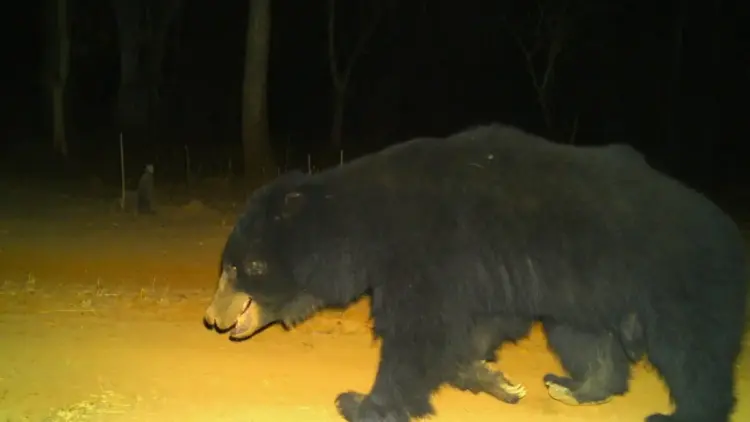
PANNA TIGER RESERVE, MADHYA PRADESH — In the rugged, sun-scorched landscapes of the Vindhya hill range, a silent drama of survival unfolds. Sloth bear mothers (Melursus ursinus), known for the unique sight of carrying their cubs on their backs, are engaging in a high-stakes game of spatial and temporal avoidance. A groundbreaking study conducted in the Panna Tiger Reserve has revealed that these mothers are deliberately choosing "suboptimal" habitats—hotter, more rugged, and less resource-rich—to protect their young from the potential threats posed by lone adult bears.
The research, recently published in the journal Ecology and Evolution, provides a rare and intimate look into the breeding ecology of one of India’s most enigmatic and understudied large carnivores. By analyzing years of camera-trap data, scientists have mapped a "landscape of fear" where the needs of maternal care override the biological preference for comfort and easy sustenance.
Main Facts: A Strategic Retreat into the Heat
The core finding of the study is a distinct behavioral segregation between two demographic groups: lone adult sloth bears and females with dependent offspring. While lone adults—a category that includes both males and non-breeding females—frequently occupy mixed forest landscapes with cooler temperatures and proximity to vital water sources, mothers with cubs are moving to the margins.
According to the study, sloth bear mothers are distinctly avoiding the areas favored by lone adults. This avoidance is not merely a preference but a survival strategy that comes with significant physiological costs. The researchers found that females with offspring were consistently associated with hotter land surface temperatures and more rugged, difficult terrain.

“Space-wise, they [females with offspring] are actually avoiding lone adults very distinctly,” explained Sankarshan Chaudhuri, a project scientist at the Wildlife Institute of India (WII) and the study’s lead author. This spatial segregation is mirrored by temporal shifts; although sloth bears are primarily nocturnal or crepuscular (active at dawn and dusk), mothers in Panna were found to be more active during the day than their lone counterparts, likely to avoid encounters during the peak activity hours of other adults.
Chronology: From "Bycatch" Data to Biological Breakthrough
The journey to these findings began in 2018, spanning six seasons through 2021. The data was collected over two summers and four winters, totaling a massive 47,800 trap nights. Interestingly, the study was born out of the "bycatch" of a different mission. The camera traps used were originally deployed as part of the All India Tiger Estimation programme.
- 2018–2019: Initial camera trap deployments in the core zone of Panna Tiger Reserve. Researchers began noticing patterns in the timestamps of sloth bear sightings.
- 2020: The study period continued through the pandemic, capturing seasonal variations in movement.
- 2021: Final data collection concluded. The team began the arduous task of categorizing thousands of images into "lone adults" and "females with offspring" (cubs less than a year old or dependent yearlings).
- 2023–2024: Analysis and modeling phases. Researchers utilized multi-state occupancy models to statistically separate the habitat preferences of the two groups.
- Late 2024: Publication of the findings in Ecology and Evolution, marking a significant addition to the sparse literature on sloth bear reproductive behavior.
Historically, sloth bear research has been overshadowed by India’s "Big Cats." As Nishith Dharaiya, co-chair of the IUCN Sloth Bear Expert Team, noted, species-specific funding has been scarce, leaving large gaps in our understanding of the bear’s social structures. This study represents one of the first major efforts in India to quantify how reproductive status alters the species’ use of space and time.
Supporting Data: The Metrics of Avoidance
The scale of the study allowed for robust statistical modeling. Of the thousands of bear detections, only 8.4% were identified as females with offspring. This low percentage reflects the elusive nature of breeding females but was sufficient to reveal clear trends when processed through multi-state occupancy models.
1. Habitat Quality and Resource Scarcity:
The study found that lone adults gravitated toward resource-rich riverine habitats, particularly near the Ken River, which serves as the lifeblood of the water-scarce Bundelkhand region. These areas offer water, cooler microclimates, and access to honey—a high-energy food source. Conversely, mothers with cubs actively avoided these riverine zones, especially during the punishing summer months.

2. Thermal Stress:
The physiological trade-off is perhaps the most striking data point. Pregnant and lactating mammals already face higher internal body temperatures due to the metabolic demands of milk production. Despite this, mothers were found in areas with higher land surface temperatures. By choosing hotter regions, they reduce the risk of cub mortality from predators or aggressive conspecifics (members of their own species), but they increase their own risk of heat stress.
3. Terrain Complexity:
In summer, lone adults showed a strong preference for complex terrain—areas with caves and rocky outcrops that provide natural air conditioning. However, the study found that mothers with cubs had a much weaker association with these prime denning sites during the summer. The researchers hypothesize that if lone adults dominate the best caves, mothers are forced into more exposed, less complex landscapes to maintain their distance.
Official Responses and Expert Hypotheses
The scientific community has greeted the study as a vital piece of the conservation puzzle. The researchers have proposed two primary hypotheses for why this segregation occurs:
The Infanticide Hypothesis:
In many solitary carnivore species, such as lions and grizzly bears, unrelated males may kill cubs to bring the female back into estrus (breeding readiness). While infanticide has not been definitively proven in sloth bears, it is a suspected driver of female behavior. “So far, there is no hard-and-fast evidence or solid proof that sloth bears are showing infanticide,” Chaudhuri cautioned, but noted that the 1999 study from Nepal first suggested it as a possibility. The current findings of extreme avoidance lend weight to the theory that mothers perceive other adults as a lethal threat to their young.
The Competition Hypothesis:
Sloth bears are myrmecophagous (ant and termite-eating) but also rely heavily on seasonal fruits. When resources are concentrated, competition becomes fierce. By moving to marginal areas, mothers ensure that they are not competing with larger, more aggressive lone adults for limited food supplies, even if the food in the marginal areas is of lower quality.

Nishith Dharaiya emphasized the importance of these findings for the broader Indian context. "These findings are an important contribution… as very few such studies are conducted in India," he said. He added that understanding these patterns is crucial because "the species is more involved in human-wildlife conflict," and knowing where mothers are likely to be can help mitigate these encounters.
Implications: Conservation and Human-Wildlife Conflict
The study’s findings have immediate implications for the management of tiger reserves and the protection of sloth bear populations.
1. Managing the "Buffer Zones":
While this study was conducted in the protected core zone of Panna, the behavior of sloth bear mothers suggests they may be pushed toward the "buffer zones" or human-dominated landscapes to avoid other bears. This is a critical insight, as many human-bear conflicts involve mothers protecting their cubs. If conservationists know that mothers are being excluded from the best habitats within the park, they can better predict conflict "hotspots" near village borders.
2. Climate Change Vulnerability:
The revelation that mothers already occupy hotter-than-ideal habitats suggests they may be disproportionately vulnerable to rising global temperatures. If climate change makes these marginal habitats even hotter, the physiological cost of raising cubs may become unsustainable, leading to higher cub mortality or lower birth rates.
3. Beyond the "Charismatic" Mega-fauna:
The study underscores the value of "bycatch" data. By utilizing the infrastructure of the All India Tiger Estimation, researchers were able to study a "vulnerable" species without the need for a massive, dedicated budget. This model of multi-species monitoring is likely to become the standard for conservation in resource-strapped regions.

Conclusion: A Delicate Balance
The life of a sloth bear mother in Panna is one of constant calculation. To raise the next generation, she must navigate a landscape where the greatest threat is often her own kind. By retreating into the heat and the rugged hills, she pays a "motherhood tax" in the form of physical exhaustion and thermal stress, all to ensure the safety of the cubs clinging to her back.
As Sankarshan Chaudhuri aptly summarized, “It’s a very delicate balance they are maintaining.” Future research will now look to the monsoon season and human-dominated landscapes to see if the presence of people further complicates this already grueling survival strategy. For now, the study serves as a testament to the hidden complexities of India’s wildlife, proving that even in the shadow of the tiger, the sloth bear leads a life of sophisticated and heroic endurance.