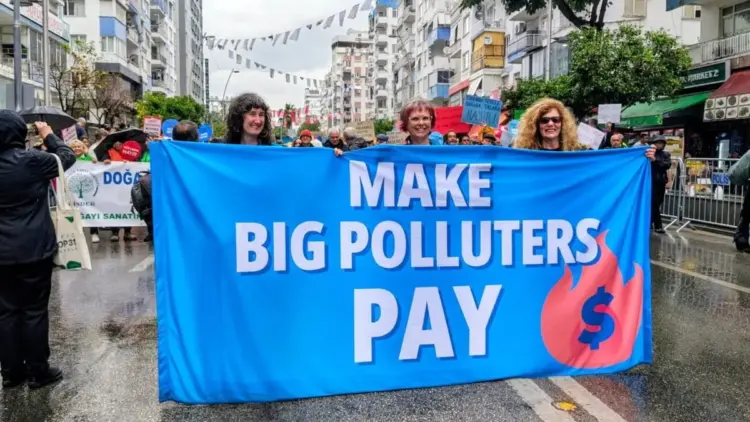
While government ministers and technical experts inside the air-conditioned plenary halls of COP31 grappled with the minutiae of carbon markets and finance mechanisms, the streets of Antalya echoed with a different urgency. The procession, a kaleidoscope of hand-painted banners, giant street installations, and costumed performers, marked the commencement of the People’s Climate Summit, a parallel five-day gathering designed to challenge the perceived "corporate capture" of official UN proceedings.
Main Facts: A Convergence of Global Movements
The mobilization in Antalya was not a monolithic protest but a coalition of interests. According to organizers, the People’s Climate Summit (held from November 14–18) brought together more than 130 organizations from 34 countries. The diversity of the crowd reflected a maturing climate movement that now views environmental degradation as inseparable from economic inequality, labor rights, and colonial legacies.

The core demands of the marchers were centered on four pillars:
- Immediate Fossil Fuel Phase-Out: An end to new exploration and a rapid transition away from coal, oil, and gas.
- Loss and Damage Financing: A demand that wealthy, high-emitting nations fulfill their financial obligations to the Global South.
- Corporate Accountability: Legal and financial consequences for companies responsible for large-scale deforestation and pollution.
- A Just Transition: Ensuring that the shift to a green economy protects workers’ livelihoods rather than enriching private capital.
Chronology of the Day: From Rain to Resistance
The day began under a heavy, grey sky. By mid-morning, despite a persistent drizzle and a significant security presence, the city center began to fill. By 11:00 AM, the "riot of color" described by participants was in full swing.
At the heart of the procession were activists from the Global South, many of whom had traveled thousands of miles to ensure their communities’ voices were not sidelined. By noon, the march reached Republic Square, where the atmosphere shifted from a protest to a massive outdoor assembly.

Performers used giant masks and expanses of red fabric—symbolizing the "red lines" of planetary boundaries—to turn the streets into a stage. Chants against "corporate greed" and "forest destruction" drowned out the sound of the rain. By the afternoon, representatives from various sectors—ranging from Indonesian women farmers to European trade unionists—took to makeshift stages to deliver a unified message: the official negotiations are moving too slowly for a world already in flames.
Supporting Data: The Growing Gap in Climate Finance
The fervor on the streets was underpinned by sobering data released just weeks prior to the conference. A key driver of the protest was the United Nations climate body’s October 2026 report on the "Fund for Responding to Loss and Damage."
The report revealed a staggering disparity: while the fund was officially operationalized, the total pledged capital remained under 5% of the estimated $400 billion needed annually by 2030 to help developing nations recover from climate-induced disasters. This "finance gap" was a recurring theme on the banners in Antalya, with many protesters calling for a "Polluter Pays" tax on fossil fuel profits to bridge the deficit.

Furthermore, the Indonesian environmental group WALHI (The Indonesian Forum for the Environment) presented a 2026 analysis during the summit that sharpened the focus on corporate land use. Their data showed that nearly 50% of the fire hotspots in Indonesia during the previous year were located within concessions owned by forestry and oil palm companies. This data challenged the narrative that forest fires are merely a result of climate-induced drought, pointing instead to deliberate land-clearing practices for commercial gain.
The Labor Dimension: A Just Transition for the Working Class
In a notable departure from earlier climate protests, the Antalya march saw a massive turnout from international trade unions. This reflects the growing influence of the International Labour Organization’s (ILO) "Guidelines for a Just Transition."
Labor leaders at the march argued that the transition to a low-carbon economy must not repeat the mistakes of previous industrial shifts, which often left workers in "rust belts" with no social safety net.

- The Demand: Protesters called for public control of energy grids to prevent "green energy" from becoming a vehicle for private profit at the expense of affordable electricity.
- The Strategy: Unions are demanding guaranteed retraining programs, social security, and "meaningful consultation" in the decommissioning of fossil fuel infrastructure.
A banner reading "Public Power, Not Private Profit" captured the sentiment that the transition is as much an economic revolution as a technological one.
Official Responses: Inside the "Sterile" Rooms
The contrast between the street and the summit was stark. Inside COP31, the mood was described by delegates as "painstaking" and "technical." While the protesters demanded an immediate end to fossil fuels, negotiators were bogged down in discussions over Article 6 of the Paris Agreement, which governs international carbon markets.
A spokesperson for the UN climate secretariat acknowledged the protests, stating that "civil society is the conscience of the COP." However, many activists dismissed such statements as "performative."

"Inside those rooms, they talk about ‘abated’ versus ‘unabated’ fossil fuels, which is just a code for keeping the industry alive," said one campaigner from a Pacific Island nation. "Outside here, we talk about survival."
Government representatives from several developing nations expressed sympathy with the marchers’ demands for Loss and Damage funding. However, several high-income nations continued to resist "mandatory" contributions, favoring "voluntary" private sector investments—a stance that directly contradicts the "Polluter Pays" principle championed on the streets.
Implications: A Movement Reimagined
The events in Antalya on November 14 suggest that the global climate movement has entered a new, more intersectional phase. The implications for future policy and social stability are significant:

1. The End of "Carbon Tunnel Vision"
The Antalya mobilization proves that activists no longer accept climate change as a standalone environmental issue. By linking carbon emissions to gender equality, food systems, and peace, the movement is building a broader political base. This makes it harder for governments to offer narrow, tech-centric solutions (like Carbon Capture and Storage) without addressing underlying social inequities.
2. Increased Pressure on Corporate Sovereignty
The focus on WALHI’s data regarding Indonesian forest fires indicates a rising demand for "Extraterritorial Accountability." Activists are increasingly targeting the global supply chains of multinational corporations, demanding that they be held liable in their home countries for environmental crimes committed abroad.
3. The Rise of the "Just Transition" as a Political Necessity
The presence of trade unions suggests that any climate policy failing to account for labor rights will face stiff domestic opposition. For governments, this means that "green deals" must include robust social welfare components to maintain public consent for the energy transition.

4. The Legitimacy Crisis of the COP Process
The widening gulf between the "direct and colourful" demands of the people and the "sterile" negotiations inside the COP raises questions about the long-term viability of the UN process. If COP31 fails to deliver a significant breakthrough on finance and fossil fuel phase-out, the momentum may shift toward "minilateralism" or more radical forms of direct action outside of international frameworks.
Conclusion: The Faces Behind the Justice
As the march concluded at Republic Square, the rain finally stopped, leaving the streets of Antalya shimmering under the city lights. The banners were soaked, but the resolve of the participants appeared hardened.
The People’s Climate Summit in Antalya serves as a reminder that while diplomacy is conducted in quiet rooms, the consequences of those decisions are felt in the forests of Indonesia, the factories of Europe, and the flood-prone plains of the Global South. The message from the streets of Türkiye was clear: climate justice is not a technical adjustment to the current system, but a fundamental reimagining of how power and resources are distributed on a warming planet.

For the negotiators returning to their tables the following morning, the chants of the thousands outside remained a haunting reminder that the world is no longer waiting for permission to demand change.