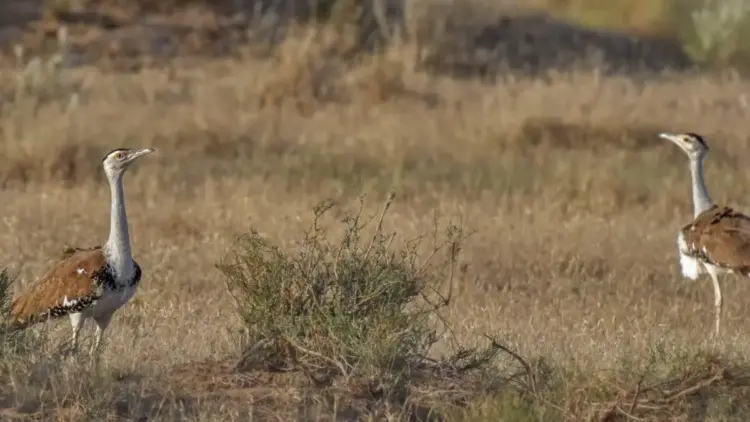
The Great Indian Bustard (Ardeotis nigriceps), a majestic bird once found across the dry plains of the Indian subcontinent, now stands on the precipice of extinction. With fewer than 150 individuals remaining in the wild, the species is classified as Critically Endangered on the IUCN Red List. In a high-stakes effort to pull the species back from the brink, conservationists have turned to one of the most complex biological experiments in modern history: a captive-breeding and rewilding program known as Project Great Indian Bustard.
In early October, the project reached a significant milestone when four captive-bred Great Indian Bustards (GIBs) were released into the wild at the Desert National Park (DNP) in Rajasthan. However, the celebration was short-lived. On October 17, less than two weeks after their release, one of the birds was found dead. Preliminary evidence suggests the bird was predated upon by a desert fox. This incident has ignited a fierce debate among conservationists, scientists, and policy experts regarding the transparency of the project, the ethics of predator management, and the brutal realities of rewilding a species that has forgotten the dangers of the wild.
Chronology of a Conservation Crisis
The journey toward the recent release began nearly a decade ago. Faced with a plummeting wild population—primarily due to habitat loss, hunting, and collisions with high-voltage power lines—the Indian government, in collaboration with the Wildlife Institute of India (WII) and the Rajasthan Forest Department, established two conservation breeding centers at Sam and Ramdevra in Jaisalmer.
2015–2022: The Founder Phase
The project began by collecting eggs from wild nests in the Thar Desert. These eggs were incubated under strictly controlled conditions, and the resulting chicks formed a "founder population" of approximately 40 birds. The goal was to create a "safety net" population that could eventually be used to supplement wild numbers.
March–April 2024: The Gujarat Experiment
Earlier this year, the project attempted the "Jumpstart Approach" in Kutch, Gujarat. This method involved transporting a fertilized egg from the Rajasthan breeding center to Gujarat, where a wild female bustard was encouraged to incubate and rear the chick. While a chick successfully hatched in March, it went missing in April. Despite exhaustive searches by forest officials, no trace of the chick was found, and predation was suspected. This loss prompted the Gujarat state government to intensify habitat protection and predator-control measures.
October 2024: The Rajasthan Release
With the captive population growing to nearly 100 individuals, officials decided to move to the rewilding phase ahead of schedule. Originally planned for a 15-year timeline, the first release of four birds took place in early October. The subsequent death of one bird on October 17 serves as a grim reminder of the challenges inherent in transitioning from a protected environment to the unforgiving desert landscape.

Supporting Data: The Odds of Survival
The statistics surrounding GIB conservation highlight why the project is both necessary and incredibly difficult. In the wild, the survival rate for GIB eggs is abysmally low, estimated at just 18%. Predators such as foxes, feral dogs, and monitor lizards often raid nests located on the ground.
By contrast, the captive-breeding program has seen remarkable success. Sutirtha Dutta, a lead scientist with the WII, notes that while international bustard conservation programs typically see a survival rate of around 48%, India’s program has achieved an 80% survival rate. This success is what allowed the team to move the rewilding timeline forward to eight years instead of fifteen.
However, "survival in captivity" does not equate to "survival in the wild." Dutta explains that in rewilding programs, a 30% survival rate among released birds is considered a success. "Even if we are able to release 30 birds in a year, and 10 of them survive and get recruited into the wild population, that is a massive addition to the current population of about 40 individuals in Desert National Park," Dutta said.
The data suggests that the project must operate on a "numbers game" logic: maximize the output of captive-bred birds to offset the high mortality rate expected during the initial phases of rewilding.
Official Responses: Resilience vs. Criticism
The death of the released bird has drawn varying responses from the scientific community. Project leaders maintain that such losses are an expected part of the "learning curve" for both the birds and the scientists.
The Perspective of the Wildlife Institute of India (WII)
Sutirtha Dutta maintains that the loss of one bird does not constitute a setback. He emphasizes that rewilding is a process of exposing birds to natural risks, including predation and starvation, as well as anthropogenic threats like infrastructure. According to Dutta, the remaining captive-bred birds are being monitored closely, and more releases are planned for November and December, provided the birds meet health and behavioral fitness criteria.
The Critique of Transparency and Strategy
Conversely, independent wildlife biologists have raised concerns about the project’s management. Sumit Dookia, an associate professor at GGS Indraprastha University and a long-time GIB researcher, has criticized what he perceives as a lack of transparency.

"This is a Government of India project of national importance, yet there is very little information shared with the public or the wider scientific community," Dookia argued. He questioned the specifics of the predation incident, asking how a fox could enter what was supposed to be a "predator-proof" enclosure if the death occurred within a protected zone. Dookia suggests that if captive-bred birds cannot recognize or avoid natural predators, the program will face a continuous cycle of loss.
The Predator Dilemma: Foxes vs. Bustards
One of the most contentious issues arising from the recent death is the proposal for "predator management." Following the loss of the bird, reports surfaced of a proposal to destroy desert fox dens and relocate the animals away from GIB habitats.
The desert fox (Vulpes vulpes pusilla) is itself a protected species under Schedule I of the Wildlife (Protection) Act, 1972. It is an integral part of the Thar Desert’s ecosystem. Conservationists like Dookia argue that targeting foxes is a reactionary measure that fails to address the underlying issue: the birds’ inability to survive in a natural ecosystem.
Dutta, however, clarified that large-scale removal of foxes was never on the table. He described the "strategic translocation" of foxes from specific GIB breeding enclosures as a scientifically informed practice. These enclosures cover only about 20 square kilometers of the 3,100-square-kilometer DNP. "Almost 50% of wild GIB eggs get predated, mostly by foxes whose numbers are very high inside these breeding enclosures," Dutta explained. He noted that this practice has been sanctioned by the Supreme Court of India as a necessary measure to ensure the survival of the critically endangered bustard.
Implications for the Future of Conservation
The challenges facing Project Great Indian Bustard are a microcosm of the global struggle to save species in the Anthropocene. The implications of this project reach far beyond the borders of Rajasthan.
1. The "Soft Release" Requirement
The death of the bird suggests that "soft release" protocols—where birds are kept in large outdoor pens to acclimatize to the environment before full release—may need to be extended or refined. Teaching a captive-bred bird to recognize a predator is a complex task that remains one of the greatest hurdles in avian rewilding.
2. Habitat Integrity
The debate over fox relocation underscores a larger truth: a species cannot be saved in isolation. The GIB requires vast, contiguous grasslands. When these habitats are fragmented or fenced off, it alters the predator-prey balance. True success will require not just breeding birds, but restoring the ecological health of the entire Thar landscape.

3. The Role of Infrastructure
While predation is a natural threat, the most significant "unnatural" threat remains power lines. As the project moves toward releasing more birds, the push to move overhead power lines underground in GIB priority areas remains a legal and financial battleground between the government, energy companies, and conservationists.
4. Scientific Accountability
The calls for transparency by experts like Dookia highlight the need for an open-source approach to conservation. By sharing failures and successes in real-time, the project could benefit from a wider pool of expertise and build public trust in what is an expensive and high-stakes endeavor.
Conclusion
The death of a single captive-bred Great Indian Bustard in the Rajasthan desert is a tragedy, but in the cold calculus of conservation biology, it is also a data point. The road to saving the GIB was never expected to be easy. It is a path defined by trial and error, where the survival of the species depends on the ability of scientists to adapt their strategies as quickly as the birds must adapt to the wild.
As the next cohort of bustards prepares for release in the coming months, the eyes of the global conservation community will be on the Thar Desert. The project represents more than just the survival of a bird; it is a test of whether human ingenuity and intervention can truly undo the damage of the past and restore a piece of India’s natural heritage to the skies.