KALIMPONG, WEST BENGAL — “When the flood took everything from me, it took more than my home and livelihood; it took away the place I once had in society. People look at us differently now. The relationships and respect we once had are no longer the same. I am not a beggar, and I was never born into a life like this.”
These words, spoken by 36-year-old Bijay Pradhan, encapsulate a tragedy that the official ledgers of disaster management often fail to record: the erosion of human dignity. For Pradhan, a former independent farmer and livestock rearer turned daily-wage laborer, the Glacial Lake Outburst Flood (GLOF) of October 2023 was not a singular event but the beginning of a permanent state of precariousness.
Nearly three years after the South Lhonak Lake in Sikkim breached its banks, sending a wall of water and debris down the Teesta River, the landscape of North Bengal remains a testament to both environmental volatility and administrative inertia. While the water receded within days, the lives of thousands remain submerged in a cycle of temporary shelters, recurring monsoonal anxiety, and a bureaucratic stalemate that has left the most vulnerable without a path home.

I. Chronology of a Crisis: From Breach to Permanent Limbo
The disaster began in the high altitudes of the Himalayas on the night of October 3, 2023. A breach in the South Lhonak Lake, triggered by heavy rainfall and potentially a seismic event, released an estimated 270 million cubic metres of water and sediment downstream. The resulting GLOF impacted over 80,000 people across Sikkim and West Bengal, destroying the Teesta III dam at Chungthang and washing away segments of National Highway 10, the region’s primary artery.
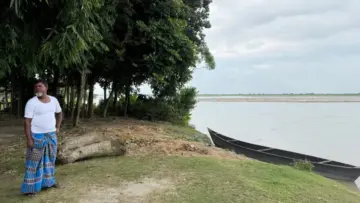
In the years following the initial catastrophe, the disaster has effectively "re-run" during every monsoon season. In 2024 and 2025, consecutive flash floods struck the same regions. These were not new GLOFs but the result of a fundamentally altered river morphology. The 2023 event deposited so much silt—reportedly raising the riverbed by six to 14 metres in areas like Melli and Teesta Bazaar—that even standard seasonal rains now cause the river to breach its banks.
By late 2026, the situation has transitioned from an emergency to a chronic humanitarian crisis. Residents who once lived safely hundreds of meters from the water now find the Teesta at their doorsteps, a constant reminder of a geography that no longer offers safety.
II. Scientific and Morphological Shifts: A Changing River
The 2023 GLOF was a transformative geological event. A 2025 study published in the journal Science highlighted the sheer volume of sediment—270 million cubic metres—swept downstream. This "sediment pulse" has choked the Teesta’s channel, reducing its carrying capacity and forcing the water to spread laterally into settlements.

“The river is less predictable now,” notes 75-year-old resident Pradhan Baje. He recalls a time when traditional knowledge provided a safety net. “Whenever the river water began to rise, we could smell the rotten fish and algae, what we call vale. That alerted us to the danger.”
Today, that traditional early warning system has been rendered obsolete by decades of anthropogenic intervention. Road construction, settlement expansion, and the proliferation of hydroelectric dams have fragmented the river’s flow. Studies indicate that the Teesta’s channel width has decreased over time due to encroachment, while damming has altered the natural rhythm of sediment transport. When the GLOF hit, these vulnerabilities were exploited, turning a natural hazard into a man-made catastrophe.
III. The Human Cost: Life in the Relief Camps
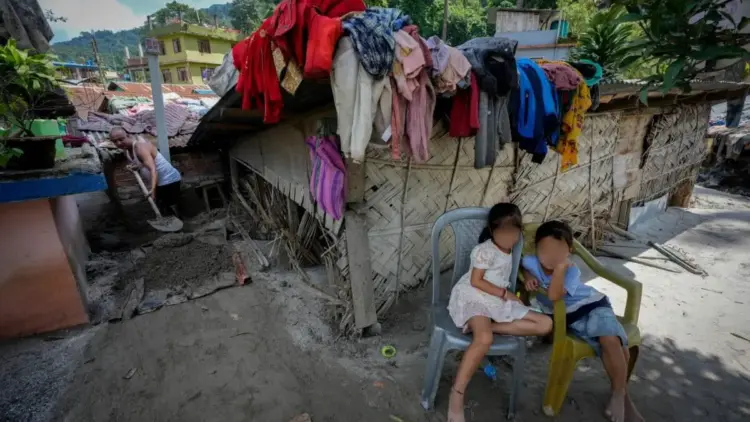
The physical evidence of the GLOF’s destruction is most visible in the "relief camps" that have become permanent settlements. In Gafur Busty, families live inside the Haat Ghar, an unfinished concrete building. Here, "homes" are partitioned by plastic sheets, bamboo, and tin. There are no cement walls, no privacy, and shared sanitation facilities.
“We have become like an exhibition,” says Bijay Pradhan, who lives in the Haat Ghar with his mother, wife, and two children. “People keep coming here, taking photographs and asking questions, but nothing changes for us.”

Further along the NH10, at Labar Bhotay, 32 families displaced from the border town of Melli live on forest land. Their makeshift dwellings are prone to infestations of rats and snakes, and the constant threat of falling branches from the overhanging canopy. Because they occupy forest land under a temporary arrangement, they are trapped in a legal vacuum: they cannot build permanent structures, yet they have no titles to the land they occupy.
For others, like 56-year-old Kopila, the flood was an economic execution. A week before the 2023 breach, she had invested her life savings and loans into a riverside camping business. The flood swept away her campsite, her equipment, and the car she used to transport tourists. Today, she runs a small canteen, struggling to service debts for assets that no longer exist.
IV. Official Responses and the Warning Gap
The failure of the technical early warning system remains a point of deep contention. Just three weeks before the 2023 disaster, a high-level team led by the National Disaster Management Authority (NDMA) had installed weather stations at South Lhonak Lake. However, the sensors specifically designed to detect a sudden drop in lake levels—the primary indicator of a GLOF—had not yet been commissioned.
“Rivers do not follow administrative boundaries,” says Eklavya Sharma, former director of ICIMOD. “States need to share monitoring data and early warnings, not work in isolation.”

The administrative response in West Bengal has been criticized as fragmented compared to neighboring Sikkim. While the Sikkim government declared the GLOF a state disaster, providing rental assistance to 447 families and sanctioning 4,100 new houses under the Punarvaas Awaas Yojana, West Bengal never officially categorized the event as a "disaster" in the same legal sense.
The compensation in Kalimpong has been limited to a one-time payment: ₹75,000 for a completely destroyed house and ₹5,000 for partial damage. In a region where construction costs are high due to terrain, these sums are viewed by locals as a pittance.
Political friction has further complicated the recovery. Disagreements between the Trinamool Congress-led Gorkhaland Territorial Administration (GTA) and the BJP-led central government have led to a "blame game" over the deployment of relief funds. While the state government claims the Centre has not provided specific GLOF relief for Kalimpong, local MPs point to state-level mismanagement and the failure to declare a formal disaster.
V. Implications: The "Mountain Premium" and the Future of the Himalaya
The Teesta crisis highlights a broader challenge known as the "Mountain Premium." As Praful Rao, founder of the Kalimpong-based organization ‘Save The Hills’, explains: “The same amount of money that could benefit thousands in the plains may reach only a few hundred in the hills because of difficult terrain and expensive infrastructure.”

The implications for the future are sobering:
- The Window for Mitigation: Experts argue that flood mitigation must happen during the winter dry season. However, attention usually only shifts to the Teesta when the monsoon arrives and disaster is already imminent.
- Planned Relocation: There is an urgent need for the government to identify the most vulnerable communities and relocate them to "climate-safe" zones. Currently, settlements continue to rebuild on unstable, silt-heavy land because there are no alternatives.
- Transboundary Governance: The Teesta is an interstate and international river. The lack of a coordinated data-sharing mechanism between Sikkim and West Bengal (and eventually Bangladesh) ensures that downstream communities will always be the last to know when a surge is coming.
Conclusion: Hope Amidst Silt
As the 2026 monsoon season approaches, the residents of Teesta Bazaar and Melli remain in a state of suspended animation. The river, now higher and more volatile, continues to claim territory. The repeated surveys conducted by the GTA and district administration have yielded data but no brick-and-mortar solutions.
For Bijay Pradhan, the fight is no longer just about survival, but about a return to the independence he lost in 2023. “I have not lost my hope,” he says, standing near the makeshift walls of the Haat Ghar. “I am still waiting for a permanent solution that will allow my family to rebuild our lives again.”
His wait is a reflection of a larger regional struggle: a battle against a changing climate, an unpredictable river, and a political system that has yet to bridge the gap between disaster response and genuine recovery. Until permanent housing and land allocation are prioritized, the survivors of the Teesta GLOF remain "refugees in their own land," waiting for the day they are finally counted.