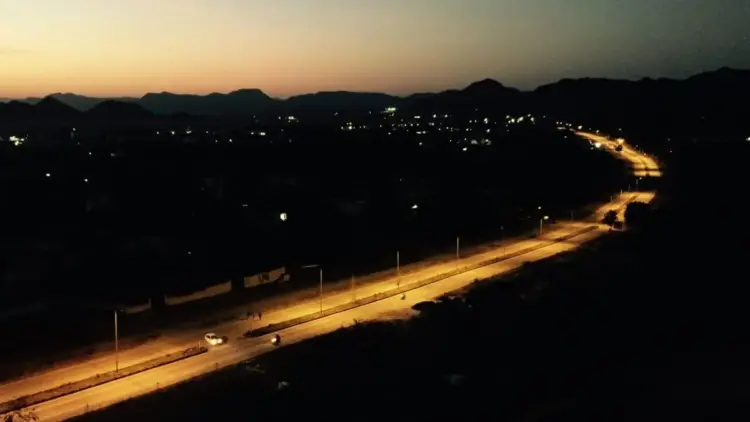
The Western Ghats of India, a UNESCO World Heritage site and one of the world’s eight "hottest hotspots" of biological diversity, is facing a silent, luminous intruder. While conservation efforts traditionally focus on habitat fragmentation, poaching, and climate change, a recent study has cast light on a pervasive but often overlooked threat: Artificial Light at Night (ALAN).
A comprehensive new study, led by researcher Haripriya S. and published in Biological Conservation, has meticulously mapped the extent of light pollution across 21 protected areas in Kerala. The findings reveal a complex tapestry of illumination that threatens to disrupt the delicate ecological balance of one of the planet’s most sensitive environments. From the diffuse "skyglow" of distant cities to the bright beacons of local places of worship, the night is no longer dark in the wilderness of the Western Ghats.
Main Facts: A New Frontier in Conservation Science
The study represents a significant step forward in understanding the "sensory pollutants" affecting Indian wildlife. By integrating satellite-derived night-time light data from 2024 with infrastructure mapping from OpenStreetMap, the research team provided a high-resolution look at how human activity bleeds into the natural world.
Key Findings at a Glance:
- The Scope: 21 protected areas (PAs) in Kerala were assessed, covering a vast range of altitudes and ecosystems.
- The Culprit Within: Inside the boundaries of protected areas, the density of places of worship was identified as the primary driver of high light levels.
- The Culprit Without: In the buffer zones and surrounding landscapes, road density and "places of interest" (tourism hubs, activity centers, and commercial zones) were the main predictors of light pollution.
- The Hotspot: Periyar Tiger Reserve West emerged as the most illuminated region among those studied, recording the highest average and maximum light levels.
- The Reach: Light pollution is not merely a "border" issue. The study found that significant light contribution comes from sources located 10 to 30 kilometers away from the protected area boundaries, proving that "skyglow"—the scattering of light in the atmosphere—is a regional problem.
Chronology: The Evolution of the Luminous Threat
To understand the current state of Kerala’s night-time environment, one must look at the rapid transformation of the state’s landscape over the last three decades. Kerala is unique in India for its "rurban" character—a continuous spread of habitation that blurs the lines between rural villages and urban centers.
The 1990s – Early 2000s: The Infrastructure Boom
As Kerala’s economy grew, driven largely by remittances and a burgeoning tourism sector, the density of roads and electrification increased significantly. During this period, light pollution was largely confined to major urban centers like Kochi, Thiruvananthapuram, and Kozhikode.
The 2010s: The Encroachment of the Buffer Zones
As land became scarce, human settlements and tourism facilities began to press directly against the boundaries of the Western Ghats’ protected areas. High-intensity LED lighting became affordable and ubiquitous, replacing dimmer incandescent bulbs. This shift increased the "blue light" spectrum of ALAN, which is known to be more disruptive to biological systems.
2020-2024: The Era of Satellite Monitoring
The recent study utilizes the latest 2024 satellite data, marking a turning point where scientists can now monitor light pollution in near-real-time. The chronology shows a clear trend: light is no longer just a byproduct of cities; it has become an omnipresent feature of the rural and forest-fringe landscape.
Supporting Data: Mapping the Radiance
The methodology of the study provides a granular look at how light penetrates the forest. The researchers did not just look at the reserves in isolation; they examined five concentric distance zones: 0–2 km, 2–5 km, 5–10 km, 10–20 km, and 20–30 km.
The Distance Paradox
One might assume that the closer a light source is to a forest, the more damage it does. However, the data revealed a more complex reality. While the immediate 0–2 km zone is critical, the 10–20 km and 20–30 km zones contributed statistically similar and significant levels of light to the overall exposure of the protected areas.
This is due to Atmospheric Scattering (Skyglow). When light is directed upward or reflected off surfaces, it hits moisture and dust particles in the air, scattering back down to earth miles away. This means a brightly lit town 25 kilometers away can effectively "erase" the darkness of a deep forest valley, even if no direct bulbs are visible from within the woods.
Internal vs. External Drivers
The study highlights a fascinating dichotomy in what causes light pollution:
- Internal Drivers (Inside PAs): The researchers found a strong correlation between light levels and the density of places of worship. In Kerala, many temples, churches, and shrines are located within or on the very edge of forest lands. These sites often host festivals and night-time vigils characterized by high-intensity decorative lighting.
- External Drivers (Outside PAs): Beyond the 5 km mark, the primary predictors changed to road density. Kerala has the highest road density in India, and the electrification of these arteries ensures that ribbons of light cut through the landscape, acting as barriers for nocturnal wildlife.
The Ecological Cost: Why Darkness Matters
While the study focuses on measuring light, the underlying concern is the profound impact on biodiversity. Haripriya S. emphasizes that ALAN is a "less studied area" that can fundamentally alter the ecosystem.
Disruption of Circadian Rhythms
Almost all life forms have evolved with a 24-hour light-dark cycle. Artificial light disrupts the production of melatonin, the hormone responsible for regulating sleep and biological clocks. In mammals, this can lead to stress, reduced immune function, and reproductive failure.

Predator-Prey Dynamics
Night-time is the shield of the prey. Small mammals, such as the Malabar large-spotted civet or various species of rodents, rely on the cover of darkness to forage. Increased light gives an unnatural advantage to visual predators, potentially leading to the collapse of prey populations. Conversely, some predators may avoid lit areas, restricting their hunting grounds and leading to starvation.
Navigation and Reproduction
Many insects, including vital pollinators like moths, are fatally attracted to artificial lights—the "vacuum cleaner effect." This not only kills the insects but also deprives the forest of pollinators and birds of their food source. Furthermore, amphibians in the Western Ghats, many of which are endemic, rely on specific light cues for mating calls and migration. ALAN can silence these nocturnal choruses, leading to a "silent spring" in the heart of the monsoon forests.
Official Responses and Scientific Perspective
While official government policy regarding "light pollution" in India is still in its infancy compared to air or water pollution regulations, the scientific community is calling for urgent intervention.
Lead author Haripriya S. has indicated that this study is just the beginning. She intends to expand the literature to look deeper into specific animal behaviors. The "official response" from the data suggests that current management plans for Tiger Reserves and National Parks must evolve to include "Lighting Management Plans."
Conservationists argue that the Forest Department needs to collaborate with local panchayats (village councils) and religious authorities. The goal is not to eliminate light—which is essential for human safety and culture—but to "shield" it. By using directional lighting that points downward and choosing warmer color temperatures (avoiding blue-rich LEDs), the impact on the Western Ghats can be drastically reduced.
Implications: A Call for "Dark Sky" Corridors
The implications of this study are far-reaching for the future of conservation in India.
1. Rethinking Buffer Zones
Current buffer zone regulations focus on land use and construction. This study suggests they must also regulate "luminous output." Establishing "Dark Sky" buffers where street lighting is restricted or modified could be essential for the survival of nocturnal species.
2. Sustainable Tourism
Kerala’s tourism industry, which markets itself as "God’s Own Country," relies on the pristine nature of the Western Ghats. If the night-time environment is degraded, the very "wilderness" experience tourists seek is compromised. Eco-resorts must lead the way by adopting zero-light-spill policies.
3. Cultural Collaboration
The finding regarding places of worship is sensitive but crucial. It opens a dialogue for "Green Pilgrimages," where religious festivities can be celebrated with traditional oil lamps or low-intensity, shielded electric lights rather than massive LED arrays that pierce the forest canopy.
4. Technological Integration
The use of OpenStreetMap and satellite data proves that we have the tools to monitor environmental degradation in real-time. This methodology can be scaled across India to create a National Light Pollution Map, helping the Ministry of Environment, Forest and Climate Change prioritize areas for "darkness restoration."
Conclusion
The study of Kerala’s Western Ghats serves as a wake-up call. As we illuminate our world, we are inadvertently blinding the creatures with whom we share the planet. The high light levels in Periyar Tiger Reserve West and the far-reaching glow of Kerala’s road networks are symptoms of a world that has forgotten the value of the dark.
For the elephants, tigers, and endemic frogs of the Western Ghats, the night is not just a time of rest—it is a requirement for life. Preserving the "Great Dark" of the Western Ghats is the next great challenge for 21st-century conservation. As Haripriya S. continues her research, the hope is that policy will follow science, ensuring that the only lights seen in the heart of the forest are the stars above and the fireflies within.