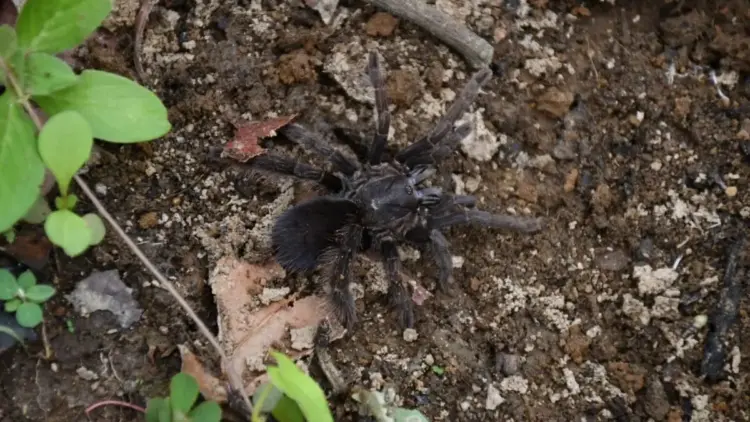
In the dense, humid forest fringes of the Kamrup (Rural) district in Assam, the arrival of the pre-monsoon rains signals more than just a change in weather. For the indigenous Rabha community, this season marks the emergence of a specific, formidable inhabitant of the earth: the Indian black earth tiger spider (Lyrognathus crotalus). While tarantulas are often met with trepidation in many parts of the world, for the Rabhas, they represent a deeply rooted cultural tradition and a seasonal culinary delicacy known locally as bhaluk makara.
A groundbreaking study recently published in the Proceedings of the Zoological Society has brought this clandestine practice into the scientific spotlight. Led by researchers Jyotiprakash Boro, Kuldeep Bora, Chandramita Boro, and Samir Terdalkar, the documentation offers a rare glimpse into the ethnobiology of Northeast India, where the boundaries between biodiversity conservation and ancestral heritage often intersect.
Main Facts: An Ancient Practice Meets Modern Science
The Rabha people, also known as the Ravas, are an indigenous Tibeto-Burman community primarily inhabiting the plains of western Assam, specifically the Goalpara and Kamrup districts, as well as parts of Meghalaya and West Bengal. Their lives are intrinsically linked to the forest ecosystems they inhabit, particularly the vast tracts of Sal (Shorea robusta) trees that define the landscape of the Brahmaputra valley’s southern bank.
The focus of the recent study is the Lyrognathus crotalus, a species of burrowing tarantula endemic to the region. Characterized by its dark coloration and robust build, this "earth tiger" is a master of subterranean architecture. The researchers conducted extensive fieldwork between April and June 2025, centering their efforts on the village of Mouman and its surrounding forest fringes. Through interviews with 34 community members—ranging from seasoned elders to energetic young collectors—the team documented a practice that has remained largely undocumented by mainstream science since the spider was first taxonomically described in 1895.

Key Findings of the Study:
- Species Focus: Lyrognathus crotalus (Indian black earth tiger spider).
- Primary Season: April to June (pre-monsoon).
- Community: The Rabha tribe of Kamrup and Goalpara.
- Cultural Status: A seasonal delicacy and a rite of passage for young men.
- Preparation: Fried in mustard oil with salt and garlic, typically paired with local rice beer.
Chronology: A Tradition Passed Through the Breath of Ancestors
The consumption of spiders among the Rabha is not a recent adaptation to food scarcity; rather, it is a "tale as old as time," as described by village elders. While the scientific community only officially recognized the species at the end of the 19th century, the Rabha oral tradition suggests the practice has existed for centuries.
The Seasonal Cycle
The collection cycle is strictly dictated by the rhythms of nature. The spiders are most active and abundant during the pre-monsoon months of April, May, and June. During this window, the ground softens with early rains, making the spiders’ burrows easier to identify and excavate.
Community members typically organize collection trips three to four days a month during this peak season. A single foraging expedition, often involving groups of young men or families, can yield between 20 and 30 spiders. This seasonal window ensures that the spiders are not over-harvested throughout the year, allowing the population to recover during the monsoon and winter months.
Generational Continuity
Unlike many indigenous traditions that are fading in the face of urbanization, the consumption of bhaluk makara appears to be thriving among the younger generation. For young men in their early 20s, like Ashok Rabha, the hunt is as much about social bonding as it is about food. It serves as a rite of passage, requiring knowledge of the forest, the ability to spot camouflaged burrows, and the skill to extract a venomous arachnid without injury.

Supporting Data: The Ecology of the "Earth Tiger"
The study provides a detailed look at the ecological niche occupied by L. crotalus and how the Rabha have adapted their foraging techniques to match the spider’s biology.
Burrowing Habits
Taxonomic research indicates that L. crotalus constructs sophisticated, flare-mouthed burrows. Adult females, which are larger and more frequently targeted for consumption, build J-shaped tunnels lined with thick silk. These burrows often extend deep into the earth, ending in an enlarged chamber where the spider resides.
The Foraging Technique
The Rabha collectors have developed a keen eye for these structures, which are usually hidden among organic debris and the root systems of Sal trees. To extract the spider, collectors use two primary methods:
- Careful Excavation: Using small hand tools to dig along the silk lining until the chamber is reached.
- The Provocation Method: Inserting a slender wooden stick into the burrow to irritate the spider, coaxing it to emerge at the entrance where it can be swiftly captured.
Diet and Diversity
The 2024 ethnobotanical study in Goalpara district highlighted the Rabhas’ extensive knowledge of local biodiversity, documenting 51 species of wild edible plants. The spider is part of this wider "forest pharmacy" and pantry, which includes various fish, meat, and wild greens. While rice remains the staple, the inclusion of high-protein arachnids like the tarantula provides a diverse nutrient profile, particularly during the transition between agricultural seasons.

Official Responses and Expert Perspectives
The research team, led by Jyotiprakash Boro, a wildlife biologist and research scholar at Fergusson College, Pune, has been careful to balance cultural documentation with scientific caution.
The Community Voice
Bhupen Rabha, a village elder, emphasized the cultural significance of the practice during interviews: "The traditional consumption of the spider is a longstanding cultural practice that has been passed down orally from generation to generation. It was regularly collected and eaten by our parents and grandparents as a seasonal delicacy."
Similarly, Rohini Kumar Nongbag, an experienced collector, noted that the practice remains a "highly active seasonal event," refuting the idea that indigenous food habits are necessarily dying out.
The Researcher’s Cautionary Note
While the community views the spider population as stable, Jyotiprakash Boro points out the lack of empirical data. "We have not independently assessed their abundance or their population status," Boro stated. He noted that while an experienced collector can still find 30 spiders in a trip—a sign of local abundance—this does not account for the long-term ecological health of the species across its entire range.

Boro and his colleagues advocate for a multi-disciplinary approach to future research, encompassing:
- Nutritional Analysis: Scientifically verifying the protein and micronutrient content of the spiders.
- Population Dynamics: Tracking the impact of harvesting on the species’ survival rates.
- Taxonomy: Further clarifying the relationship between various Lyrognathus species in the Northeast.
Implications: Conservation, Culture, and the Future of Entomophagy
The documentation of the Rabha community’s relationship with the Indian black earth tiger spider raises significant questions regarding conservation and the rights of indigenous peoples to manage their natural resources.
The Global Context of Spider Consumption
The study notes that spider consumption is not an isolated phenomenon. In neighboring Nagaland, the Lotha Naga community consumes orb-weaver spiders (Nephila pilipes and Trichonephila clavata), which are prized for their creamy, nutty flavor. Globally, entomophagy (the eating of insects and arachnids) is increasingly viewed by the United Nations and the FAO as a sustainable solution to food security, given the low environmental footprint of "mini-livestock" compared to cattle or poultry.
Conservation Risks
However, tarantulas are uniquely vulnerable. Unlike many insects that reproduce in the thousands, many tarantula species have slow growth rates and delayed sexual maturity. In other parts of India, species like the Neoheterophrictus have faced population declines due to the illegal pet trade. While the Rabha’s subsistence harvesting is vastly different from commercial exploitation, researchers warn that habitat loss—specifically the thinning of Sal forests—could pose a greater threat than traditional consumption.

Preserving Indigenous Knowledge
The study underscores the importance of documenting "Traditional Ecological Knowledge" (TEK). The Rabhas’ ability to identify species, understand burrowing patterns, and utilize forest resources without apparent depletion is a form of science that has sustained the community for centuries.
As the world looks for more sustainable ways to live in harmony with nature, the "earth tiger" of Assam serves as a powerful symbol. It represents a bridge between the ancient traditions of the Rabha people and the modern need for biodiversity conservation. The challenge for the future lies in ensuring that this seasonal feast can continue for generations to come, supported by both the wisdom of the elders and the rigorous data of the scientific community.
Scientific Citation:
Boro, J., Bora, K., Boro, C., & Terdalkar, S. (2025). First Record on the Traditional Consumption of the Indian Black Earth Tiger Spider (Lyrognathus crotalus) Among the Rabha Tribe from Northeast India. Proceedings of the Zoological Society.