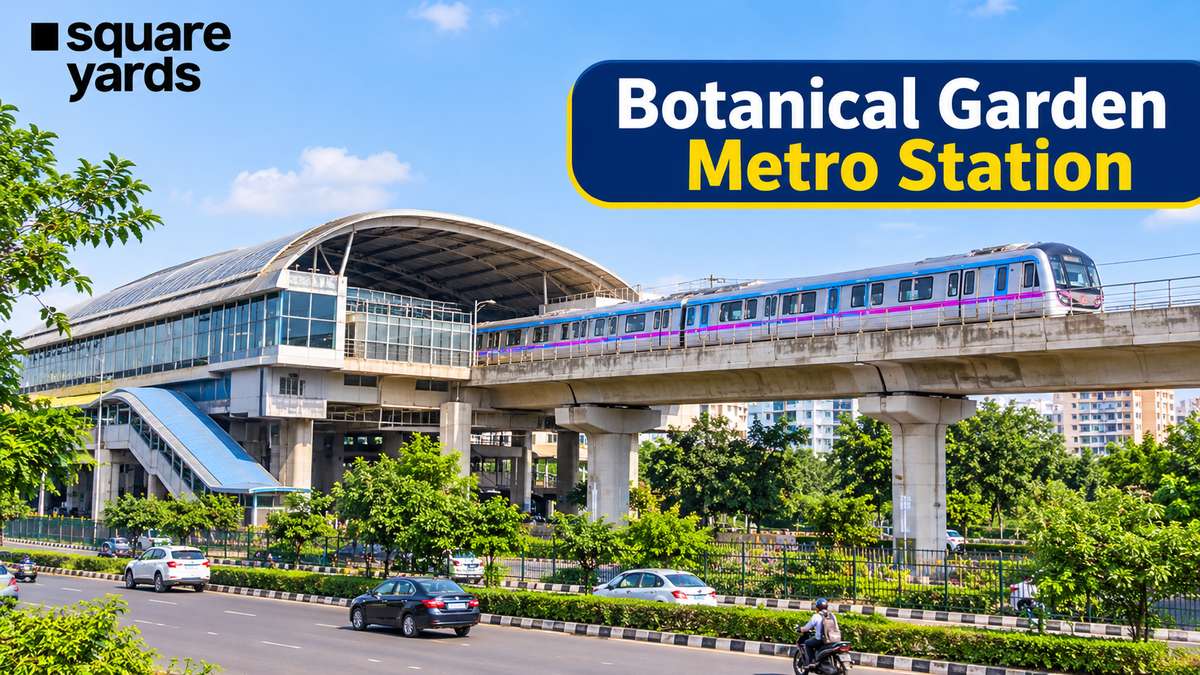
NOIDA – As the urban sprawl of the National Capital Region (NCR) continues to expand, few transit points have attained the strategic importance of the Botanical Garden Metro Station. Located in the heart of Noida’s Sector 38, this station serves as more than just a stop; it is a vital artery connecting the residential hubs of Uttar Pradesh with the commercial nerve centers of Delhi and the international gateway of the Indira Gandhi International Airport.
Recently recognized by the Delhi Metro Rail Corporation (DMRC) as the "Best Metro Station" during its 30th Foundation Day in May 2024, Botanical Garden stands as a testament to efficient urban planning and multimodal connectivity. This comprehensive report explores the station’s operational mechanics, its historical evolution, the significant infrastructure projects on the horizon, and its profound impact on the local real estate landscape.
1. Main Facts: The Architecture of a Transit Powerhouse
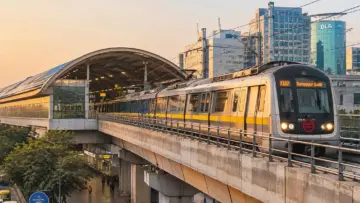
Botanical Garden Metro Station is an elevated interchange facility that bridges the Blue Line (Line 3/4) and the Magenta Line (Line 8). Managed by the DMRC, it holds the distinction of being the first elevated interchange station located outside the formal boundaries of Delhi.
Technical Specifications at a Glance
| Feature | Details |
|---|---|
| Station Code | BCGN |
| Location | Sector 38, Noida, Uttar Pradesh |
| Structure Type | Elevated Interchange (Two Levels) |
| Platforms | 4 Side Platforms |
| Accessibility | Fully Wheelchair Accessible; Lifts and Escalators |
| Parking | Multi-level Car Parking (MLCP) at Gate 4 |
| Operator | Delhi Metro Rail Corporation (DMRC) |
The station is strategically positioned on Captain Vijayant Thapar Marg. While its name suggests proximity to greenery, commuters should note that the actual Botanic Garden of Indian Republic is approximately 0.6 km away. This distinction is crucial for travelers using ride-sharing apps, who often confuse the station with the park or the adjacent Sector 37 residential block.
2. Chronology: From Suburban Stop to National Benchmark
The evolution of Botanical Garden reflects the rapid urbanization of Noida over the last two decades.
- November 12, 2009: The station opened its doors as part of the Blue Line extension, providing Noida residents with a direct link to Central Delhi and Dwarka.
- December 25, 2017: A milestone in NCR transit history occurred when the Magenta Line was inaugurated. This transformed Botanical Garden into an interchange hub, slashing travel time to South Delhi and the Domestic Airport (Terminal 1).
- May 3, 2024: DMRC officially crowned it the "Best Metro Station," citing excellence in maintenance, passenger facilities, and operational efficiency.
- January 5, 2025: Magenta Line services were extended to Krishna Park Extension, further broadening the station’s reach.
- February 14, 2026: The Union Cabinet formally approved the Aqua Line extension, a move set to eventually turn Botanical Garden into a "triple interchange" hub.
- November 9, 2026: Larsen & Toubro (L&T) secured the contract for the Aqua Line extension, signaling the start of the next phase of construction.
3. Supporting Data: Operational Dynamics, Timings, and Fares
Understanding the internal logic of the station is essential for the daily commuter. The station utilizes four side platforms, where doors always open on the left.
Platform Navigation
- Platform 1 (Blue Line): Eastbound towards Noida Electronic City.
- Platform 2 (Blue Line): Westbound towards Rajiv Chowk and Dwarka Sector 21.
- Platform 3 (Magenta Line): Termination platform for arriving trains.
- Platform 4 (Magenta Line): Westbound towards Terminal 1-IGI Airport and Krishna Park Extension.
Connectivity and Fare Structure
The most frequented route from this station is the 30-minute journey to Rajiv Chowk.
Fare Estimates (As of late 2026):
- To Noida Sector 18: ₹11 (Standard)
- To Rajiv Chowk: ₹43 (Mon-Sat) | ₹32 (Sun/Holidays)
- To Terminal 1-IGI Airport: ₹54 (Mon-Sat) | ₹43 (Sun/Holidays)
- To Terminal 3 (via Airport Express): Approximately ₹107.
Service Hours
While timings are subject to minor seasonal adjustments or special events (such as IPL matches where services extend until 12:45 AM), the standard first train leaves at approximately 5:50 AM, with the last services departing between 11:00 PM and midnight.
4. Official Responses: The Future Aqua Line Integration
The most significant development currently occupying urban planners is the integration of the Noida Metro (Aqua Line). Currently, commuters wishing to switch from the Blue Line to the Aqua Line must travel to Sector 52 and undertake a 300-meter walk to Sector 51.
The 2026 Breakthrough
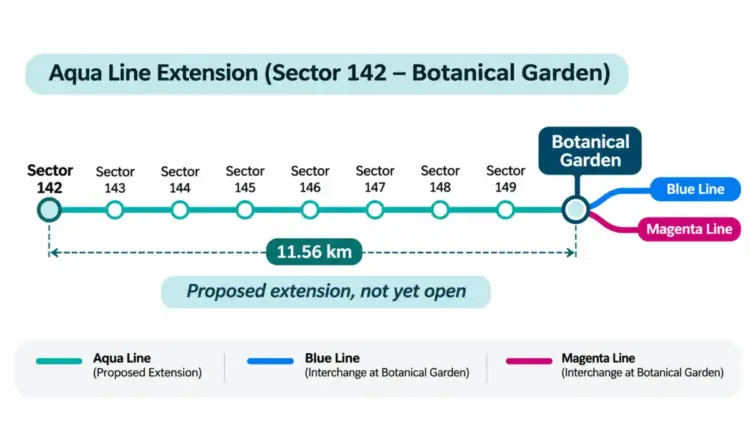
On February 14, 2026, the Union Cabinet approved an 11.56 km extension of the Aqua Line from Sector 142 to Botanical Garden. This project, estimated to cost ₹2,254 crore, will feature eight elevated stations.
Larsen & Toubro’s Mandate: In November 2026, L&T was awarded the contract for the design and construction of this corridor. Official statements from the Noida Metro Rail Corporation (NMRC) suggest a 36-month construction window. Once completed, Botanical Garden will be the only station in the NCR to seamlessly connect three distinct metro lines (Blue, Magenta, and Aqua), creating a "super-hub" for the region.
However, officials have urged patience. While the contract is awarded, the link between Krishna Park Extension and Deepali Chowk on the Magenta Line remains under construction, with an expected completion date in late 2026. Until these gaps are closed, the network remains a work in progress.
5. Implications: Real Estate and Urban Growth
The "Metro Effect" on property values is nowhere more visible than in the sectors surrounding Botanical Garden. The station acts as a catalyst for both residential demand and commercial footfall.
The Residential Ecosystem
The proximity to an interchange hub has made Sectors 29, 37, 38, and 44 some of the most sought-after addresses in Noida. Data from real estate aggregator Square Yards indicates that as of November 2026, there are over 5,400 property listings within a 2-km radius of the station.
Key Projects and Pricing (November 2026):
- Arun Vihar (Sectors 37/29): A legacy project offering 2 and 3 BHK units. Prices start at approximately ₹98.25 lakh, appealing to the mid-segment.
- Lord Mahavira Apartment (Sector 29): Known for its proximity (0.47 km), with prices hovering around ₹1.08 crore.
- Godrej Riverine (Sector 44): A premium, under-construction project with 3 and 4 BHK homes starting at ₹7.56 crore, targeting the luxury segment with a projected possession in 2029.
Commercial and Lifestyle Impact
The station serves as a gateway to Noida’s premier retail district. Within a 1.5 km radius lie:
- DLF Mall of India: The largest mall in the country.
- The Great India Place (GIP): A major shopping and entertainment hub.
- Atta Market (Sector 18): A bustling traditional retail market.
- Worlds of Wonder: A popular amusement and water park.
This concentration of retail and transit has led to a surge in "Transit-Oriented Development" (TOD). Commercial rentals in Sector 18 and Sector 38 have remained resilient, buoyed by the constant influx of commuters who use the station as their primary point of entry into Noida.
6. Navigating the Hub: Practical Tips for Commuters
For those new to the station, the following logistical details are paramount:
- Gates: Use Gate 4 if you are arriving by car, as it leads directly to the multi-level parking. Gate 3 is strictly for exiting, while Gates 1 and 2 serve as primary entries from the main road.
- Interchanging: The walk between the Blue and Magenta platforms is internal and well-signposted. However, during peak hours (8:30 AM – 10:30 AM and 6:00 PM – 8:00 PM), the escalators experience heavy congestion.
- Last-Mile Connectivity: The station is a major hub for DTC and NMRC buses. Routes like 33, 34, and 323 connect the station to deeper pockets of Noida and East Delhi. The NMRC route 103A is particularly useful for those heading toward Greater Noida.
Conclusion: The Anchor of Noida’s Ambition
The Botanical Garden Metro Station is a microcosm of the modern Indian city—busy, evolving, and increasingly connected. Its transition from a standard Blue Line stop to a multi-line interchange has mirrored Noida’s own transition from a residential suburb to a self-sustaining urban center.
As the Aqua Line extension moves from the drawing board to reality over the next three years, the station’s influence is only set to grow. For residents, it offers unparalleled access; for investors, it represents a stable anchor in a volatile market; and for the thousands of daily commuters, it remains the most efficient bridge between their homes in Noida and their aspirations in the wider National Capital Region.
Travelers are advised to keep the DMRC and NMRC apps updated, as the ongoing construction of the Magenta Line’s final links and the upcoming Aqua Line work will likely lead to periodic changes in exit routes and timings. In the interim, Botanical Garden remains the undisputed "Best Metro Station" of the Noida-Delhi corridor.