By [Your Name/News Desk]
Published: November 4, 2026
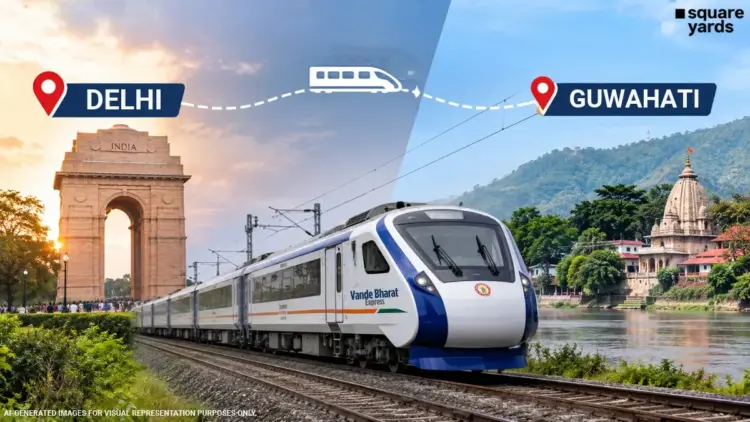
In a landmark move for India’s infrastructure landscape, the Union Government has officially signaled the commencement of one of the world’s most ambitious high-speed rail projects. The proposed Northern Bullet Train Corridor, a massive 1,500-kilometer artery, is set to redefine connectivity between the National Capital and the Northeast. By bridging the vast geographical and economic gap between Delhi and Guwahati, the project promises to shrink travel times from nearly a full day to a mere fraction of that, fundamentally altering the socio-economic fabric of Northern and Eastern India.
The announcement, made by Union Railway Minister Ashwini Vaishnaw on October 31, 2026, marks the transition of the "Bullet Train" dream from a localized western corridor to a pan-Indian reality. With the Prime Minister’s formal approval, the project now enters a critical phase of planning and development, promising to bring high-speed mobility to some of the most densely populated and strategically significant regions of the country.
Main Facts: A New Era of High-Speed Connectivity
The Northern Bullet Train Corridor is designed to be a high-capacity, high-speed rail link spanning approximately 1,500 kilometers. The corridor will originate in Delhi and terminate in Guwahati, Assam, passing through the heartlands of Uttar Pradesh, Bihar, and West Bengal.
The Route and Key Stations
The proposed alignment traverses the Gangetic plains, connecting ten of India’s most significant urban, industrial, and religious centers. According to the preliminary plan, the corridor will serve the following major hubs:
| Proposed City | State/Region | Significance |
|---|---|---|
| Delhi | National Capital Territory | Political and Economic Nerve Center |
| Agra | Uttar Pradesh | Global Tourism Hub (Taj Mahal) |
| Kanpur | Uttar Pradesh | Major Industrial and Leather Hub |
| Lucknow | Uttar Pradesh | State Capital and Administrative Center |
| Ayodhya | Uttar Pradesh | Major Religious and Cultural Destination |
| Varanasi | Uttar Pradesh | Spiritual Capital and Transit Node |
| Prayagraj | Uttar Pradesh | Educational and Judicial Hub |
| Patna | Bihar | State Capital and Ancient Historical Center |
| Siliguri | West Bengal | Gateway to the Northeast and International Borders |
| Guwahati | Assam | Commercial Capital of the Northeast |
Dramatic Reductions in Travel Time
The most striking feature of the project is the projected reduction in transit time. Currently, the journey from Delhi to Siliguri via premium trains like the Rajdhani Express takes approximately 20 hours. Under the high-speed rail framework, this is expected to drop to just six hours. Furthermore, while official estimates for the full Delhi-Guwahati stretch are pending, projections suggest a total travel time of less than eight hours—a journey that currently takes upwards of 28 to 30 hours by conventional rail.
Chronology: From Concept to Approval
The journey toward a high-speed rail network in India has been a decade-long evolution, beginning with the Mumbai-Ahmedabad High-Speed Rail (MAHSR) project. The Northern Corridor represents the second major phase of this national vision.
- February 2026: The Union Budget 2026-27 is presented, allocating record capital expenditure for the Ministry of Railways. The budget outlines a roadmap for seven new High-Speed Rail (HSR) corridors, totaling nearly 4,000 km.
- August 2026: Feasibility studies for the Varanasi-Howrah and Delhi-Varanasi stretches are reviewed by the National High-Speed Rail Corporation Limited (NHSRCL).
- October 31, 2026: Railway Minister Ashwini Vaishnaw, speaking in Varanasi prior to flagging off the Varanasi-New Delhi Vande Bharat Sleeper Express, announces that Prime Minister Narendra Modi has officially approved the extension of the corridor all the way to Guwahati.
- November 2026: The Ministry of Railways begins the process of drafting the Detailed Project Report (DPR) specifically for the Siliguri-Guwahati extension, integrating it into the broader Northern Corridor.
Supporting Data: Technical and Financial Landscape
The scale of the Northern Bullet Train Corridor necessitates unprecedented engineering and financial mobilization. While the final project cost has not been disclosed, analysts estimate the expenditure could exceed ₹3.5 lakh crore (approximately $42 billion), based on the per-kilometer cost of existing high-speed rail benchmarks.
Technical Specifications
The corridor is expected to utilize Shinkansen-style technology or its equivalent, capable of maintaining operational speeds of 320-350 km/h.
- Track Gauge: Standard Gauge (1435 mm), consistent with international high-speed standards.
- Infrastructure: A mix of elevated viaducts to minimize land acquisition issues in the densely populated Gangetic plains and specialized bridges over major rivers like the Ganga and the Brahmaputra.
- Rolling Stock: Aerodynamic trainsets with advanced safety features, including early earthquake detection systems and automated braking.
Comparative Connectivity
The project bridges four states and the National Capital. By integrating Siliguri, the project addresses a critical bottleneck. Siliguri sits in the "Chicken’s Neck" or Siliguri Corridor, a narrow stretch of land that connects mainland India to the Northeast. Providing high-speed rail access through this corridor is seen as a logistical masterstroke for both civilian and strategic movement.
Official Responses: Political Will and Regional Aspirations
The announcement has been met with significant enthusiasm from government officials and regional leaders, who view the project as a catalyst for "Viksit Bharat" (Developed India).
Railway Minister Ashwini Vaishnaw emphasized the Prime Minister’s vision of regional equity. "The approval of the Delhi-Guwahati corridor is a testament to the government’s commitment to the Northeast. We are not just building tracks; we are building a bridge to the future for millions of citizens in Bihar, West Bengal, and Assam," Vaishnaw stated during his Varanasi address.
Assam Chief Minister Himanta Biswa Sarma welcomed the move, highlighting its economic potential. "This is a historic day for Assam. Connecting Guwahati to Delhi via a six-to-eight-hour rail journey will open the floodgates for investment, tourism, and industrial growth in our state. It aligns perfectly with our goal to make Assam a high-tech industrial hub," Sarma noted in a social media statement.
Industry Experts have also weighed in, noting that while the ambition is laudable, the execution remains the primary challenge. "The Northern Corridor is geographically more complex than the Mumbai-Ahmedabad route due to the river systems and the seismic activity in the Himalayan foothills near Siliguri," said a senior consultant at an infrastructure think tank.
Implications: Economic, Strategic, and Social Impact
The Northern Bullet Train Corridor is more than a transport project; it is an economic corridor that will likely yield dividends for decades.
1. Transformation of the "Religious Circuit"
With stops in Agra, Ayodhya, Varanasi, and Prayagraj, the corridor will revolutionize religious and cultural tourism. Pilgrims and international tourists will be able to visit multiple heritage sites in a single weekend, a feat currently impossible due to slow transit times. This is expected to quadruple tourism revenue in these cities by 2035.
2. Integration of the Northeast
For decades, the Northeast has faced challenges of "geographic isolation." By bringing Guwahati within eight hours of Delhi, the corridor effectively integrates the region into the national economic mainstream. This will facilitate the easier movement of skilled labor, perishable goods, and corporate services.
3. Boosting the "Act East" Policy
Strategically, the corridor strengthens India’s "Act East" policy. Better connectivity to Guwahati allows for more efficient logistics toward the borders of Myanmar and Southeast Asia. In the event of national emergencies, high-speed rail provides a rapid-response capability for moving personnel and essential supplies to the border regions.
4. Real Estate and Urbanization
The areas surrounding the proposed stations are expected to see a massive surge in real estate value. New "Bullet Train Cities" or satellite townships could emerge, easing the population pressure on the main metropolitan areas of Delhi and Patna.
Challenges and the Road Ahead: The Path to Completion
Despite the optimism, several hurdles remain before the first bullet train reaches Guwahati.
- Land Acquisition: The route passes through some of the most fertile and densely populated agricultural land in Uttar Pradesh and Bihar. Navigating land acquisition without causing social unrest or prolonged legal battles will be the Ministry’s greatest challenge.
- Environmental Concerns: The extension from Siliguri to Guwahati passes through ecologically sensitive zones. Ensuring minimal impact on wildlife corridors and forest cover will require sophisticated environmental clearances and potentially expensive tunneling or elevated structures.
- Funding Models: Given the astronomical costs, the government may look toward international funding agencies (like JICA) or Public-Private Partnerships (PPP). The financial viability will depend on fare structures and the ability to attract "executive" travelers who currently opt for air travel.
- DPR and Technical Feasibility: The Detailed Project Report (DPR) will be the definitive document. It will finalize the exact locations of stations—some of which may be several kilometers outside current city centers to accommodate high-speed curves.
Conclusion
The Northern Bullet Train Corridor is a statement of intent from a nation seeking to modernize its backbone. By connecting the National Capital to the farthest reaches of the Northeast, India is betting on high-speed rail to drive its next phase of economic growth. While the timeline for completion remains fluid, the approval of the 1,500-km route marks a point of no return in India’s journey toward becoming a global leader in high-speed infrastructure. As the Ministry of Railways moves toward technical assessments, the eyes of the nation—and the world—will be on the "Chicken’s Neck" as it prepares for a high-speed revolution.