The Hadoti region of Rajasthan, long defined by its rugged landscapes, historic forts, and its modern identity as India’s premier coaching hub, is on the cusp of a logistical revolution. The Rajasthan state government has officially codified a deadline of October 4, 2027, for the completion of the Kota-Bundi Greenfield Airport. This Rs 1,507-crore infrastructure project is not merely a construction exercise; it represents a strategic pivot intended to unlock the economic potential of a four-district cluster that has historically been underserved by the aviation sector.
As the project moves from the blueprint stage into intensive construction at Shambhupura, the focus has intensified on how this facility will bridge the connectivity gap for students, tourists, and industrial stakeholders.
1. Main Facts: A Modern Gateway for the Hadoti Region
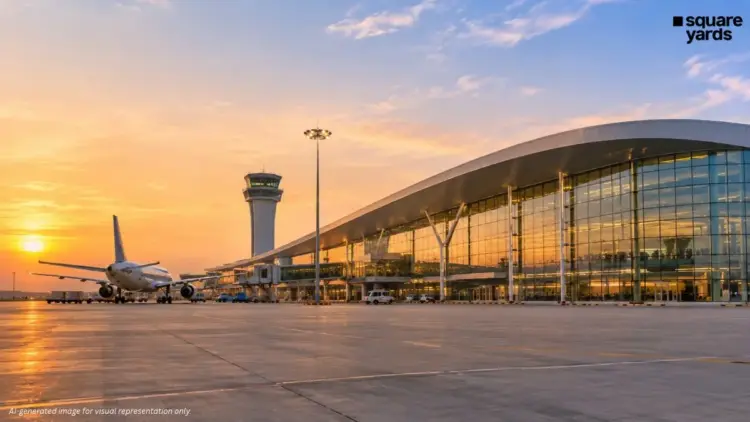
The Kota-Bundi Greenfield Airport is designed to be a high-capacity facility capable of handling modern commercial jetliners, a significant upgrade from the existing, constrained infrastructure in Kota.
Key Project Specifications:
- Total Investment: Approximately Rs 1,507 crore.
- Land Area: 440 hectares of land transferred by the state government to the Airports Authority of India (AAI).
- Runway Dimensions: A 3,200-metre-long runway, engineered specifically to accommodate A-321 type aircraft, ensuring that major domestic airlines can operate standard narrow-body fleets.
- Terminal Capacity: A 20,000-square-metre terminal building designed to manage a peak-hour flow of 1,000 passengers, with an ultimate annual capacity of two million travelers.
- Ancillary Infrastructure: The site will feature seven aircraft parking bays, two link taxiways, a state-of-the-art Air Traffic Control (ATC) tower, a technical block, and a dedicated fire station.
- Sustainability Features: In alignment with national green energy goals, the airport will host a 1 MWp solar power plant and a 250-kilolitre-per-day sewage treatment plant (STP).
Located near Shambhupura, the airport is strategically positioned between the twin cities of Kota and Bundi. While these two urban centers are the primary beneficiaries, the airport’s "catchment area" extends to the districts of Baran and Jhalawar, effectively serving the entire Hadoti administrative division.
2. Chronology: From Concept to the 2027 Deadline
The trajectory of the Kota-Bundi airport has been marked by years of advocacy followed by a rapid escalation in administrative momentum over the last 24 months.
- The Constraint Phase (Pre-2024): For decades, Kota relied on a legacy airport with a 1,220-metre runway. Encroached upon by urban development and limited by its short strip, the old facility could only handle small turboprops or VIP charters. Commercial airlines bypassed the city, forcing residents to endure a 4-to-5-hour road journey to Jaipur or a longer trip to Delhi.
- March 2026 – The Foundation Stone: The project received its most significant political impetus when the Prime Minister laid the foundation stone. During the ceremony, the airport was framed as a cornerstone of the PM Gati Shakti National Master Plan, emphasizing integrated multi-modal connectivity.
- Mid-2026 – Land and Logistics: The Rajasthan government completed the transfer of 440 hectares to the AAI. Engineering surveys and soil testing at Shambhupura paved the way for civil works.
- November 2026 – The Strategic Review: Rajasthan Chief Secretary V. Srinivas conducted a comprehensive review of the project’s progress. Recognizing the risk of "siloed" development, he directed officials to adopt a parallel construction model. Rather than waiting for the runway to finish before starting the terminal, all critical components—ATC, terminal, and runway—are now being developed simultaneously.
- October 4, 2027 – The Final Deadline: This date has been set as the hard target for operational readiness, providing a clear window for airlines to begin planning routes and for local businesses to align their investments.
3. Supporting Data: Comparing the Old vs. the New
To understand the magnitude of this project, one must compare the current aviation limitations of Kota with the projected capabilities of the Shambhupura site.
| Feature | Existing Kota Airport | New Kota-Bundi Greenfield Airport |
|---|---|---|
| Runway Length | 1,220 Metres | 3,200 Metres |
| Terminal Size | 400 Sq M | 20,000 Sq M |
| Peak Passenger Capacity | 50 Passengers | 1,000 Passengers |
| Aircraft Capability | Small Private/VIP Planes | A-321 / Boeing 737 Class |
| Annual Capacity | Negligible | 2,000,000 Passengers |
| Parking Facilities | Limited/Informal | 300 Cars, 70 Taxis, EV Charging |
Furthermore, the integration of a six-lane approach road ensures that the "last-mile" connectivity to the airport does not become a bottleneck. The inclusion of a 1 MWp solar plant is projected to offset nearly 25% of the facility’s annual energy requirements, marking it as one of the more sustainable mid-sized airports in Northern India.
4. Official Responses: A Vision of Integrated Development
The push for the 2027 deadline is backed by a unified stance from both state and central authorities.
Chief Secretary V. Srinivas has been vocal about the need for speed and quality. During his November 2026 inspection, he emphasized that the airport is a "multi-departmental responsibility." His directives to the AAI and state public works departments focused on ensuring that utility shifts (electricity lines and water pipes) do not delay the primary construction of the runway.
The Union Government’s Perspective: At the foundation-stone ceremony, federal leadership highlighted that the airport is designed to serve as a "development magnet" for the four districts of Kota, Bundi, Baran, and Jhalawar. The official narrative suggests that the airport is not just a transport node but a tool for social equity, allowing students from humble backgrounds across India to reach Kota’s educational facilities more safely and quickly.
Local Administration: District collectors in Kota and Bundi have begun coordinating on the "Airport Corridor" plan, ensuring that zoning laws around Shambhupura prevent the kind of haphazard urban sprawl that rendered the old Kota airport obsolete.
5. Implications: Economic, Educational, and Real Estate Impact
The completion of the airport in late 2027 is expected to trigger a domino effect across several sectors of the regional economy.
A. The Education Ecosystem
Kota is globally recognized as a "Coaching Hub," hosting over 200,000 students annually who prepare for competitive exams like the JEE and NEET. Currently, these students—often accompanied by parents—must travel via long-distance trains. An operational airport will:
- Allow families from distant states (such as Kerala, West Bengal, or Bihar) to reach Kota in hours rather than days.
- Facilitate the movement of premium visiting faculty and educational consultants.
- Enhance the "brand value" of Kota as a modern, accessible educational destination.
B. Tourism and Heritage
While Jaipur and Udaipur dominate Rajasthan’s tourism map, Bundi is a "hidden gem" known for its intricate stepwells (baoris) and the Taragarh Fort.
- Bundi’s Gain: The airport’s proximity to Bundi makes it a viable weekend destination for travelers from Delhi or Mumbai.
- Circuit Tourism: It enables the creation of a new "Hadoti Circuit," linking Kota’s riverfront, Bundi’s heritage, and the wildlife of Mukundara Hills Tiger Reserve.
C. Industrial and Agricultural Growth
The Hadoti region is a powerhouse for "Kota Stone" mining and power generation.
- Business Travel: Improved connectivity allows technical teams, investors, and buyers to visit manufacturing units without the friction of a 5-hour drive from Jaipur.
- Agro-Exports: Jhalawar and Baran are significant producers of oranges and garlic. While the airport is initially passenger-focused, the presence of a 3,200m runway provides the future option for belly-cargo exports, potentially linking local farmers to international markets.
D. Real Estate and the Shambhupura Corridor
The most immediate physical impact will be seen in property markets.
- Commercial Hubs: The area surrounding Shambhupura is expected to see a surge in demand for hotels, warehouses, and logistics parks.
- The "Expressway Effect": The airport’s utility is multiplied by the nearby Delhi-Mumbai Expressway. This synergy between high-speed road and air connectivity makes the Shambhupura-Kota belt a prime candidate for industrial townships.
- Residential Shifts: As airport operations staff and ancillary service providers move in, new residential pockets are likely to emerge between Kota and the airport site.
E. Regional Connectivity and Time Savings
The most tangible benefit for the average resident is time. Currently, a traveler from Kota going to Mumbai might spend 12–15 hours on a train or 5 hours driving to Jaipur plus 2 hours at the airport. The new airport will reduce this to a simple 30-minute drive to Shambhupura, followed by a direct flight, saving nearly 8 to 10 hours of transit time.
Conclusion
The October 4, 2027, deadline marks the beginning of a countdown for Rajasthan’s southeast corner. By committing Rs 1,507 crore and a 3,200-metre runway to the Shambhupura site, the government is betting on the fact that air connectivity is the missing link in Hadoti’s growth story. As the runway takes shape and the terminal rises, the project stands as a testament to the region’s transition from a regional coaching center to a fully integrated national economic player. For the residents of Kota, Bundi, Baran, and Jhalawar, the sky is no longer the limit—it is the new gateway.