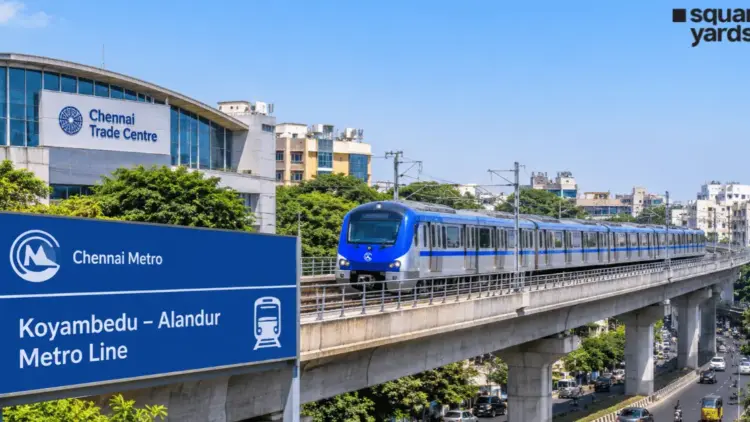
CHENNAI – In a decisive move to maintain the momentum of the city’s massive infrastructure overhaul, the Chennai Metro Rail Limited (CMRL) has officially initiated a high-priority 45-day sprint to complete the remaining track-laying work on a vital segment of the Phase II Red Line. The focus is currently concentrated on the stretch between the Chennai Trade Center and Alandur, a critical link within the larger 15-km Koyambedu-Alandur section of Corridor 5.
As the city grapples with increasing traffic congestion, the completion of this segment is viewed as a cornerstone for the 2027 operational goal, promising to redefine urban mobility for hundreds of thousands of residents in Western Chennai.
Main Facts: The 45-Day Sprint and the Red Line Vision
The CMRL’s current directive focuses on a 4.5-km gap in track infrastructure that remains to be completed toward the Alandur interchange. This work is part of Corridor 5 (the Red Line), which is designed to eventually span 47 kilometers, connecting Madhavaram Milk Colony in the north to Sholinganallur in the south.
The immediate priority, however, is the 15-km elevated stretch connecting the wholesale hub of Koyambedu to the transit gateway of Alandur. This section is strategically vital as it traverses several of Chennai’s most densely populated and commercially significant neighborhoods, including Virugambakkam, Valasaravakkam, Ramapuram, and Manapakkam.
The project highlights for this specific section are summarized below:
| Project Feature | Details |
|---|---|
| Metro Corridor | Corridor 5 (Red Line) |
| Project Phase | Chennai Metro Phase II |
| Section Under Focus | Koyambedu to Alandur |
| Approximate Section Length | 15 km |
| Total Red Line Length | 47 km |
| Total Planned Stations (Red Line) | 45 |
| Remaining Track Work (Alandur Side) | Approximately 4.5 km |
| Target Completion for Track-Laying | 45 Days |
| Projected Operational Date | March 2027 |
Chronology: From Blueprint to the 2027 Target
The journey of the Red Line is a testament to Chennai’s long-term urban planning. Following the success of Phase I, which established the Blue and Green lines, Phase II was conceived to penetrate the "blind spots" of the existing network—specifically the western suburbs and the burgeoning IT corridors.
- Phase II Approval: The project was sanctioned to address the burgeoning population in areas like Porur and Manapakkam, which were underserved by the initial rail network.
- Construction Commencement: Work on the elevated structures for Corridor 5 began with a focus on shared infrastructure. Notably, parts of the Red Line share elevated viaducts with the Phase II Yellow Line, an engineering feat designed to minimize the project’s physical footprint.
- Current Milestone (Late 2023 – Early 2024): With the viaducts largely in place between Koyambedu and the Chennai Trade Center, the focus shifted to the "permanent way" or track-laying.
- The 45-Day Deadline: In a strategic push to avoid delays, CMRL has set a rigorous 45-day window to finalize the 4.5 km of track leading into Alandur.
- Looking Ahead: Once track-laying is completed, the focus will shift to electrification, signaling, and station finishing works throughout 2025 and 2026, leading to a projected public opening in March 2027.
Supporting Data: Connectivity and Localities Covered
The Red Line is more than just a transit corridor; it is a lifeline for the Arcot Road and Mount-Poonamallee Road belts. These areas have historically suffered from bottleneck traffic due to the high volume of commuters traveling toward the DLF IT SEZ and various commercial hubs.
The alignment includes several key stations:
- Northern Hubs: Koyambedu Market and Natesan Nagar.
- Residential Core: Virugambakkam, Alwarthirunagar, Valasaravakkam, and Karambakkam.
- Industrial/Commercial Hubs: Alapakkam, Mugalivakkam, Ramapuram, and Manapakkam.
- Institutional/Event Hubs: Chennai Trade Center and Butt Road.
- Southern Interchange: Alandur.
By providing a direct Metro connection to the Koyambedu wholesale market and the Chennai Mofussil Bus Terminus (CMBT) area, the Red Line will significantly reduce the reliance on long-distance road trips and multiple bus transfers for residents in the western periphery.
Official Responses and Engineering Focus
While CMRL officials have maintained a focused approach, the emphasis remains on the "intermodal" nature of this project. According to project briefings, the Alandur and Koyambedu stations are being developed as "super-hubs."
At Koyambedu, the Red Line will integrate with the existing Green Line (Chennai Central to St. Thomas Mount), allowing passengers from the western suburbs to reach the city’s main railway terminus with ease.
At Alandur, the integration is even more complex and beneficial. The Red Line will meet both the Blue Line (Airport to Wimco Nagar) and the Green Line. This ensures that a commuter from a residential pocket like Valasaravakkam can reach the Chennai International Airport or the industrial estates of Guindy with just one interchange.
Engineers have noted that the 45-day track-laying target is ambitious but achievable through synchronized shifts and the use of advanced rail-welding technologies. The focus is not just on speed but on the precision required for high-speed metro operations.
Implications: Real Estate and Economic Impact
The "Metro Effect" is already palpable in the real estate markets along the Koyambedu-Alandur belt. As connectivity improves, property values and rental demand are seeing a steady upward trajectory.
Price Insights: The Real Estate Landscape
| Locality | Average Price per Sq. Ft. (INR) | Key Developers in the Area |
|---|---|---|
| Koyambedu | ₹6,900 – ₹13,300 | Radiance Realty, Ramaniyam, Akshaya |
| Virugambakkam | ₹8,000 – ₹14,000 | Ceebros, Royal Splendour, Appaswamy |
| Valasaravakkam | ₹8,000 – ₹13,200 | Radiance Realty, ETA Star, Ceebros |
| Mugalivakkam | ₹7,000 – ₹11,500 | Shriram, India Builders, Royal Splendour |
| Ramapuram | ₹8,000 – ₹12,000 | Kgeyes, Step Stones, Appaswamy |
| Manapakkam | ₹8,500 – ₹12,500 | Shriram, TVS Emerald, DLF |
| Alandur | ₹7,200 – ₹10,800 | Casagrand, Appaswamy, Rajni Foundation |
Source: Square Yards
Economic Transformation of Micro-markets
- Koyambedu’s Commercial Evolution: Beyond the existing market, the proposed redevelopment of the 36-acre former CMBT site is expected to be a game-changer. With the potential for high-end retail, luxury hotels, and Grade-A office spaces, the Red Line will provide the necessary transit infrastructure to support this massive commercial influx.
- The IT/SEZ Boom in Manapakkam and Ramapuram: These areas are already home to the DLF IT SEZ and numerous multinational corporations. The Metro will solve the "last-mile" connectivity issue for thousands of IT professionals, likely leading to a surge in demand for premium rental housing and "walk-to-work" residential projects.
- Residential Stability in Virugambakkam and Valasaravakkam: These are established middle-to-high-income residential zones. The Metro connectivity is expected to trigger a wave of redevelopment, where older independent houses are converted into modern low-rise apartments to accommodate a new generation of urban professionals.
- The MICE Tourism Boost: The Chennai Trade Center is the city’s premier destination for exhibitions and international conventions. Currently, reaching the venue during major events can be a logistical nightmare. The dedicated Metro station will enhance the city’s "Meeting, Incentives, Conferences, and Exhibitions" (MICE) tourism potential, making the venue more accessible to international delegates arriving via the airport.
Conclusion: A Connected Future
The 45-day track-laying target set by CMRL is a clear signal that the Chennai Metro Phase II is entering its most critical execution phase. By 2027, the Koyambedu-Alandur section of the Red Line will do more than just move people; it will bridge the gap between the historic residential heart of West Chennai and the modern, fast-paced IT and commercial corridors of the south.
As the tracks are laid and the stations take shape, the economic and social fabric of these neighborhoods is being permanently rewoven. For the residents of Chennai, the promise of a "smarter" commute is finally moving from the drawing board to the rail.