By Editorial Staff
Published: November 5, 2026
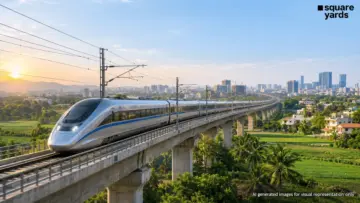
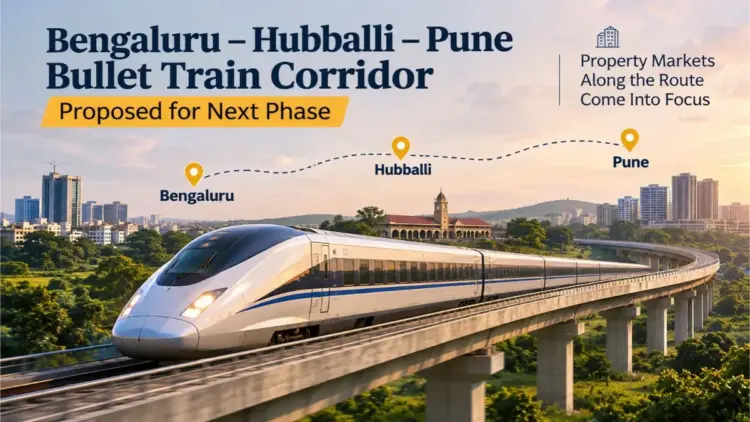
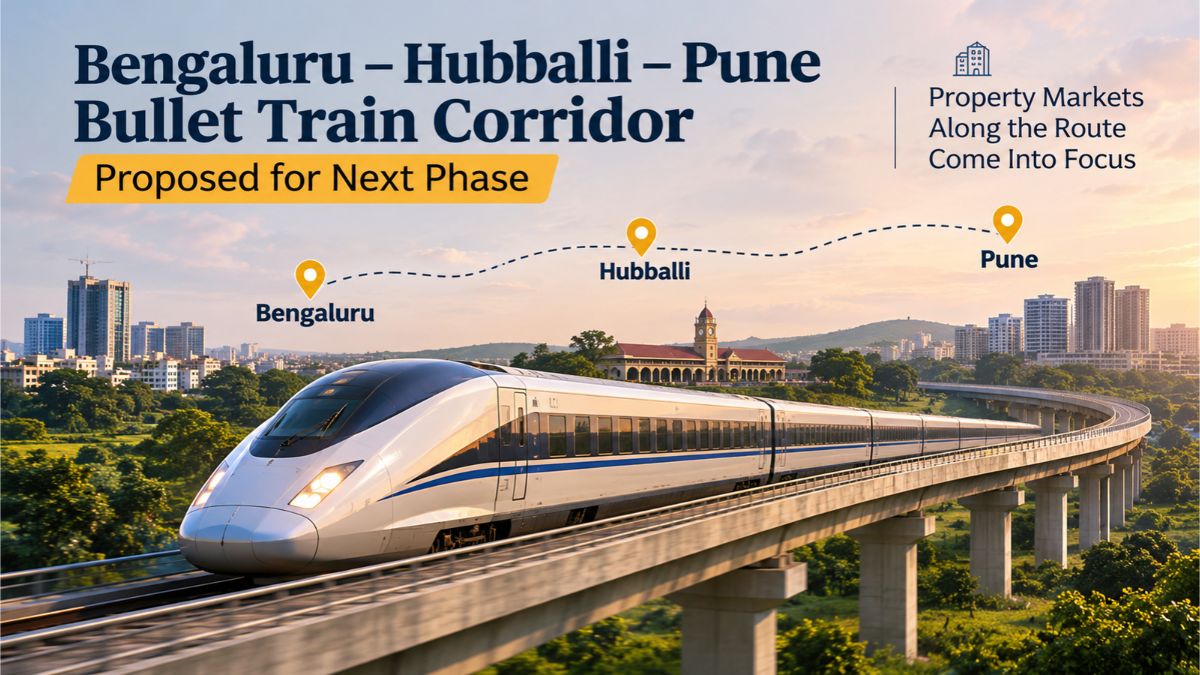
In a move set to redefine the economic geography of Peninsular India, Union Railway Minister Ashwini Vaishnaw has formally proposed the inclusion of the Bengaluru–Pune High-Speed Rail (HSR) corridor in the nation’s next ambitious phase of bullet train development. The proposed corridor, which will traverse the crucial industrial and educational hub of Hubballi, forms a cornerstone of a massive 3,000-kilometer expansion of India’s high-speed rail network.
This announcement marks a pivotal shift in India’s infrastructure strategy, signaling an intent to link the nation’s primary technology hubs—Bengaluru and Pune—via a high-capacity, ultra-fast transit spine. For the first time, the northern stretches of Karnataka and the southern hinterlands of Maharashtra are being integrated into a vision of "frictionless mobility" that promises to shrink travel times from a grueling ten-hour road or rail journey to a mere fraction of that duration.
I. Main Facts: The Vision for a Connected Deccan
The proposal unveiled by Minister Vaishnaw outlines a transformative blueprint for the Indian Railways. The Bengaluru–Pune corridor via Hubballi is designed to bridge the gap between the Silicon Valley of India and the "Oxford of the East" (Pune), creating a mega-region of innovation and commerce.
Key Highlights of the Proposal:
- The Route: The corridor will likely follow the general alignment of the NH-48 (Bengaluru-Mumbai Highway), passing through North Bengaluru, Tumakuru, Davanagere, Hubballi-Dharwad, Belagavi, and Kolhapur before reaching Pune.
- Expansion Scope: This corridor is part of a broader second phase of the National High-Speed Rail Corporation Limited (NHSRCL) project, which aims to add 3,000 km of new routes beyond the initial Mumbai-Ahmedabad project.
- Existing Southern Grid: The Minister confirmed that the previously approved Southern Corridor—connecting Bengaluru to Hyderabad, Amaravati, and Chennai—is progressing. In that sector, the Bengaluru–Chennai commute is projected to take just 73 minutes, while Bengaluru–Hyderabad will be reduced to approximately 130 minutes.
- Developmental Stage: Currently, the Bengaluru–Hubballi–Pune route is in the "pre-feasibility" and "proposal" stage. Detailed Project Reports (DPRs), final route alignments, and specific station locations are expected to be commissioned in the coming fiscal year.
II. Chronology: The Evolution of India’s HSR Ambitions
To understand the significance of the Bengaluru–Pune announcement, one must look at the timeline of India’s high-speed rail journey, which has evolved from a single-line experiment to a multi-state network strategy.
- 2014–2017: The Genesis: The Mumbai–Ahmedabad High-Speed Rail (MAHSR) project was conceptualized and formalized with Japanese collaboration (JICA). This served as the "laboratory" for HSR in India.
- 2020–2022: The National Rail Plan (NRP): The government released the NRP 2030, which identified several high-traffic corridors for HSR, including Delhi–Varanasi and Mumbai–Nagpur. However, the Bengaluru–Pune link remained a secondary consideration at this stage.
- 2023–2025: Operational Milestones: As significant portions of the MAHSR track were completed in Gujarat, the focus shifted toward a nationwide grid. The approval of the Bengaluru–Chennai and Bengaluru–Hyderabad lines marked the first major HSR commitment to South India.
- November 2026: The Strategic Pivot: Minister Vaishnaw’s latest announcement elevates the Bengaluru–Pune route to a priority status. This reflects a strategic decision to connect the "Information Technology Golden Triangle" (Bengaluru–Hyderabad–Pune).
III. Supporting Data: The Real Estate and Economic Landscape
The announcement has sent ripples through the property markets of three major regions. Real estate analysts suggest that "connectivity premiums" are already being factored into long-term investment strategies.
1. North Bengaluru: The Launchpad
North Bengaluru is already the city’s fastest-growing quadrant, buoyed by the Kempegowda International Airport and the Aerospace SEZ. The addition of a Bullet Train terminal—likely near Devanahalli or Hebbal—would create a "Triple-Threat" infrastructure node (Air, Metro, and HSR).
- Current Pricing (Late 2026):
- Devanahalli: Plot rates range from ₹6,000 to ₹10,000 per sq ft.
- Yelahanka: Apartment prices sit between ₹8,250 and ₹14,050 per sq ft.
- Hebbal: The premium gateway node commands ₹15,050 per sq ft.
- Projection: Analysts expect a 15–20% surge in commercial office space demand in North Bengaluru if the HSR terminal is integrated with the existing airport metro line.
2. Hubballi–Dharwad: The Emerging Mid-Point
Historically a commercial hub for North Karnataka, the twin cities have lacked the "Tier-1" connectivity needed to attract global IT firms. The HSR could change this overnight.
- Market Data:
- Hubballi: Apartment prices are currently modest at ₹4,000 to ₹5,000 per sq ft.
- Dharwad: Prices have climbed to ₹7,960 per sq ft, driven by educational institutions and institutional growth.
- Economic Impact: The HSR would allow professionals to live in the more affordable Hubballi-Dharwad region while commuting to Bengaluru or Pune for work, effectively turning the twin cities into a high-end satellite "commuter town."
3. Pune: The Western Terminus
Pune’s Western IT belt is the natural beneficiary of this corridor. The city’s residential market has already seen an average price movement to ₹12,950 per sq ft as of early 2026.
- Locality Breakdown:
- Hinjewadi: ₹6,500 – ₹9,500 per sq ft.
- Baner: ₹11,700 per sq ft.
- Balewadi: ₹11,000 per sq ft.
- Strategic Synergy: A bullet train would facilitate seamless movement between Pune’s auto/tech clusters and Bengaluru’s software/startup ecosystem, fostering a "single labor market" across state lines.
IV. Official Responses: Government and Industry Perspectives
The announcement has been met with a mix of optimism and calls for rigorous planning.
Union Railway Minister Ashwini Vaishnaw emphasized the government’s "Gati Shakti" vision:
"Our objective is not just to run fast trains, but to create economic corridors that spur urban renewal. The Bengaluru–Pune HSR will be a lifeline for the Deccan region, integrating the strengths of Karnataka and Maharashtra. This is part of our commitment to add 3,000 km of HSR tracks to the national grid in the coming years."
State Government Sentiment:
While official statements from the Karnataka and Maharashtra state governments are pending detailed DPRs, sources within the Karnataka Infrastructure Development Department (IDD) suggest that the state is keen on "Transit-Oriented Development" (TOD). This would involve increasing the Floor Area Ratio (FAR) around proposed HSR stations to encourage high-density commercial skyscrapers.
Industry Experts:
Real estate consultants at Square Yards and other major firms note that while the announcement is positive, the "gestation period" is a concern. "Infrastructure projects of this scale take a decade from conception to operation. Investors should look at this as a 10-to-15-year play," says a senior market analyst.
V. Implications: Beyond the Tracks
The introduction of a Bengaluru–Pune bullet train carries implications that extend far beyond simple transportation. It represents a fundamental shift in how India’s "urban clusters" will function in the mid-21st century.
1. The Rise of the "Mega-Region"
If the Bengaluru–Pune, Bengaluru–Chennai, and Bengaluru–Hyderabad corridors are all completed, Bengaluru will sit at the center of a "Star-Shaped" HSR network. This could lead to the emergence of a South-Western Mega-Region, rivaling the Pearl River Delta in China in terms of economic output and connectivity.
2. Decongesting the Metros
One of the primary goals of the HSR via Hubballi is to encourage "de-urbanization" from Bengaluru and Pune. By making Tier-2 cities like Belagavi, Davanagere, and Hubballi accessible within 60–90 minutes of a major metro, the government can incentivize companies to set up "spoke" offices in these smaller cities, where land and labor are cheaper.
3. Environmental and Logistics Shift
The HSR is expected to significantly reduce the load on the NH-48, one of India’s most congested highways. By shifting high-income business travelers from air and road to electric-powered rail, the project aligns with India’s Net Zero emissions targets. Furthermore, the existing "slow" rail tracks can be freed up for dedicated freight movement, boosting the logistics efficiency of the industrial belts in Maharashtra and Karnataka.
4. Speculative Real Estate Risks
While the potential for appreciation is high, the "early stage" nature of the project carries risks. Until the NHSRCL freezes the route alignment, land speculation can lead to "artificial bubbles." Experts warn that property prices in areas like Kolhapur or Gadag might spike prematurely based on rumors of station locations, only to correct if the final alignment bypasses them.
Conclusion: A Multi-Decadal Transformation
The proposal for the Bengaluru–Pune bullet train via Hubballi is more than a transport project; it is an economic manifesto. By committing to an additional 3,000 km of high-speed rail, the Indian government is betting on a future where geography is no longer a barrier to growth.
For the property markets of North Bengaluru, Hubballi-Dharwad, and Western Pune, the announcement provides a long-term "growth floor." However, the transition from a ministerial announcement to a functioning rail corridor involves complex land acquisition, environmental clearances, and engineering feats. As the Detailed Project Reports are drafted in the coming months, the eyes of investors and citizens alike will be on the map—waiting to see exactly where the future of Indian mobility will make its next stop.