By Senior Correspondent
November 2026
The infrastructure narrative of Maharashtra has reached a pivotal juncture with the formal advancement of the Neral-Shirur Highway. Since its approval by the state government in May 2026, the proposed 134-km, four-lane corridor has transitioned from a conceptual blueprint to a significant driver of regional economic speculation. Connecting the lush, residential potential of Raigad district with the industrial powerhouse of eastern Pune, the highway is poised to redefine the "golden triangle" of Mumbai, Pune, and Nashik.
As of November 2026, real estate markets along this corridor are exhibiting varied responses to the project. While the promise of enhanced connectivity has historically acted as a price multiplier in Indian real estate, current data suggests a nuanced market where local infrastructure, existing industrial activity, and project-specific quality remain the primary arbiters of value.
I. Main Facts: The Blueprint of a 134-km Connectivity Corridor
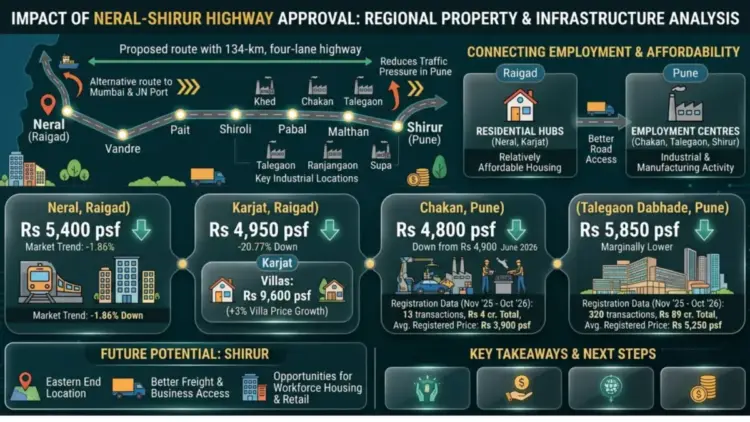
The Neral-Shirur Highway is designed as a high-speed arterial road aimed at bypassing the congested urban cores of Mumbai and Pune. Spanning 134 kilometers, the four-lane project begins in Neral, situated in the Raigad district, and terminates at Shirur on the Pune-Ahilyanagar (formerly Ahmednagar) highway.
Key Route Details
The highway’s alignment is strategically mapped to traverse several emerging nodes, including:
- Vandre and Pait: Agricultural and semi-rural zones expected to see land-use shifts.
- Shiroli and Pabal: Historical and rural hubs that will gain direct access to the industrial grid.
- Malthan: A critical junction point before reaching the eastern terminus.
The project’s primary objective is twofold: to provide an alternative, more efficient route for freight vehicles traveling from the hinterlands toward the Jawaharlal Nehru Port (JNPT) and Mumbai, and to significantly alleviate the traffic bottlenecks currently plaguing the Pune-Mumbai Expressway and the old NH-4.
Industrial Synergy
Beyond residential connectivity, the highway is a logistics play. It creates a direct link to some of India’s most vital manufacturing clusters, including:
- Chakan: The "Detroit of the East," home to global automotive giants.
- Talegaon: A burgeoning hub for electronics and heavy engineering.
- Khed, Ranjangaon, and Supa: Key industrial estates managed by the Maharashtra Industrial Development Corporation (MIDC).
By bridging these hubs with the Raigad region, the highway facilitates a more fluid movement of goods and labor, potentially lowering logistics costs for manufacturers.
II. Chronology: From Approval to Market Realization
The timeline of the Neral-Shirur Highway reflects the state government’s urgency in addressing the infrastructure deficit in the Mumbai-Pune periphery.
- May 2026: The Maharashtra government officially grants administrative approval for the 134-km project. The announcement triggers immediate interest from institutional investors and land aggregators.
- June – August 2026: Initial speculative interest leads to a brief surge in asking prices in areas like Chakan, where prices peaked at approximately ₹4,900 per square foot (psf).
- September 2026: Market stabilization occurs. Data indicates a slight correction in asking prices as buyers await physical progress on the ground. Chakan’s average asking price adjusts to ₹4,800 psf.
- October 2026: Government registration records begin to reflect the actual transaction volume. In Talegaon Dabhade, 320 transactions are recorded, signaling robust end-user and investor confidence.
- November 2026: Six months post-approval, the market presents a segmented picture. While Neral maintains a higher asking price due to its proximity to the Mumbai Metropolitan Region (MMR), Shirur emerges as a long-term "dark horse" for warehousing and commercial development.
III. Supporting Data: A Deep Dive into Locality Performance
According to the latest locality data from Square Yards, which tracks prices through September 2026 and registrations through October 2026, the real estate response to the highway has been localized rather than uniform.
Residential Price Points (Asking vs. Registered)
The discrepancy between "asking prices" (the price quoted by sellers) and "registered prices" (the actual value at which transactions are recorded) provides a realistic view of the market’s health.
| Locality | Average Asking Price (psf) | Noted Trends |
|---|---|---|
| Neral | ₹5,400 | Highest in the corridor; driven by MMR proximity. |
| Karjat | ₹4,950 | Strong preference for luxury/second homes. |
| Chakan | ₹4,800 | Slight dip from ₹4,900 in June; industrial focus. |
| Talegaon | ₹5,250 (Registered) | High volume of transactions (320) totaling ₹89 Cr. |
The Villa Phenomenon in Karjat
One of the most striking data points emerges from Karjat. While standard apartments average ₹4,950 psf, the villa segment has seen asking prices soar to approximately ₹9,600 psf. This segment recorded a 3% growth during the reporting period, suggesting that Karjat is successfully positioning itself as a premium "second home" or "work-from-anywhere" destination. The highway is expected to further this trend by reducing travel time for high-net-worth individuals (HNIs) from Pune’s eastern IT hubs.
Chakan’s Industrial Resilience
Chakan presents a different narrative. The average registered price stands at ₹3,900 psf, significantly lower than the asking price of ₹4,800 psf. Between November 2025 and October 2026, registration records showed 13 high-value transactions worth approximately ₹4 crore. This suggests that while the residential market is cautious, the area remains a stronghold for industrial and commercial land acquisitions.
IV. Official Responses and Strategic Intent
While official statements from the Maharashtra State Road Development Corporation (MSRDC) and the Ministry of Public Works emphasize the engineering aspects, the underlying strategy is one of "Decongestive Development."
The "Bypass" Strategy
Officials have noted that the current road network forces heavy transit through Pune’s internal ring roads, leading to massive delays and pollution. "The Neral-Shirur link is not just a road; it is a bypass for the state’s economy," a senior planning official remarked during a recent infrastructure summit. "By shifting freight movement to this four-lane corridor, we are effectively giving the city of Pune room to breathe while simultaneously opening up Raigad’s interior for sustainable growth."
Land Use and Planning
The state government is also reportedly looking at "Integrated Township" policies along the highway. By allowing for planned residential hubs near future highway junctions, the administration aims to prevent the haphazard "ribbon development" that has plagued other major Indian highways. The focus is on ensuring that utilities—water, electricity, and sewage—are planned in tandem with the road construction.
V. Implications: Looking Toward 2030
The long-term implications of the Neral-Shirur Highway extend far beyond mere property price appreciation. It represents a structural shift in how the Mumbai-Pune region will function over the next decade.
1. The Emergence of the "Commuter Corridor"
If travel times are halved, Neral and Karjat will no longer be viewed solely as "affordable alternatives" to Mumbai. Instead, they will become viable residential bases for the workforce employed in Pune’s industrial belt. This "reverse migration" of commuters could lead to a surge in demand for schools, hospitals, and retail infrastructure in the Raigad district.
2. Shirur as a Logistics Powerhouse
Shirur, located at the eastern terminus, stands to benefit the most in terms of commercial potential. Its position at the intersection of the new highway and the Pune-Ahilyanagar route makes it an ideal location for "Last Mile" delivery hubs, cold storage facilities, and regional distribution centers.
3. Industrial De-risking
For manufacturers in Chakan and Talegaon, the highway offers a critical "de-risking" of their supply chains. Having an alternative route to JNPT means that disruptions on the main Expressway will no longer bring their logistics to a standstill.
4. The Challenge of Inclusive Growth
The success of the corridor hinges on "last-mile" connectivity. For the highway to truly benefit the property markets in Pabal or Malthan, the government must invest in feeder roads that connect the highway to the heart of these villages. Without this, the highway remains a "closed pipe" that passes through the region without enriching it.
Conclusion
The Neral-Shirur Highway is a testament to Maharashtra’s vision of an interconnected, multi-modal future. While the real estate data of late 2026 shows a market that is currently "watching and waiting," the underlying fundamentals remain strong. For investors, the opportunity is location-specific; for the state, it is a necessary step in maintaining its status as India’s industrial engine. As the first shovels hit the ground, the transition from speculative interest to tangible economic growth will be the next chapter in this transformative project.