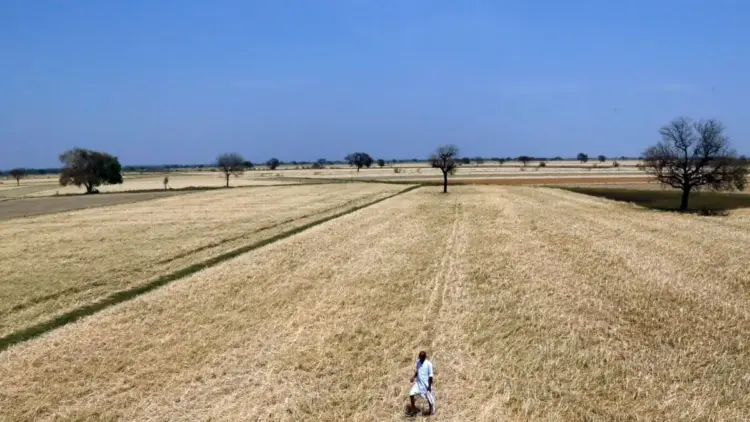
For the Indian subcontinent, the specter of an El Niño year has historically been synonymous with a faltering monsoon. While the relationship between the warming of the central and eastern Pacific Ocean and Indian rainfall is a tendency rather than an absolute rule, the odds are historically stacked against the Indian farmer. In 2026, those odds materialized into a harsh reality, revealing a profound systemic gap: while India’s meteorological science has reached world-class precision, the mechanisms for delivering that science to the smallholder farmer are fracturing under the weight of the digital age.
Main Facts: The 2026 Monsoon and the El Niño Signal
The 2026 monsoon season was marked by one of the most emphatic climate signals in recent history. Early in the year, the India Meteorological Department (IMD) placed the probability of El Niño developing during the critical monsoon months at a staggering 92%. This was echoed by the United States National Oceanic and Atmospheric Administration (NOAA), which projected a 96% chance of the phenomenon persisting through the winter. Experts categorized the event as entering "super El Niño territory," drawing ominous parallels to the devastating 2015 season.
The IMD’s seasonal outlook was conservative but clear: rainfall was expected to be just 90% of the Long Period Average (LPA), with a 60% likelihood of the season concluding with a significant deficit. These were not mere academic projections; they were a clarion call for a country where nearly half the population relies on agriculture.
As the season progressed, the warnings bore fruit in the form of parched earth. By the first week of September, the state of Rajasthan—already a drought-prone region—recorded a 21% rainfall deficit. Out of its 33 districts, 21 were classified as deficient. Nationally, the situation was equally grim, with a 13.8% shortfall between June and August. By the end of September, cumulative rainfall remained approximately 15% below the LPA.
The human and economic impact was swift. Maharashtra, a powerhouse of Indian agriculture, was forced to declare drought in 265 of its 358 talukas. However, the most critical data point was found in the fields long before the formal declarations. By July 10, Kharif (summer-sown) sowing had lagged by 16% compared to the previous year, covering only 53.12 million hectares against the usual 63.27 million. While sowing recovered slightly in late July, the rains did not, leaving millions of hectares of young crops at the mercy of a disappearing monsoon.

Chronology of a Crisis: From Forecast to Failure
The timeline of the 2026 crisis illustrates a system that functions perfectly at the top but begins to dissipate as it reaches the ground.
Phase 1: The Early Warning (January – April)
The global "Multi-Model Ensemble" and statistical forecasting systems identified the El Niño signal six to eight months in advance. At this stage, the information was primarily utilized by policy-makers, commodity traders, and large-scale agricultural planners.
Phase 2: The Seasonal Outlook (May – June)
The IMD released its detailed monsoon forecast, lowering expectations to 90% of the LPA. This is the window where "anticipatory action" should begin. For farmers with institutional links, this was the time to reconsider water-intensive crops like paddy and soybean.
Phase 3: The Sowing Pivot (July)
As the monsoon arrived with a whimper, the "Gramin Krishi Mausam Sewa" (GKMS) began issuing twice-weekly medium-range bulletins. These advisories recommended specific actions: "hold back sowing," "delay irrigation," or "switch to short-duration varieties."
Phase 4: The Realization (August – September)
By August, the rainfall gap became insurmountable. While some farmers had adjusted their strategies based on the May warnings, a significant portion of the farming community—those outside the extension network—continued with traditional sowing patterns, leading to widespread crop failure and the eventual declaration of drought by state governments in September.

Supporting Data: A Tale of Two Farmers
An investigation into the 2026 season in Rajasthan highlights a striking dichotomy in how information translates into resilience. Researchers interviewed farmers across various geographic zones, revealing that access to information—and the medium of that information—was the single greatest predictor of success.
The Informed Adaptors
Farmers who maintained active contact with their local Krishi Vigyan Kendras (KVKs) and utilized digital advisory channels demonstrated remarkable agility.
- Case Study (Sri Ganganagar): One farmer, Rampal, utilized the El Niño warning to stagger his rice sowing. By watching the rain patterns and sowing in small sections rather than all at once, he minimized his risk.
- Case Study (Pratapgarh & Baran): Farmers like Sheeshpal and Rajpal abandoned water-intensive soybeans and rice entirely, opting instead for pearl millet (bajra) and guar—crops far better suited for a deficit year.
- Calculated Risk: In Baran, a farmer with 25 bighas of land chose to sow only 10 bighas. His logic was precise: if the rains failed, his tube well could sustain 10 bighas, whereas sowing the full 25 would have resulted in total loss.
The Information-Deprived
Conversely, farmers without institutional links found themselves "relying on God." In Jaisalmer, farmers like Girdhari reported sowing their crops as usual, only to watch them wither as the rain failed to materialize. For this group, the warning system "may as well not have existed."
The Infrastructure of Dissemination
India has spent nearly 50 years building its Agromet Advisory Services.
- 1977: State-level bulletins via All India Radio and newspapers.
- 2008: Extension to the district level via Gramin Krishi Mausam Sewa.
- 2018: Extension to the block level, involving over 130 Agromet Field Units.
- Modern Day: A move toward SMS, WhatsApp, and apps like Meghdoot.
Despite this infrastructure, the "last mile" remains broken for millions.

Official Responses and the Digital Paradox
The official response to the 2026 drought has highlighted a new challenge: the "Digital Paradox." While the government has successfully moved advisories from radio to smartphones, this shift has introduced a crisis of authority and precision.
The Problem of Precision
Farmers frequently complain that while a forecast might be correct for a "block" (an administrative unit), it is often too coarse for the microclimate of an individual plot. This is attributed to a thin network of automated weather stations (AWS), which leaves vast gaps in local data.
The Collapse of Authority
In the era of All India Radio, a broadcast carried the weight of the state. Today, government advisories arrive on a farmer’s phone alongside private forecasts, viral WhatsApp rumors, and outright speculation.
- Dhanraj (Hanumangarh): "Messages come from every direction… we just glance at them and delete them. We can’t tell which warning is genuine and which is false."
- Mohanlal (Jodhpur): Reported that a viral WhatsApp message falsely predicted a "very good monsoon," leading farmers to buy expensive seeds only to face a dry season and massive financial loss.
Institutional Fragmentation
Currently, drought management is split across the IMD, the Ministry of Agriculture, the National Disaster Management Authority (NDMA), and ISRO. This fragmentation means that while each agency performs its technical role, no single entity is held accountable for whether the farmer actually understood or acted upon the information.
Implications: Securing the Future of Indian Agriculture
The lessons of the 2026 El Niño year suggest that technological advancement in forecasting is insufficient if it is not paired with a revolution in communication and trust-building.

1. Moving Beyond the "Aggregate" Success
A drought warning system can be a national success but a local failure. National food security may be maintained if 60% of farmers are reached, but the remaining 40% face personal economic ruin. True resilience requires a system designed for the most vulnerable, not just the most "connected."
2. The Human Element: The "Varuna Mitra" Model
Data suggests that "talking to a person" remains the most effective way to build trust. Karnataka’s Varuna Mitra service, which connects farmers directly with agrometeorologists via a phone line, provides a blueprint. A human voice can restore the sense of authority that was lost in the transition to digital text.
3. Localized and Linguistic Customization
The 2026 investigation found that many advisories were written in technical or non-regional language. To meet the goals of the Sendai Framework Target G (increasing access to multi-hazard early warning systems by 2030), India must invest in audio-based, regional-language outreach that bypasses the literacy and digital fluency barriers.
4. Expanding the AWS Network
To solve the precision problem, the density of automated weather stations must be increased significantly. A forecast is only useful to a farmer if it reflects the reality of their specific village, not a town 30 miles away.
Conclusion: The Warning vs. The Forecast
The 2026 season proved that India can forecast a "Super El Niño" with remarkable accuracy months in advance. However, the season also proved that a forecast is not a warning. A forecast is a scientific statement; a warning is a piece of actionable information that reaches the person who needs it most, in a language they speak, through a channel they trust. Until the gap between the satellite and the smallholder is closed, the Indian monsoon will continue to be a gamble that the most vulnerable are destined to lose.