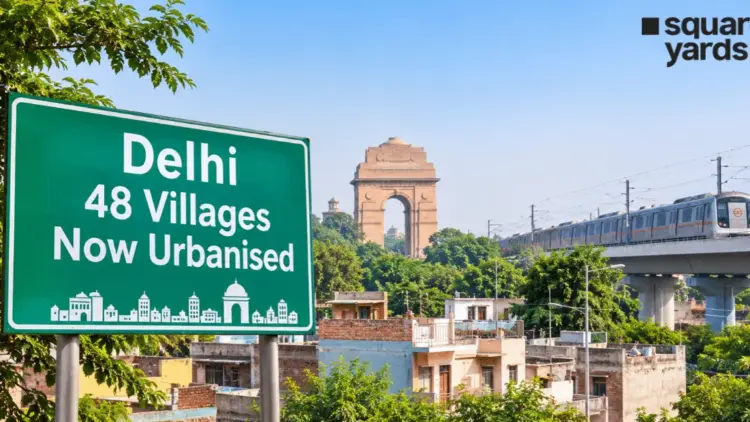
NEW DELHI – In a move that marks the end of an era for the National Capital Territory’s rural landscape, the Delhi government has formally integrated its final 48 rural villages into the urban framework. This administrative milestone completes the urbanization process for all 357 villages within Delhi, effectively signaling the total transition of the capital from a mix of agrarian and metropolitan pockets into a singular, unified urban entity.
The transformation was formalized through a notification issued under Section 507(a) of the Delhi Municipal Corporation (DMC) Act, 1957. This legal instrument removes the "rural" classification from these settlements, bringing their inhabited areas (abadi) and expansive revenue estates under the direct jurisdiction of urban planning and municipal governance.
The Final Milestone: Completing the Urbanization Map
For decades, Delhi has existed as a hybrid territory, where ultra-modern high-rises stood in stark contrast to villages governed by archaic land reform laws. With this latest notification, that duality has been officially dissolved. The 48 villages, primarily located in the Outer North and South-West districts, represented the last vestiges of Delhi’s rural administrative category.
The decision follows a systematic recommendation by the Delhi Development Authority (DDA), which was subsequently approved by the Municipal Corporation of Delhi (MCD) in September. By bringing these remaining 48 villages into the fold, the government has finalized a process that saw 309 villages urbanized in various phases over the preceding decades.
The newly urbanized areas are concentrated in seven key revenue segments. Notable among them are Bijwasan, Ghuman Hera, Dhansa, Fatehpur Beri, Chandan Hola, Palla, and Mungeshpur. These areas, once considered the "periphery" of the city, are now poised to become the new frontiers of Delhi’s real estate and infrastructural expansion.
Chronology of the Transition: From Recommendations to Reality
The journey toward 100% urbanization has been a multi-step administrative marathon involving several tiers of government.
- The Earlier Phases: Historically, Delhi’s urbanization occurred in spurts. Prior to this notification, 309 villages had already been brought under the DMC Act’s urban provisions to accommodate the city’s burgeoning population and the need for standardized civic amenities.
- DDA Recommendations: The catalyst for the final phase was a formal recommendation by the DDA. The authority recognized that the persistence of rural pockets was hindering the implementation of the Master Plan for Delhi, particularly regarding land pooling and large-scale infrastructure projects.
- MCD Approval (September 2024): The Municipal Corporation of Delhi reviewed the DDA’s proposal and granted its approval, noting that the rural governance model was no longer self-sustaining or efficient given the level of "semi-urban" activity already occurring in these villages.
- The Section 507(a) Notification: The final legal step was the issuance of the notification under the DMC Act. This act serves as the "switch" that flips the status of the land from rural revenue estates to urban municipal wards.
Administrative and Legal Overhaul: What Changes?
The shift from rural to urban status is far more than a change in nomenclature; it triggers a cascade of legal and administrative transformations that fundamentally alter how land is managed and how citizens interact with the state.
Dissolution of Gram Sabhas
Under the rural framework, these 48 villages were governed by Gram Sabhas. With the urbanization notification, these local bodies are dissolved. According to Section 150(3) of the Delhi Land Reforms Act, the assets, rights, and liabilities previously held by the Gram Sabhas are transferred to the Central Government.
Transfer of Land Control
Once the assets are vested in the Central Government, the land is typically placed under the management of the DDA under Section 22(1) of the Delhi Development Act. This allows the DDA to utilize "Gram Sabha land" (now public land) for community facilities, parks, schools, and health centers—amenities that were often difficult to develop under the rural administrative setup.
Unified Governance: MCD vs. DDA
The urbanization clarifies the division of labor between government agencies:
- The MCD: Will now take full responsibility for "micro" civic services. This includes the construction and maintenance of internal roads, the implementation of formal drainage and sewerage systems, street lighting, and daily waste management.
- The DDA: Will oversee "macro" urban planning. This includes land-use changes, the enforcement of the Master Plan 2047, and the implementation of the Land Pooling Policy.
Master Plan 2047 and the Land Pooling Paradigm
The urbanization of these 48 villages is a critical prerequisite for the Master Plan for Delhi (MPD) 2047. A central pillar of this plan is the Land Pooling Policy, which aims to prevent the haphazard, unauthorized growth that characterized Delhi’s expansion in the 1990s.
Under land pooling, landowners in these newly urbanized villages can voluntarily surrender their land to the DDA. The DDA then acts as a facilitator, consolidating the land, developing the necessary infrastructure (roads, utilities, green belts), and returning a portion of the developed land to the owners for residential or commercial use.
This policy is particularly relevant for villages like Bijwasan, Kangan Heri, and Dhansa. Their proximity to the Indira Gandhi International Airport and the burgeoning corporate hubs of Gurugram makes them prime candidates for high-end residential layouts and logistics hubs. Without urbanization, these lands were locked under the Delhi Land Reforms Act of 1954, which strictly prohibited the use of agricultural land for non-agricultural purposes without tedious and often impossible conversion processes.
Real Estate Impact: A Shift in Market Dynamics
The real estate sector views the urbanization of the final 48 villages as a "venting mechanism" for Delhi’s saturated property market. With little to no vacant land available in South or Central Delhi, these outer belts represent the future of the city’s growth.
Strategic Micromarkets
- South-West Delhi (The Airport Belt): Villages such as Bijwasan and Badusarai are expected to see the most significant appreciation. Their location makes them ideal for "Transit-Oriented Development" (TOD), focusing on high-density living near public transport corridors.
- South Delhi (The Expansion Belt): Fatehpur Beri and Chandan Hola offer a bridge between the posh Chhatarpur area and the Haryana border. Urbanization allows for the formalization of these areas, potentially leading to more planned "farmhouse" redevelopments or luxury low-rise apartments.
- Outer North (The Industrial & Logistics Hub): Palla and Mungeshpur, located near the Kundli-Manesar-Palwal (KMP) Expressway, are likely to evolve into logistics and warehousing centers, supporting the capital’s supply chain.
Current Market Valuations
Based on research by Square Yards, the indicative price points for these newly urbanized areas vary significantly based on their proximity to existing infrastructure:
| Micromarket | Key Villages | Indicative Price (per sq. ft.) |
|---|---|---|
| South-West (Dwarka/Bijwasan) | Bijwasan, Badusarai, Nanak Heri | Rs 5,200 – 5,800 |
| South (Chhatarpur/Fatehpur) | Fatehpur Beri, Chandan Hola | Rs 5,300 – 6,600 |
| North-East (Shahdara/Burari) | Sabapur, Jagatpur, Burari | Rs 4,800 – 7,800 |
| South-East (Mayur Vihar) | Chak Chilla | Rs 5,000 – 6,000 |
| Outer North (Narela/Bawana) | Palla, Bakoli, Mungeshpur | Rs 2,100 – 2,900 |
| Najafgarh/Dhansa Belt | Ghuman Hera, Dhansa, Kair | Rs 2,000 – 3,000 |
Implications for Residents: Opportunities and Hurdles
For the thousands of families living in these 48 villages, the "urban" tag is a double-edged sword that brings both the promise of modernization and the burden of new regulations.
The Benefits: Civic Integration
For years, residents of rural Delhi complained of being "step-citizens"—surrounded by a global city but lacking basic sewerage and piped water. Urbanization mandates the MCD to provide these services at the same standard as developed colonies like Rohini or Dwarka. It also paves the way for better public transport connectivity, as the Delhi Metro and DTC can more easily plan routes through officially urbanized sectors.
The Challenges: Regulation and Taxation
- Building Bylaws: In rural areas, construction was often unregulated. Now, any new construction or expansion must adhere to the Delhi Unified Building Bye-Laws. This requires architectural approvals, which may be a hurdle for those accustomed to informal building practices.
- Property Tax: Urban status typically brings these areas into the property tax net of the MCD. While this provides revenue for local development, it represents a new recurring cost for residents.
- Land Mutation Issues: A recurring problem in previously urbanized villages has been "mutation"—the process of updating land ownership records. When a village is urbanized, the revenue department often stops maintaining records, and the DDA/MCD may be slow to take them over. This "documentation vacuum" can make it difficult for residents to sell property or take out bank loans in the short term.
Conclusion: A Unified Future
The urbanization of the final 48 villages is more than a bureaucratic checkbox; it is the final piece of the puzzle in creating a "Greater Delhi." By removing the legal barriers of the 1954 Land Reforms Act and dissolving the rural-urban administrative divide, the government has cleared the path for the Master Plan 2047.
However, the success of this transition will depend on implementation. For the residents of Bijwasan, Palla, and Ghuman Hera, the true test of this notification will not be found in the legal text of Section 507(a), but in whether their taps run with water, their streets are paved with bitumen, and their land values reflect the status of being part of India’s most vital metropolitan core. As the city expands outward, the focus now shifts from "declaring" these areas urban to "building" them into the urban world-class standard Delhi aspires to achieve.