

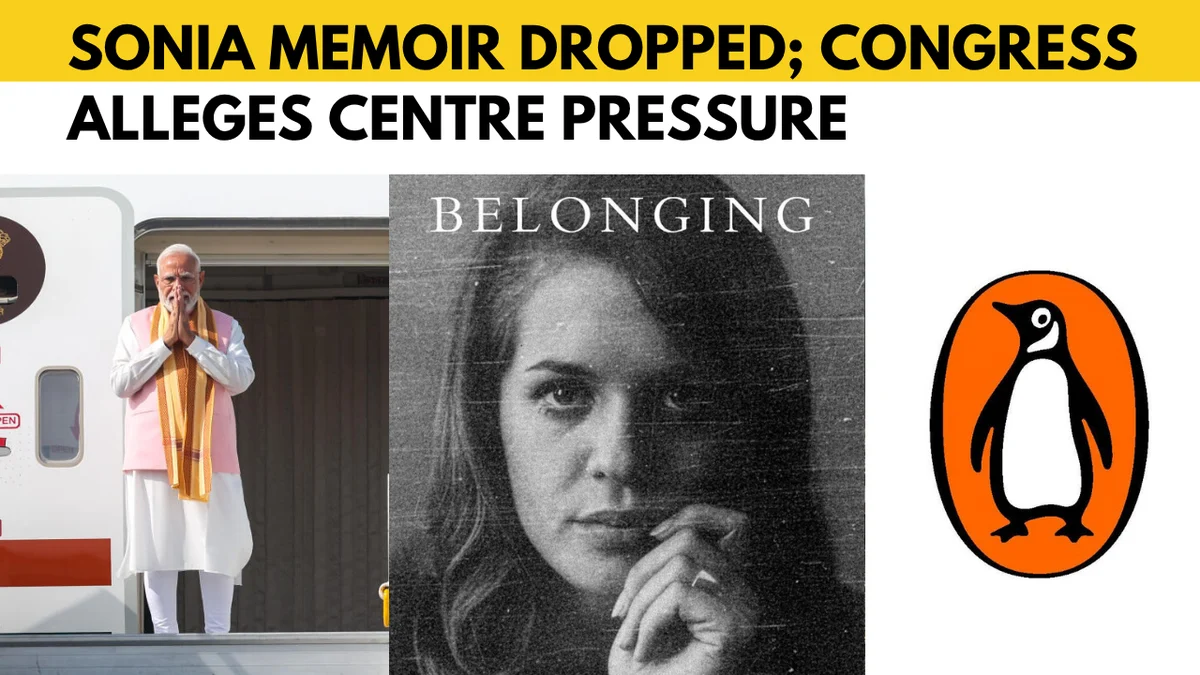
New Delhi — In a move that has sent shockwaves through India’s literary and political landscapes, Penguin Random House India has officially announced the withdrawal of Belonging, the highly anticipated memoir of former Congress President Sonia Gandhi. The decision comes a mere eight weeks before the book was slated for a global release, sparking a firestorm of controversy. While the publisher maintains that the decision was influenced by "evolving circumstances," the Indian National Congress has launched a scathing attack on the Prime Minister Narendra Modi-led government, alleging that the Centre exerted "unprecedented pressure" to suppress sections of the book critical of the current administration and its ideological foundations.
I. Main Facts: A Literary Blackout
The announcement, made late on the evening of August 29, 2026, marks one of the most significant instances of a high-profile political memoir being pulled in recent Indian history. Belonging was marketed as a definitive, first-person account of Sonia Gandhi’s journey from a small town in Italy to the epicenter of Indian politics. It promised to cover her marriage into the Nehru-Gandhi family, her reluctant entry into politics following the assassination of Rajiv Gandhi, and her two-decade tenure at the helm of the country’s oldest political party.
The crux of the controversy lies in three specific thematic areas of the manuscript:
- The Modi Era: Detailed critiques of Prime Minister Narendra Modi’s governance style and the centralization of power.
- The RSS Factor: An analytical deep dive into the influence of the Rashtriya Swayamsevak Sangh (RSS) on state institutions.
- National Security: Sensitive reflections on India-China relations, specifically regarding the border standoffs in Ladakh and the diplomatic maneuvers following the 2020 Galwan Valley clash.
While Penguin India issued a brief statement asserting they remained "willing to publish" until late in the process, the sudden reversal has led to accusations of "structural censorship" and a "chilling effect" on the freedom of expression within the Indian publishing industry.
II. Chronology: From Announcement to Aborted Launch
The trajectory of Belonging has been a subject of intense speculation for over two years. To understand the gravity of the current cancellation, one must look at the timeline of its development:
- January 2024: Rumors first surface at the Jaipur Literature Festival that Sonia Gandhi has completed a significant portion of her memoirs, working with a team of researchers and ghostwriters to document her years in the UPA (United Progressive Alliance) government.
- November 2025: Penguin Random House India officially announces the acquisition of the rights to the memoir. The deal is rumored to be one of the largest in Indian publishing history.
- March 2026: The title Belonging is revealed. Pre-orders begin on major e-commerce platforms, quickly reaching the "Bestseller" category within 48 hours.
- June 2026: Legal vetting of the manuscript begins. Sources within the publishing house suggest that external legal counsel flagged several "high-risk" chapters pertaining to the 2002 Gujarat riots and recent Chinese incursions.
- August 15, 2026: Reports emerge that a "high-level meeting" took place between representatives of the Ministry of Information and Broadcasting and senior executives at Penguin.
- August 29, 2026: Penguin India issues a formal notification to distributors and retailers stating that the publication of Belonging has been "indefinitely suspended due to unforeseen contractual and legal complexities."
III. Supporting Data: The Contentious Chapters
While the full manuscript remains under lock and key, leaked excerpts and briefings from those close to the project provide insight into why the book became a political lightning rod.
1. The Critique of the "New India"
The memoir reportedly contains a section titled "The Architecture of Silence," where Gandhi describes the transformation of democratic institutions between 2014 and 2026. She allegedly argues that the "spirit of consensus" that defined Indian democracy for decades was systematically replaced by a "majoritarian diktat."
2. The RSS and the Deep State
Data provided by sources involved in the book’s research suggests Gandhi dedicated over 50 pages to the RSS. She reportedly details instances where she believes the ideological wing of the ruling party bypassed traditional bureaucratic channels to influence policy in education and culture.
3. The China Conundrum
Perhaps the most sensitive data point involves Gandhi’s account of the 2020-2022 border tensions. The book allegedly includes transcripts of briefings she received as a member of the Opposition, claiming that the government’s public narrative significantly diverged from the tactical reality on the ground. In a climate where national security is a cornerstone of the ruling party’s platform, these revelations were viewed as a direct challenge to the government’s credibility.
IV. Official Responses: A War of Words
The fallout from the cancellation was immediate, with both sides of the political aisle digging in their heels.
The Congress Party:
Senior Congress leader and communications head, Jairam Ramesh, held an emergency press conference shortly after the news broke. "This is not just an attack on a book; it is an attack on the history of this country," Ramesh stated. "The Modi government is so terrified of the truth that it has used every tool in its arsenal—from tax authorities to regulatory threats—to ensure that Sonia Gandhi’s voice does not reach the people. Penguin has not caved to ‘legal complexities’; they have caved to the Centre’s bullying."
The BJP Government:
The Bharatiya Janata Party (BJP) dismissed the allegations as "baseless and paranoid." National spokesperson Sambit Patra countered the Congress narrative, suggesting that the book was withdrawn because it was "riddled with factual inaccuracies and defamatory content" that would not stand up in a court of law. "The Congress party has a habit of playing the victim card," Patra said. "If a publisher decides that a book is not fit for print, it is a commercial and legal decision. To blame the Prime Minister for the editorial failures of Penguin is absurd."
The Publisher:
Penguin Random House India’s official statement remained tactically vague: "We have a long-standing commitment to diverse voices and historical narratives. However, after careful consideration of various factors, including legal sensitivities and the current publishing environment, we have decided not to proceed with the release of Belonging at this time. We value our relationship with Mrs. Gandhi and wish her the best."
V. Implications: The Future of Political Discourse
The dropping of Belonging carries profound implications for the future of the written word in India, touching upon legal, ethical, and democratic concerns.
1. The Rise of Self-Censorship
Industry experts warn that this incident will lead to "pre-emptive pruning" of manuscripts. If a global giant like Penguin Random House—backed by international legal teams and significant capital—cannot withstand political pressure, smaller publishers may avoid controversial political subjects altogether. This "chilling effect" could sanitize Indian history as it is being written, leaving future generations with a one-sided narrative.
2. Legal Vulnerability and Defamation Laws
The incident highlights the potency of India’s defamation laws and the "reasonable restrictions" on free speech. In recent years, the threat of "SLAPP" (Strategic Lawsuits Against Public Participation) suits has become a common tool to delay or stop the publication of investigative journalism and memoirs. The withdrawal of Belonging suggests that the legal cost of defending the truth is becoming prohibitively high, even for the wealthy.
3. The "Streisand Effect" and Underground Circulation
Ironically, the suppression of the book may grant it more influence than its publication ever could. Within hours of the announcement, "Sonia Gandhi Memoir" was trending globally. Digital rights activists suggest that if the book is published in the United States or Europe, "samizdat" (underground) digital copies will inevitably flood the Indian market via encrypted messaging apps, bypassing official bans but depriving the author and publisher of legitimate revenue and editorial control.
4. A Divided Legacy
For Sonia Gandhi, the memoir was intended to be her final word on her role in Indian history. By silencing the book, the current administration has ensured that her legacy remains a battleground. To her supporters, she is now a martyr of free speech; to her detractors, the book’s withdrawal is proof of its "falsehoods."
As the dust settles on this controversy, the empty shelves where Belonging was meant to sit serve as a stark reminder of the volatile intersection of power and the press in modern India. The question remains: In the world’s largest democracy, who gets to tell the story of the nation, and who holds the eraser?
