

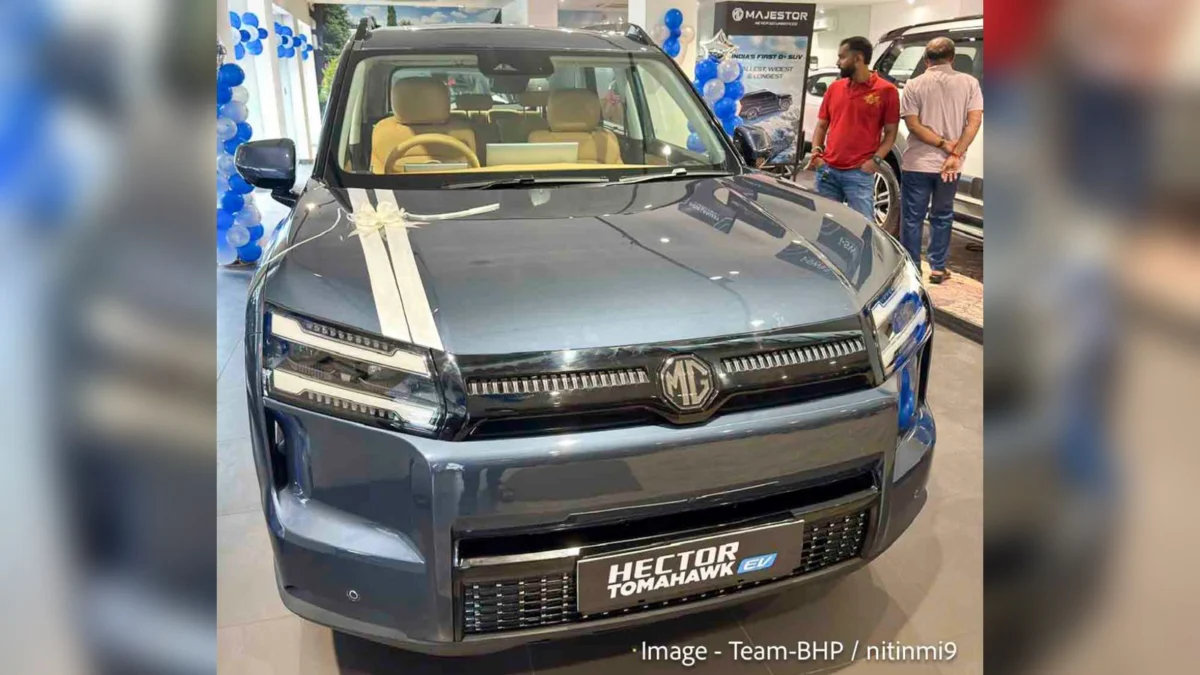
NEW DELHI – JSW MG Motor India has announced its wholesale performance for August 2026, revealing a period of significant strategic transition and steady growth. The company reported total wholesale sales of 7,508 units, a figure that underscores the brand’s resilience and its evolving focus toward a diverse powertrain strategy. Central to this month’s narrative is the commercial rollout of the highly anticipated MG Hector Tomahawk, a vehicle that marks a new chapter for the brand’s "New Energy Vehicle" (NEV) ambitions in the Indian subcontinent.
While the automotive industry at large faces fluctuating demand, JSW MG Motor India’s latest figures represent a 14.14% year-on-year (YoY) increase compared to the 6,578 units sold in August 2025. This growth is largely attributed to the brand’s aggressive expansion of its electrified portfolio and the sustained popularity of its internal combustion engine (ICE) models.
Detailed Sales Performance: A Tale of Two Trends
The August 2026 sales data presents a nuanced picture of the company’s current market standing. On one hand, the 14.14% YoY growth indicates that the joint venture between the JSW Group and MG Motor is yielding positive results in terms of market reach and production scaling. The addition of 930 units over the previous year’s August tally suggests that the brand is successfully capturing a larger slice of the mid-to-premium SUV segment.
However, a month-on-month (MoM) comparison reveals a slight cooling of momentum. In July 2026, the company dispatched 8,158 units, meaning August saw a decline of 650 units, or approximately 7.97%. Industry analysts suggest this MoM dip is likely a tactical "inventory recalibration" as the company prepares its dealer network for the massive influx of the Hector Tomahawk variants. Transitions between legacy models and next-generation platforms often result in temporary wholesale fluctuations as production lines are optimized for new tech-heavy assemblies.
Despite the MoM decline, the company remains optimistic, noting that its "New Energy Vehicle" portfolio continues to contribute a substantial percentage to total sales—a trend that is expected to accelerate as the Tomahawk EV reaches customers.
The Hector Tomahawk: A Strategic Pivot on the ADAPT Platform
The cornerstone of MG’s future strategy is the Hector Tomahawk, which officially entered the dispatch phase in August. This vehicle is not merely a facelift or a powertrain update; it is the debut model built upon MG’s proprietary ADAPT (Advanced Diverse Adaptable Powertrain Technology) platform.
The ADAPT platform is engineered to support multiple "new energy" configurations, allowing MG to manufacture Electric Vehicles (EVs) and Plug-in Hybrid Electric Vehicles (PHEVs) on the same architecture with minimal structural modifications. This flexibility is seen as a direct response to the Indian market’s varying infrastructure readiness, offering a "bridge" for consumers who are not yet ready to commit to a fully electric lifestyle.
The EV Variant: Paving the Way for Mass Adoption
The Hector Tomahawk EV is aimed at the core of the burgeoning electric SUV market. With dispatches now underway to showrooms across the country, MG is positioning the vehicle as a premium yet accessible entry into the long-range EV segment. The Tomahawk EV features a high-density battery pack and an aerodynamic design language that differentiates it from its ICE counterparts.
The PHEV Variant: A Challenge to Hybrid Dominance
Perhaps more significant for the broader market is the Hector Tomahawk PHEV. By combining a traditional petrol engine with a high-capacity battery and electric motor, the PHEV variant offers a reported pure-electric range sufficient for daily city commutes, while eliminating range anxiety for long-distance travel. This move is widely viewed as a direct challenge to established players like Toyota, who have long championed "strong hybrids" (HEVs) in the Indian market.
Disruptive Pricing and the Battery-as-a-Service (BaaS) Model
In a move to lower the entry barrier for electric mobility, JSW MG Motor India has implemented an innovative "Battery-as-a-Service" (BaaS) pricing structure for the Tomahawk lineup. This model separates the cost of the vehicle from the cost of the battery, significantly reducing the upfront purchase price.
- Hector Tomahawk EV: Launched at an introductory ex-showroom price of ₹19.49 lakh. Under the BaaS program, the price drops to a highly competitive ₹13.99 lakh, with owners paying a battery rental fee of ₹4.90 per kilometer.
- Hector Tomahawk PHEV: Priced at ₹25.69 lakh (ex-showroom). The BaaS option brings the entry price down to ₹21.79 lakh, accompanied by a battery rental charge of ₹3.20 per kilometer.
These introductory prices are restricted to a specific number of early bookings, a tactic designed to generate immediate "festive season" momentum. By lowering the sticker price to under ₹14 lakh for a full-sized electric SUV, MG is effectively competing with smaller sub-compact EVs, potentially disrupting the established hierarchy of the Indian EV market.
Chronology of the Tomahawk Rollout
The launch and distribution of the Hector Tomahawk have been meticulously phased to ensure operational efficiency:

- Early August 2026: Official unveiling and price announcement of the Hector Tomahawk EV and PHEV.
- Mid-August 2026: Commencement of wholesale dispatches for the Tomahawk EV variant. Units began arriving at Tier-1 and Tier-2 city dealerships for display and test drives.
- September 2026: Scheduled commencement of customer deliveries for the Tomahawk EV.
- October 2026: Anticipated start of test drives for the PHEV variant as the festive season peaks.
- November 2026: Scheduled commencement of customer deliveries for the Hector Tomahawk PHEV.
This staggered approach allows the company to manage its supply chain effectively while maintaining a "buzz" in the market for several consecutive months.
Official Stance and Market Positioning
While JSW MG Motor India has focused on the numbers, the underlying message from the leadership remains centered on the concept of "Choice." The company’s spokesperson emphasized that the August performance is a testament to the brand’s ability to cater to diverse consumer needs through a dual-track strategy of ICE and NEVs.
"Our sales performance in August 2026 reflects the growing consumer confidence in our brand and our technological prowess," the company stated. "With the Hector Tomahawk, we are not just selling a car; we are offering a versatile platform that adapts to the consumer’s lifestyle. Whether it is the zero-emission Tomahawk EV or the versatile PHEV, we are committed to leading the charge in India’s green mobility transition."
Industry experts note that the JSW partnership has provided MG with the capital and local insight necessary to navigate the complex Indian regulatory and consumer landscape. The focus on PHEVs is particularly noteworthy, as it provides a middle ground in a market where charging infrastructure is still maturing in rural and semi-urban areas.
Broader Implications: The "Hybrid vs. EV" Battle
The launch of the Tomahawk PHEV has sent ripples through the industry, particularly impacting the strategies of Japanese automakers like Toyota and Maruti Suzuki. Previously, the Indian hybrid market was dominated by "Strong Hybrids" (HEVs) that do not require external charging. By introducing a "Plug-in Hybrid," MG is offering a vehicle that can behave like a pure EV for 60-80 kilometers—a feature HEVs cannot match.
This has prompted competitors to step up their marketing campaigns. Toyota, for instance, has reportedly intensified its "Hybrid is for Everyone" campaign following the Tomahawk announcement, fearing that the BaaS model might make MG’s PHEVs more financially attractive than traditional hybrids.
Furthermore, the 14% YoY growth seen in August suggests that the Indian consumer is becoming more receptive to premium features and alternative powertrains. MG’s success with the Hector brand—which has been the company’s "bread and butter" since its Indian debut—now provides a stable foundation to experiment with these high-tech variations.
Looking Ahead: The Festive Season Surge
As the Indian automotive market enters the high-demand festive window (September to November), JSW MG Motor India is well-positioned. The timing of the Tomahawk EV deliveries in September is strategic, aiming to capitalize on the auspicious buying period.
The company faces several challenges, including potential supply chain bottlenecks for high-voltage battery components and the need to educate consumers on the BaaS rental model. However, with a growing dealership footprint and a product that addresses both the EV enthusiast and the hybrid-curious buyer, MG is poised to potentially end the 2026 calendar year with record-breaking numbers.
The 7,508 units sold in August are likely just the baseline. If the Tomahawk EV gains the same level of traction as the original Hector, and if the PHEV variant successfully converts hybrid skeptics, JSW MG Motor India could see its monthly volumes consistently crossing the 10,000-unit mark by early 2027.
In conclusion, August 2026 stands as a pivotal month for JSW MG Motor India. It was a month of transition where the company balanced a slight MoM dip with strong YoY growth, all while setting the stage for a technological revolution in the SUV segment. The arrival of the Hector Tomahawk at dealerships is more than just a delivery milestone; it is a signal that the battle for India’s "New Energy" future has entered its most competitive phase yet.
