

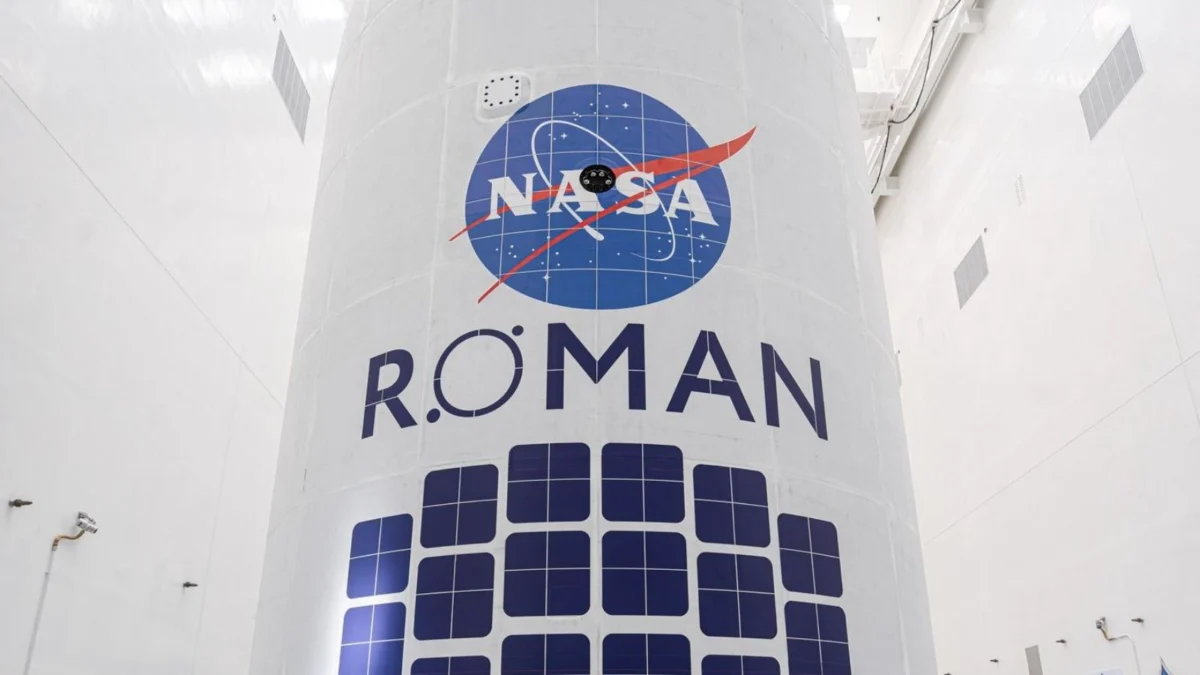
KENNEDY SPACE CENTER, FL — As the sun rises over the Florida coastline on August 30, 2026, the global scientific community stands on the precipice of a new era in cosmic discovery. At Launch Complex 39A, the iconic site of the Apollo and Space Shuttle missions, a SpaceX Falcon Heavy rocket stands fueled and ready. Its payload is the Nancy Grace Roman Space Telescope—NASA’s next "Great Observatory" designed to settle the most profound debates in modern astrophysics.
The mission, nearly a decade in the making, represents a paradigm shift in how humanity observes the heavens. While previous flagship telescopes like the Hubble and the James Webb Space Telescope (JWST) were designed to peer deep into specific, narrow points in space, Roman is built for breadth. It is a wide-field surveyor capable of capturing the "big picture" of the universe with a precision never before realized.
Main Facts: A New Eye on the Cosmos
The Nancy Grace Roman Space Telescope, formerly known as the Wide-Field Infrared Survey Telescope (WFIRST), is a NASA observatory designed to unravel the secrets of dark energy and dark matter, search for and image exoplanets, and explore many topics in infrared astrophysics.
Technical Specifications and Capabilities
The telescope features a 2.4-meter primary mirror—the same size as Hubble’s—but with a crucial difference. Roman’s Wide Field Instrument will provide a field of view that is 100 times greater than Hubble’s infrared camera. This allows the observatory to capture a single image with the same exquisite detail as Hubble but covering an area of the sky 100 times larger.
NASA officials have frequently used a "keyhole" analogy to describe the difference. If Hubble and Webb allow scientists to peer through a keyhole to see a single room in a mansion, Roman is designed to tear down the walls and provide a panoramic view of the entire estate. This capability is essential for statistical surveys of the universe, which require massive datasets to identify patterns in the distribution of galaxies and the behavior of dark energy.
The Launch Vehicle: SpaceX Falcon Heavy
To reach its destination, Roman requires the immense lifting power of the SpaceX Falcon Heavy. As one of the world’s most powerful operational rockets, the Falcon Heavy will provide the necessary thrust to break Earth’s gravity and propel the 9,000-pound (4,100 kg) observatory toward its deep-space home. The launch window is scheduled to open at 7:26 am EDT (5:00 pm IST), marking another high-stakes collaboration between NASA’s Science Mission Directorate and the private aerospace sector.
Chronology: From the Launchpad to the L2 Orbit
The journey of the Roman Space Telescope does not end at liftoff. In fact, the launch is merely the beginning of a complex, multi-month deployment sequence.
The First 24 Hours
Following a successful ascent, the Falcon Heavy’s second stage will perform a series of burns to place the observatory on a trajectory toward the second Sun-Earth Lagrange point, or L2. This point is located approximately 1 million miles (1.6 million kilometers) away from Earth in the direction opposite the Sun. At L2, the gravitational forces of the Earth and Sun balance the orbital motion of the spacecraft, allowing it to stay in a stable position with minimal fuel consumption.
The Three-Month Transit and Commissioning
Unlike Earth-orbiting satellites, Roman will spend roughly 90 days traveling to its final destination. During this transit period, mission controllers at the Goddard Space Flight Center will begin a series of delicate maneuvers:
- Deployment: The telescope’s high-gain antenna and solar arrays will be unfurled to ensure power and communication.
- Calibration: The Wide Field Instrument and the Coronagraph Instrument—a technology demonstration designed to block out starlight to see faint planets—will undergo initial testing.
- Cooldown: As an infrared telescope, Roman must operate at extremely low temperatures. The three-month journey allows the mirrors and sensors to radiate heat away and reach the thermal stability required for high-precision science.
NASA expects the first "early release" science images to be transmitted back to Earth in early 2027, following a rigorous checkout phase.
Supporting Data: The Science of the Wide-Field Survey
The Roman mission is built upon two primary scientific pillars: understanding the "Dark Universe" and the census of exoplanets.
Dark Energy and the Expansion of the Universe
One of the greatest mysteries in science is why the expansion of the universe is accelerating. Scientists attribute this to "dark energy," which makes up roughly 68% of the universe, yet its nature remains unknown. Roman will conduct a High Latitude Wide Area Survey, mapping hundreds of millions of galaxies. By measuring the shapes and distances of these galaxies, astronomers can trace how the "cosmic web" has grown over time, providing clues as to whether dark energy is a constant property of space or a field that changes over time.
The Exoplanet Census via Microlensing
While the Kepler and TESS missions have discovered thousands of planets by watching them cross in front of their stars (the transit method), Roman will use "gravitational microlensing." This phenomenon occurs when the gravity of a foreground star acts as a lens, magnifying the light of a distant background star. If a planet is orbiting the foreground star, it creates a secondary "blip" in the light.
This method allows Roman to find planets that are further from their stars—similar to the positions of Jupiter and Saturn in our own solar system—and even "rogue planets" that drift through the galaxy without a parent star.
Official Responses: "Kicking the Door Down"
At a prelaunch briefing held Saturday at the Kennedy Space Center, the atmosphere was one of calculated optimism.
Nicky Fox, NASA’s associate administrator for the Science Mission Directorate, emphasized the complementary nature of NASA’s fleet. "Hubble and James Webb were designed to look deep and narrow, providing us with incredible detail of specific targets," Fox stated. "But Roman is different. Roman will kick the door down. It gives us the context, the wide-angle view that allows us to see how the pieces of the cosmic puzzle fit together."
Jackie Townsend, the project manager for the Roman Space Telescope, highlighted the logistical advantages of the L2 orbit. "From L2, we have an unobstructed view of the cosmos. We aren’t limited by the Earth’s shadow or the interference of our atmosphere. It is the perfect vantage point for a surveyor of this magnitude."
Despite the technical readiness, the 45th Weather Squadron noted that Mother Nature remains the final arbiter. Forecasters gave a 50% chance of favorable conditions for the Sunday morning launch, citing concerns over offshore cumulus clouds and potential lightning. "We are monitoring a tropical disturbance," a meteorologist noted. "However, the outlook for the backup windows on Monday and Tuesday looks significantly better, with a 70% chance of favorable weather as the system moves west."
Implications: A New Chapter for Humanity’s Place in the Cosmos
The launch of the Nancy Grace Roman Space Telescope carries implications that transcend mere data collection. It represents a fundamental shift in the scale of astronomical inquiry.
Addressing the "Hubble Tension"
Currently, there is a discrepancy in the scientific community regarding the "Hubble Constant"—the rate at which the universe is expanding. Different measurement methods yield different results. By providing a massive, high-precision dataset of Type Ia supernovae and galaxy clustering, Roman may finally resolve this "tension," potentially forcing a rewrite of the laws of physics.
The Search for Life
While Roman is not specifically a "life-finder," its Coronagraph Instrument is a vital stepping stone. By demonstrating the ability to suppress the blinding light of a star to see the dim planets orbiting it, Roman will pave the way for future missions, such as the proposed Habitable Worlds Observatory, which will be designed to search for chemical signatures of life in the atmospheres of Earth-like planets.
The Legacy of Nancy Grace Roman
Naming the telescope after Dr. Nancy Grace Roman—often called the "Mother of Hubble"—is a poignant tribute. As NASA’s first Chief of Astronomy, she fought for the funding and vision that made space-based observatories a reality. This mission fulfills her ultimate dream: a telescope that doesn’t just see the universe, but understands its vast, interconnected structure.
As the countdown proceeds, the world watches the Falcon Heavy on the pad. If successful, the Nancy Grace Roman Space Telescope will not just take pictures; it will create a map of the invisible, charting the dark matter and dark energy that define our existence, and perhaps answering the oldest question of all: How did we get here, and are we alone?
