

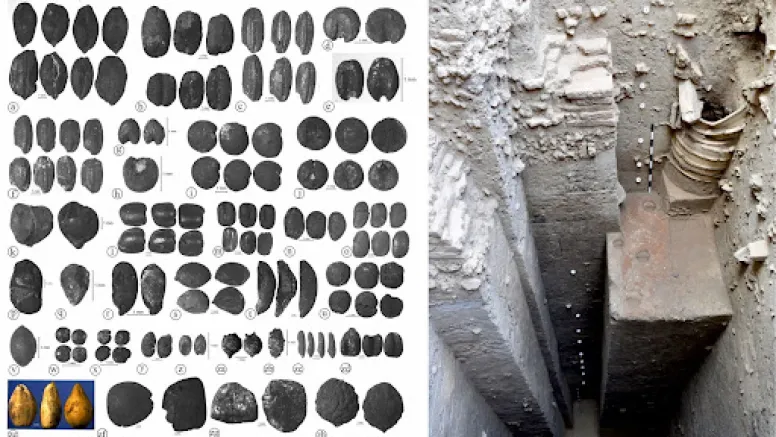
BENGALURU — In the quiet village of Uren, nestled within the Munger district of Bihar, a team of researchers has unearthed what is being described as one of the most significant "botanical time capsules" in South Asian history. By meticulously analyzing over 500,000 charred seeds, archaeologists have reconstructed a continuous, 3,000-year-old narrative of human survival, innovation, and environmental adaptation in the Eastern Ganga Plain.
The study, a collaborative effort between the Birbal Sahni Institute of Palaeosciences (BSIP) and the Archaeological Survey of India (ASI), offers a rare, uninterrupted look at the agricultural practices of ancient India. Spanning from the Iron Age in 1300 BCE to the Early Medieval period in 1200 CE, the findings reveal how early societies transitioned from subsistence farming to sophisticated, intensive agricultural systems that laid the foundation for modern civilization in the region.
The Discovery at Uren: A Window into the Past
While the Indus Valley and the Upper Ganga Plain have long dominated the archaeological spotlight, the Eastern Ganga Plain—comprising much of modern-day Bihar and West Bengal—has often been treated as a secondary frontier. However, the excavations at Uren have shattered this perception.
Unlike many archaeological sites that offer only "snapshots" of history—brief periods of occupation separated by long gaps—Uren provides a stratigraphically continuous sequence. For three thousand years, through the rise and fall of the Mauryan, Kushana, and Gupta Empires, the inhabitants of Uren remained on their land, leaving behind a microscopic trail of their diets and farming habits.
The sheer volume of the find—over half a million seeds—allows for a statistical level of detail rarely seen in archaeobotanical research. These seeds were not preserved by luck alone; they were "carbonized." In the ancient world, seeds that fell into cooking fires or were parched near hearths turned into charcoal rather than ash. This process of carbonization makes organic material resistant to decay, allowing it to survive in the damp soil of the Ganga Plain for millennia.

Chronology of Cultivation: From the Iron Age to the Medieval Era
The research team divided the 3,000-year timeline into distinct phases, mapping the evolution of the landscape alongside the political and social shifts of the Indian subcontinent.
The Early Settlers (1300 BCE – 600 BCE)
During the Iron Age, the residents of Uren practiced a highly balanced form of multi-cropping. The seed record shows a diverse mix of winter (Rabi) and summer (Kharif) crops. The community relied on winter staples like barley, wheat, and lentils (grass pea and lentil), complemented by summer crops such as small millets and early varieties of rice. This diversity was a survival strategy; by planting a wide array of crops, the farmers insured themselves against the failure of any single harvest.
The Rise of Empires and the Rice Revolution (600 BCE – 200 CE)
As the Mahajanapadas (great kingdoms) emerged and the Mauryan Empire consolidated power, the agricultural landscape underwent a radical transformation. The researchers noted a dramatic "intensification" of rice cultivation. By the Sunga-Kushana period (circa 200 BCE), rice had moved from being one of many crops to becoming the absolute dominant staple.
This shift was not accidental. The growth of major urban centers and the need to feed standing armies and a burgeoning bureaucracy necessitated a high-calorie, high-yield crop. The archaeological record shows that this was the era when farmers began investing heavily in irrigation infrastructure—tanks and canals—to support the water-intensive requirements of "Oryza sativa" (domesticated rice).
The Medieval Transition (600 CE – 1200 CE)
In the later stages of the site’s occupation, the agricultural system reached a peak of complexity. While rice remained the primary focus, the variety of legumes and oilseeds increased, suggesting a more sophisticated palate and a highly organized market economy.

Supporting Data: The Science of Archaeobotany
To extract these secrets from the earth, the researchers employed a rigorous suite of scientific methods that bridge the gap between history and biology.
The Flotation Method
The recovery of half a million seeds was made possible through "flotation." Large volumes of soil from the excavation trenches were placed into tanks of water. Because charred seeds are lighter than the surrounding mineral soil, they float to the surface (the "light fraction"), while stones and heavy artifacts sink. These floating remains were skimmed off using fine sieves and analyzed under high-powered microscopes.
Morphometrics and Radiocarbon Dating
To distinguish between wild grasses and domesticated crops, the team used morphometrics—the precise measurement of the shapes, sizes, and surface textures of the seeds. This allowed them to track the exact moment a plant species became fully domesticated. Furthermore, the timeline was anchored by radiocarbon dating, which measures the decay of Carbon-14 isotopes within the charred seeds to provide calendar dates for each soil layer.
Evidence of Global Trade
Perhaps the most surprising data point was the presence of "exotic" species. The researchers identified charred remains of garlic and tamarind. Garlic, originally native to Central Asia, and tamarind, indigenous to tropical Africa, prove that even 2,000 years ago, the villages of Bihar were nodes in a vast international trade network. These plants traveled thousands of miles via the Silk Road and maritime routes before ending up in a cooking pot in Uren.
Climate Resilience and Official Responses
A critical component of the study focuses on how ancient farmers handled climate change. Around 1,300 years ago, paleoclimate data suggests the Indian monsoon began to weaken, leading to prolonged periods of aridity.

The researchers from BSIP noted that instead of abandoning the site—a common occurrence in other parts of the world facing drought—the people of Uren doubled down on innovation. They restructured their cropping patterns, introducing more drought-resistant varieties of millets and pulses. They also expanded their water-harvesting systems, building reservoirs to capture what little rain did fall.
"This discovery is a testament to human agency," the researchers noted in their findings. "It shows that ancient societies were not merely passive victims of their environment. They were active engineers who used crop diversity as a shield against climate instability."
Official representatives from the Archaeological Survey of India have emphasized that the Uren site serves as a "benchmark" for future studies in the region. They suggest that the long-term stability seen at Uren provides a model for understanding how traditional knowledge systems can inform modern agricultural resilience.
Implications for the Modern World
The findings at Uren are far more than a historical curiosity; they have profound implications for the 21st century.
1. Food Security: As the world faces a burgeoning population, the "Rice Revolution" documented at Uren provides a historical blueprint for agricultural intensification. It demonstrates how a shift to a staple crop, supported by infrastructure, can sustain high population densities.

2. Climate Adaptation: Today, as the monsoon becomes increasingly erratic due to global warming, the ancient strategies of multi-cropping and drought-resistant farming found in the Iron Age layers of Uren are being re-examined by modern agronomists. The "old ways" of crop diversification are proving to be essential for modern climate-smart agriculture.
3. Genetic Heritage: The study of these 3,000-year-old seeds helps scientists understand the genetic evolution of crops. This data is vital for "de-extincting" certain hardy traits in ancient grains that might have been lost in modern, high-yield varieties, potentially helping to breed more resilient crops for the future.
Conclusion
The half-million seeds of Uren tell a story of a people who refused to be moved by the whims of nature or the turbulence of politics. From the first Iron Age farmers who experimented with wild grasses to the Medieval villagers who traded for garlic from the distant west, the agricultural history of Bihar is one of constant adaptation.
As the researchers conclude their analysis, the message from the soil of Uren is clear: the secret to long-term survival lies in the ability to innovate, the willingness to trade, and, above all, the wisdom to maintain a diverse and resilient relationship with the land. The seeds may be charred and broken, but the story they tell is one of enduring life.
